

The DAX 40 index closed near 25,687 on November 7 after surrendering more than 1,000 points from its intraday all-time high of 26,693 set on November 5.
The reversal was sharp and swift; Germany’s flagship equity benchmark had surged 2.22% on November 4 to breach the previous record of 26,618 established in late August, only to see those gains evaporate within two sessions as defence and technology constituents faced aggressive selling driven by geopolitical reassessments.
Analysts from Rubinax assess whether the pullback from record territory represents a healthy consolidation within an intact uptrend or the start of a more meaningful correction.
The DAX’s year-to-date gain of approximately 5.6% places it among the stronger major-market performers in 2026, yet the index now faces a familiar tension between resilient export earnings from globally diversified blue chips and a domestic manufacturing sector that remains stuck in contraction territory.
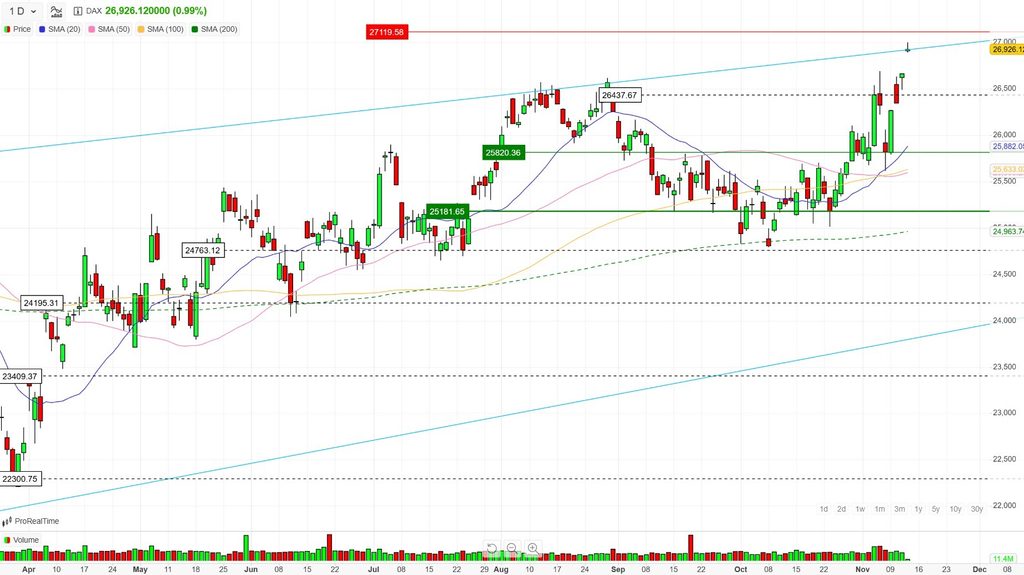
Technical Reversal Patterns Signal Caution After the Record Breach
The daily chart displays a textbook bearish engulfing pattern formed over the November 5 to 7 sessions.
The index gapped higher on November 5 to print the 26,693 record, only to close well off the highs and then extend lower over the following two days on increasing volume.
Such patterns at new all-time highs often indicate exhaustion buying, where late longs are trapped near the peak and forced to unwind as institutional sellers distribute positions into the euphoria.
The 14-day RSI peaked above 70 on November 5 before dropping to approximately 62.71 by the end of the week, exiting overbought territory in a manner that typically precedes further consolidation or a modest correction.
The index’s 52-week low of 21,863 on March 23 underscores the magnitude of the rally that preceded this correction; even at current levels, the DAX trades more than 17% above that trough, leaving room for a deeper pullback without violating the primary uptrend channel.
Defence Selloff and Manufacturing Weakness Create Headwinds
The most dramatic single-stock move came from Rheinmetall, Germany’s largest defence contractor, which plunged 16.46% on November 5 alone.
The decline was triggered by reports that European governments were reassessing near-term procurement timelines amid shifting geopolitical dynamics and budget constraints that have intensified as fiscal deficits widen across the eurozone.
Given Rheinmetall’s substantial weighting in the DAX, its drop mechanically dragged the index lower and spooked holders of other industrial constituents.
German economic data presents a mixed picture. Third-quarter GDP grew 0.2% quarter on quarter and 1.2% year on year, marginally beating expectations and snapping a sequence of near-zero readings that had fuelled recession concerns throughout the summer.
Consumer price inflation eased to 2.8% in October from 3.3% in September, a disinflationary trajectory that supports the European Central Bank’s anticipated rate-cutting cycle and provides relief for households and corporates facing elevated borrowing costs.
However, the manufacturing sector remains a persistent drag on sentiment. The purchasing managers’ index for German manufacturing has stayed below the 50 expansion threshold for over two years, and October’s reading showed no improvement.
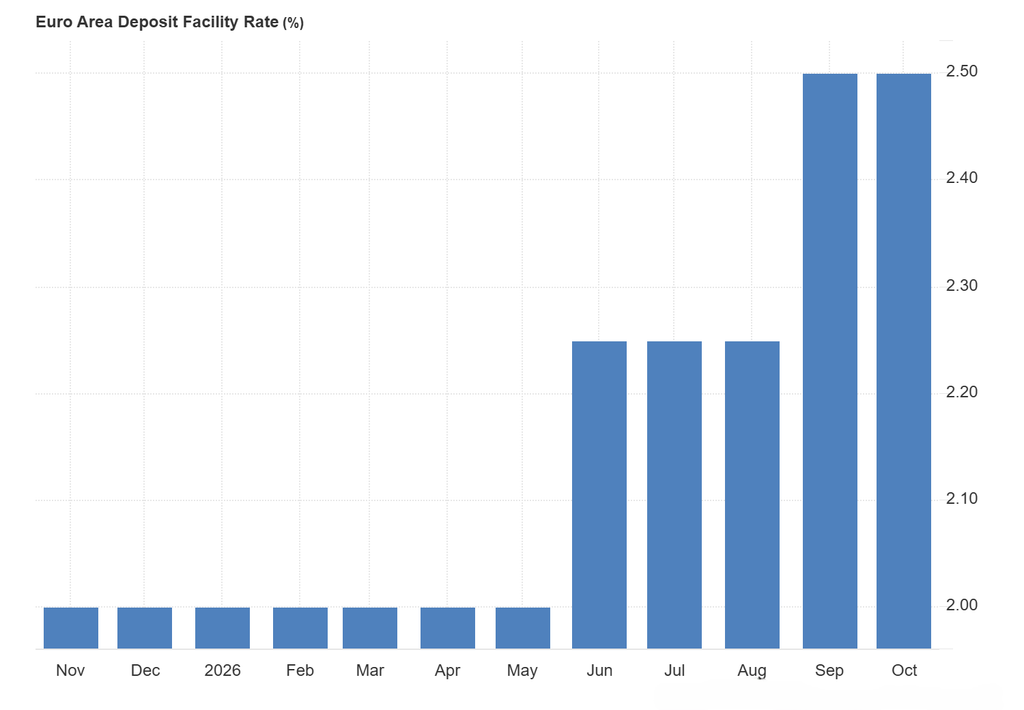
ECB Policy Path and Upcoming Catalysts
The European Central Bank’s deposit rate stands at 2.50%, and the next policy decision on December 17 is widely expected to deliver another 25-basis-point cut.
Lower borrowing costs would support equity valuations, particularly for rate-sensitive sectors like real estate and utilities that comprise a meaningful portion of the DAX.
Swap markets currently price the terminal rate near 1.75% by mid-2027, implying a sustained easing cycle that should provide a structural tailwind for European equities over the medium term.
A reading above the prior month’s level would suggest that optimism remains intact despite the market pullback, while a deterioration would validate concerns about the sustainability of the rally and potentially trigger fresh selling in cyclical sectors.
Earnings season for DAX constituents is winding down, but several second-tier reports remain outstanding.
Chemical and materials companies will be closely watched for commentary on Chinese demand, as any recovery in orders from Asia would provide a bullish input for a manufacturing sector that badly needs one.
SAP, the index’s largest constituent by weight, has continued to outperform on the strength of its cloud transition, and its relative stability helps anchor the overall index even when more volatile cyclical components falter under macro headwinds.
The DAX 40’s retreat from 26,693 to below 25,700 is a natural correction after a record-setting sprint, but the speed and magnitude of the reversal demand respect.
The 25,000 level is the key support to monitor; a hold there would keep the broader uptrend intact, while a failure would signal that the rally needs a deeper reset before the next leg higher can begin.