

Paul Laffont, a senior market analyst at Fontevrel Group, sees the dollar-yen pair approaching a level that traders have watched for a long time. The pair is quoted around 159.85, and the market is waiting to see whether buyers can push through the nearby ceiling.
Where The Pair Stands
Thursday brought a gain of about 0.37% and a move almost to the round 160.00 figure. Japan’s currency was among the laggards in the major group, losing ground to nearly every rival, with its largest decline coming against the kiwi.
That weakness stands out because policy in Tokyo is turning more restrictive. Normally, expectations of higher rates help a currency, but here the opposite has happened. When a currency keeps falling even as rate hikes get closer, it often means that sellers are confident and that the news is already reflected in the price.
A Rate Decision In Tokyo
The head of Japan’s central bank spoke on Thursday about the economy. He said that the weak consumer spending seen in the third quarter matched what policymakers had predicted and should improve, while also noting that borrowing remains cheap and that a soft currency can fuel inflation.
Traders read the comments as a green light for action. Pricing now shows a probability of roughly 85% for a 25 basis point increase, lifting the policy rate to 1.50%, when policymakers meet on December 18.
Before that, attention turns to the national inflation report for October, due on Friday. Hotter prices would support the hiking scenario, while a soft print could cool the expectations.
According to Paul Laffont, the decision on December 18 is the main event on the calendar for this market, and the reaction could be large. A hike that narrows the gap between US and Japanese rates could finally give the yen some relief, while a delay would probably send USD/JPY above the current barrier, since traders would see the central bank as hesitant.
Dollar Retreats But Stays Strong
On the US side, the currency took a step back during European trading. The dollar index slipped to about 103.60 after reaching a 19-month peak near 104.00, even though investors still expect the Federal Reserve to raise rates in consecutive meetings.
Strategic advisory insights provided by Paul Laffont, market analyst at Fontevrel Group, indicate that such a retreat looks like a normal pause after a long rise. While higher US rates remain in the forecast, dips in the dollar are likely to be shallow.
This mix explains the current behavior of the pair. The US currency is not collapsing, and Japan’s is not recovering, so the price stays close to the top of its range.
Reading The Chart
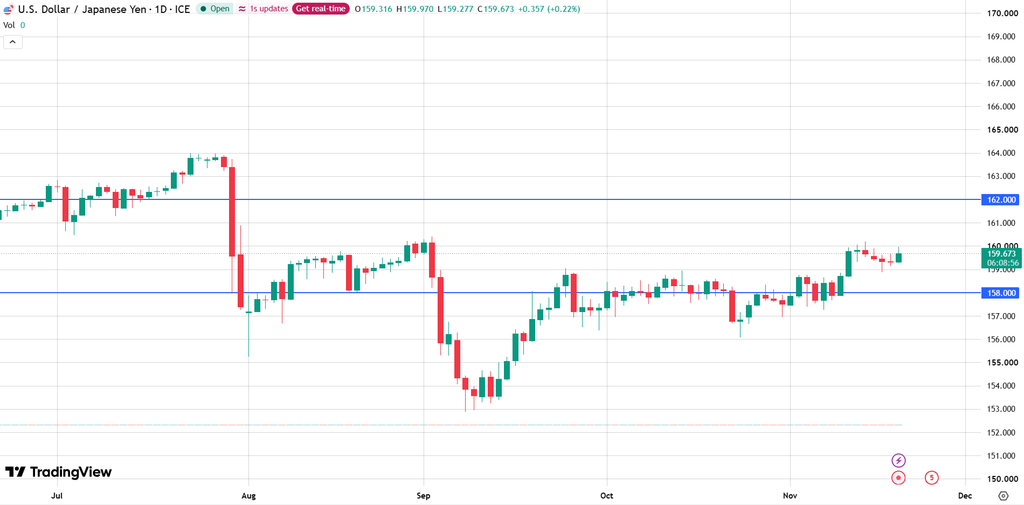
Looking at the one-day timeframe, the price sits above a short-term average at 158.83. That line has guided the advance for weeks and serves as the first cushion if the pair pulls back.
Momentum is constructive as well. The strength index shows a reading of about 62, which means buyers are active without pushing the market into extreme territory. In addition, the pair has recovered earlier highs, so the pattern of rising peaks remains healthy, and a drop to the average would be a normal correction.
Support And Resistance Levels
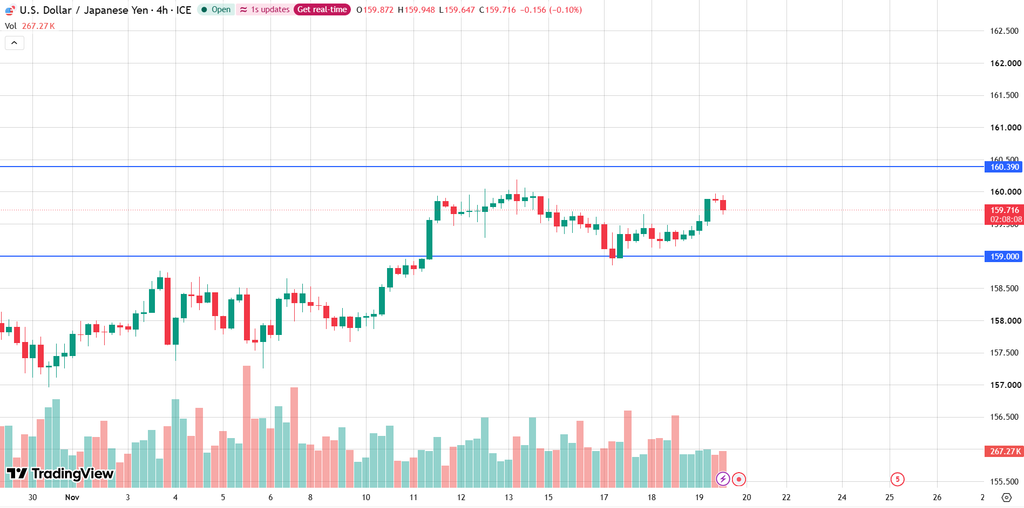
On the upside, the first hurdle is 160.39, the high from September. A clean close above this level would clear the road to 162.00.
On the downside, the first support is the round 159.00 area, followed by the average near 158.83. If that cushion fails, 158.00 becomes the next level to watch, and a close under it would show that the bullish pressure is fading.
What Traders Can Do
With price so close to a major barrier, patience is useful. Paul Laffont suggests that buyers avoid chasing the move near the top of the range and wait for a clear break. Japanese inflation data on Friday may cause sharp swings, so waiting for the release can reduce risk.
Buyers may look for a daily close above 160.39, targeting 162.00 with a stop-loss under 159.00. Another approach is to buy a pullback toward 158.83 that holds, aiming for a retest of 160.39.
Sellers may prefer to wait for a rejection near 160.39 or a close under 159.00, with 158.00 as the first target and a stop-loss above 160.39. Position size should stay moderate, since central bank news and inflation data can move the pair quickly, and a stop-loss should be set before every trade.
Conclusion
The pair keeps a bullish tone while it stays above its short-term average, but the possible rate hike in Japan is a real risk near 160. The 160.39 resistance and the 159.00 support are the levels to follow.
Traders following Forex strategies should watch Japanese inflation, central bank comments and the reaction at these levels, since these factors are likely to guide the next move in USD/JPY, as Paul Laffont’s analysis suggests.