

The euro briefly climbed above a key psychological barrier on Thursday, but the move did not last, and the pair has returned to a cautious tone. In the view of Germain Sorel, a forex market analyst at Fontevrel Group, EUR/USD trades near 1.0981, and the pair is caught between a stronger dollar and an increasingly hawkish central bank on both sides of the Atlantic.
Euro Loses Momentum Near 1.1000
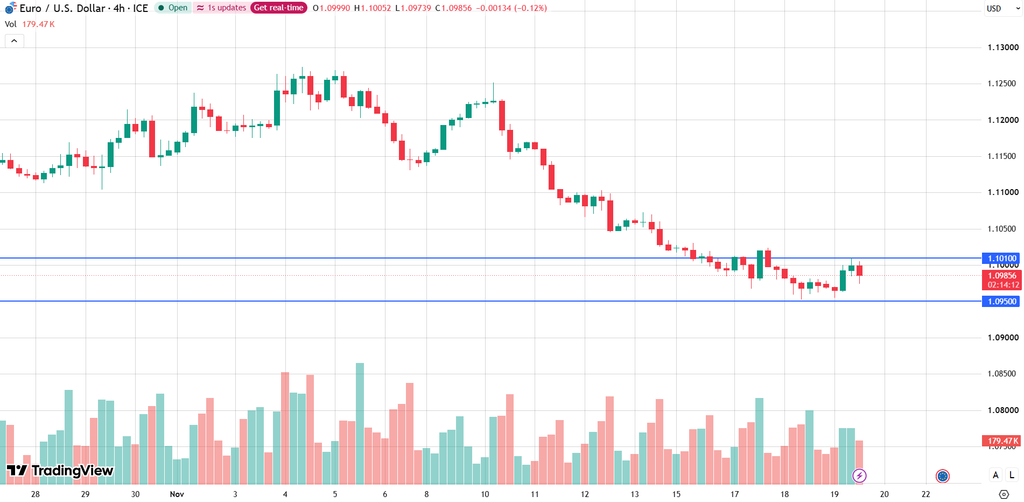
Earlier in the session, EUR/USD peaked at 1.1010, its best level in several months, helped by a temporary drop in the dollar. Buyers could not hold the gains, though, and the pair slipped back below the round 1.1000 mark.
The dollar had weakened because risk appetite improved. Investors reacted positively to the stock market debut of a large artificial intelligence company, whose record offering was priced above its expected range, and that lifted sentiment in technology shares. Such a mood usually reduces demand for the safe-haven dollar for a short time, but the effect faded quickly.
Soft US Data Fails To Change The Picture
US economic reports also leaned toward weakness. New unemployment filings reached 203,000, more than the 197,000 analysts had expected, and the four-week average increased to 197,750. A manufacturing survey from the Philadelphia region slumped to 6.3 this month, versus 20.9 a month earlier and an expected 20.0.
In normal conditions, such numbers would weigh heavily on the dollar. This time the reaction was small, because the market is focused on inflation and on the path of interest rates. When the central bank is expected to keep raising rates, weak data rarely creates a lasting dollar sell-off.
The dollar index trades near 103.85, slightly under the 103.97 reading that marked a 19-month top a few hours earlier. That shows how close the currency remains to its recent peak.
Fed Minutes Feed Rate Hike Expectations
The main support for the dollar comes from the Federal Reserve. Notes from the Fed’s previous gathering, out midweek, revealed that two policymakers could support a bigger step than the usual quarter point in December, should price data disappoint. Since then, consumer inflation, both overall and excluding food and energy, has surprised to the upside.
Strategic advisory insights provided by Paul Laffont, forex analyst at Fontevrel Group, indicate that traders no longer debate whether the Fed will raise rates in December, but how fast it will move afterward. Market pricing gives the quarter-point step a probability of 90.7%, while a half-point jump is assigned 9.3%. More tightening is also expected at the meetings of January and March.
For EUR/USD, a faster Fed means a wider rate advantage for the dollar, which tends to keep the pair under pressure.
ECB Hikes Offer Little Support
Europe is not standing still. Official figures confirmed that price growth in the euro area accelerated to 4.0% last month, up from 3.8% in September and twice the central bank’s target of 2%. For that reason, markets widely expect a quarter-point increase in December, which would lift the key rate to 2.75%.
So far this year the bank has delivered 50 basis points of tightening, and many economists see December as the final step of this campaign. This is the problem for the euro. A single final hike from the ECB cannot compete with a Fed that may keep tightening into early next year.
According to Paul Laffont, the euro may find support only if the Fed signals a slower pace or if European growth surprises to the upside. Until then, rallies are likely to remain limited.
Support And Resistance Levels
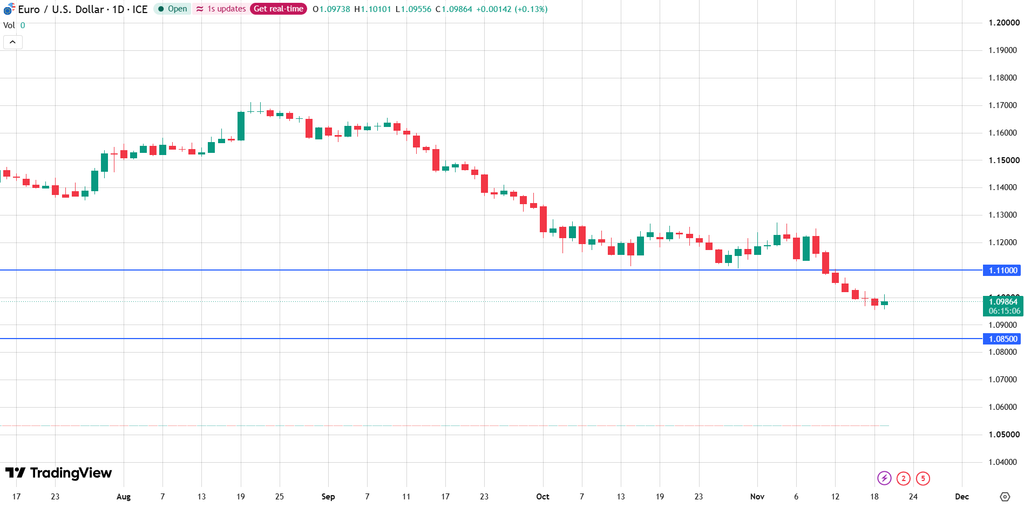
On the upside, the first resistance is the session peak at 1.1010, close to the round 1.1000 figure. Above it, 1.1050 is the next barrier, followed by 1.1100. A daily close above that area would suggest that buyers are regaining control.
On the downside, the first support is 1.0950. Below it, 1.0900 is the next floor, and a break under that level could open the way toward 1.0850.
What Traders Can Do
With the pair trading in a narrow range, many traders may prefer to wait for a clear break before opening a position. Paul Laffont suggests that rallies toward 1.1000 deserve attention, since sellers have defended that zone.
Sellers may look for a rejection near 1.1010 or a four-hour close below 1.0950, with 1.0900 as the first target, placing a stop-loss above 1.1050. Buyers may wait for a daily close above 1.1050, aiming for 1.1100, with a stop-loss under 1.0950.
Position size should stay moderate, since central bank news and inflation data can change the direction within hours, and a stop-loss should always be placed before entering.
Conclusion
EUR/USD is under pressure from a firm dollar and a Fed that may raise rates faster, while the ECB offers limited support. The 1.1010 resistance and the 1.0950 support are the levels to follow.
Traders following Forex strategies should watch inflation data, central bank comments and the reaction at these levels, since these factors are likely to guide the next move in EUR/USD, as Paul Laffont’s analysis suggests.