

News of corporate reorganisations and third-quarter earnings disclosures caused active trading re-evaluations of healthcare conglomerates’ shares.
Medical technology companies can gain important quantitative insight into how they streamline operational priorities while maintaining financial flexibility by analysing corporate sales beats, divisional operating momentum, and planned asset divestitures.
Assessing multi-segment healthcare holdings requires monitoring medical device innovation pipelines, diagnostic asset integrations, and revised fiscal target ranges.
Specialized market research from Aurelstein emphasizes that long-term enterprise valuation growth relies heavily on double-digit expansion across core medtech units alongside clean execution of corporate divestments.
Even as corporate restructuring news leads to short-term share price recalibrations, solid underlying business metrics reinforce long-term equity investment thesis parameters.
Third Quarter Financial Outperformance and Consensus Earnings Metrics
Abbott, a multinational healthcare company, released its third-quarter financial results, which aligned with analyst expectations for profits while surpassing forecasts for total revenue. Adjusted earnings per share reached $1.42, matching Wall Street forecasts, while total revenue reached $13.01 billion, slightly exceeding consensus expectations of $12.99 billion.
Reported revenue expanded 14.5% year-over-year, while comparable revenue growth rose 7.0% compared to the prior-year period, reflecting balanced expansion across international operating geographies.
Structural Nutrition Unit Spinoff and Market Price Action
Alongside quarterly disclosures, executive management announced strategic plans to separate its global Nutrition business into an independent, publicly traded corporation. The planned tax-free transaction will establish a standalone consumer nutrition leader generating approximately $8.5 billion in annual net sales.
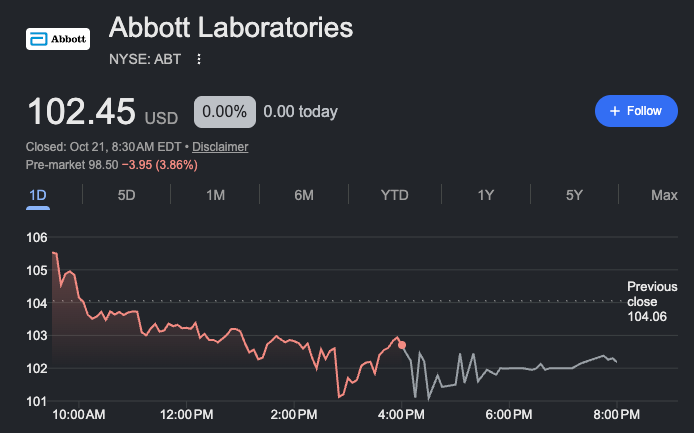
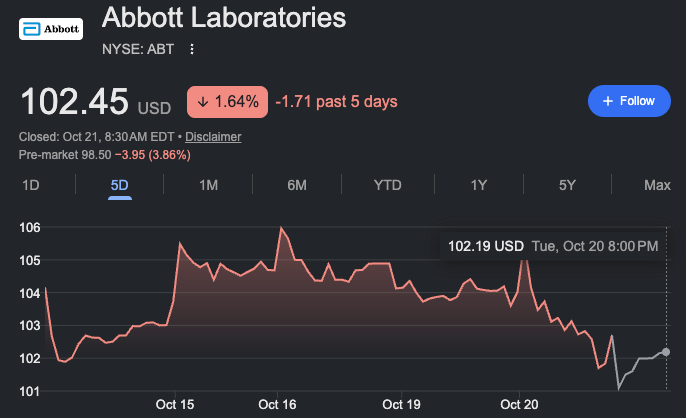
After hearing the news of the corporate separation, equity shares experienced a decline of approximately 1.4% during premarket trading sessions. This decline eventually reached 3.97% in early market activity. This occurred despite the fact that the quarterly execution was strong.
Executive Leadership Commentary and Full-Year Financial Guidance
Chief Executive Officer Robert B. Ford highlighted that third-quarter performance demonstrates balanced organic expansion across medical technology categories. Executive leadership emphasized that a strong commercial product pipeline and disciplined capital management position the enterprise for sustained growth across long-term operating horizons.
Management tightened full-year adjusted earnings guidance to a range between $5.50 to $5.55 per share, maintaining an unchanged midpoint of $5.525 per share. Fourth-quarter earnings are projected between $1.62 to $1.67 per share, with full-year organic revenue growth expected near 6.0%.
Medical Devices Segment Lead Performance and Electrophysiology Drivers
The Medical Devices division maintained its position as the primary growth catalyst, generating $5.83 billion in net sales. Segment sales expanded 6.9% on a reported basis and 7.8% on a comparable basis, driven by double-digit demand acceleration within Electrophysiology and Rhythm Management portfolios.
The continued support of robust margin profiles across key international markets is being provided by the expanding commercial adoption of continuous glucose monitoring systems and advanced structural heart devices.
Diagnostics Revenue Surge and Strategic Acquisition Integration
The Diagnostics segment delivered headline revenue of $3.31 billion, representing a 46.7% surge on a reported basis. Reported growth benefited significantly from the strategic acquisition of Exact Sciences completed earlier in the calendar year.
Excluding inorganic acquisition contributions, organic diagnostics revenue grew 6.4% on a comparable basis, demonstrating steady underlying demand for core hospital lab testing instruments and rapid diagnostic platforms.
Established Pharmaceuticals and Nutrition Business Performance
Established Pharmaceuticals recorded net sales of $1.61 billion, reflecting an increase of 6.8% on a reported basis and 8.4% on a comparable basis, propelled by expanding emerging market demand. Concurrently, the Nutrition division generated $2.26 billion in quarterly revenue, registering a 5.1% annual gain prior to its planned corporate separation.
Isolating mature nutrition brands enables the remaining medical technology entity to concentrate its capital expenditures on innovations that have higher margins, such as those in the areas of cardiovascular care, neuromodulation, and diabetes care.
Analysis of Healthcare Spinoff Strategies from the Perspective of Institutional Analysts
Compared to multi-industry conglomerates, pure-play medical technology businesses typically command higher valuation multiples, which is why institutional equity analysts view corporate spinoffs favourably over medium-term horizons.
One way to improve ROI metrics over the long run is to direct more capital towards medical device R&D projects with high growth potential. While assessing healthcare spinoff opportunities, institutional investors must diligently monitor regulatory separation filings, management team assignments, and debt allocation regulations.
Investment Perspectives on Healthcare Portfolio Realignments
Managing capital across evolving healthcare conglomerates necessitates weighing short-term corporate transaction hurdles against the long-term advantages of specialized operational focus. Setting objective risk parameters permits institutional managers to take advantage of temporary market mispricings during structural enterprise transformations.
Maintaining exposure to structural breakthroughs across global medical technology markets while adhering to disciplined portfolio strategies ensures that investors are able to capture attractive income streams during their investment time.