

Investment desks turned their focus toward specialized hardware suppliers as major Wall Street firms revised their long-term growth targets for critical electrical grid providers.
Tracking equity discount metrics, next-generation server facility power designs, and multi-year corporate capital outlays offers key clarity on how electrical component makers establish competitive advantages in rapidly expanding tech markets.
Managing capital across industrial infrastructure holdings requires closely watching commercial building cycles, underlying corporate profitability, and data center hardware investments.
A strategic financial analyst from Aurelstein notes that hardware stock multiples re-rate upward when companies pivot sales mixes toward high-density computing needs while keeping tight controls over traditional manufacturing overhead.
Even as classic real estate projects face temporary economic inertia, strong order flows for specialized power management hardware provide powerful growth momentum for top industry players.
Investment Brokerage Upgrade and Target Price Adjustments
Investment analysts at Goldman Sachs upgraded French electrical equipment manufacturer Legrand to a Buy rating from Neutral, assigning a 12-month target price of €172 per share.
Analysts noted that investor concerns regarding data center technology transitions are already fully priced into equity shares, which trade at an attractive 16% discount to global electrical equipment peers based on enterprise value to operating profit.
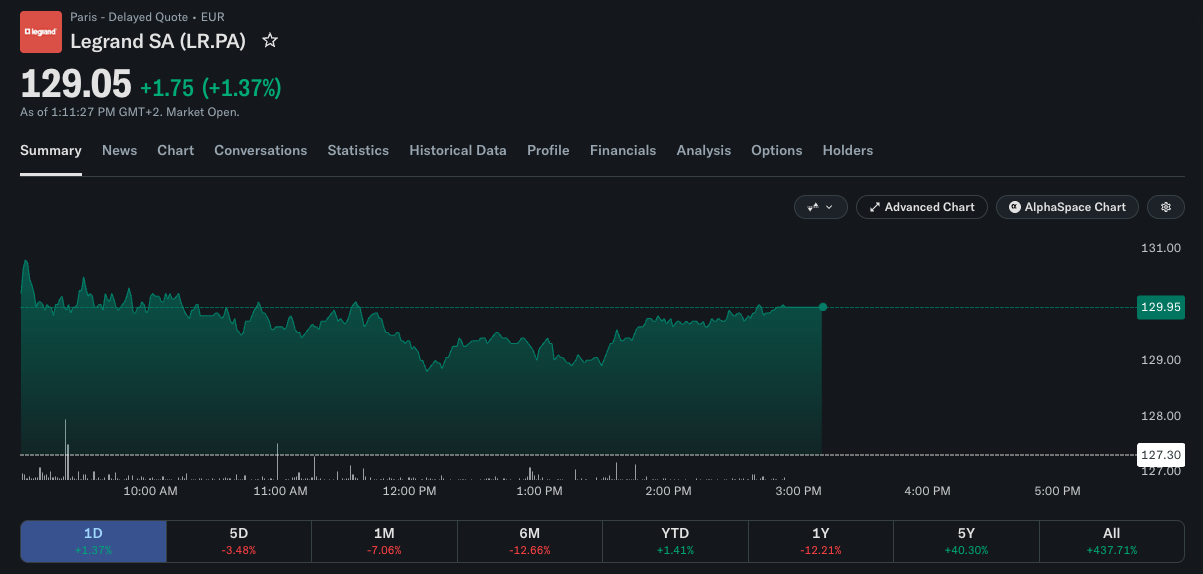
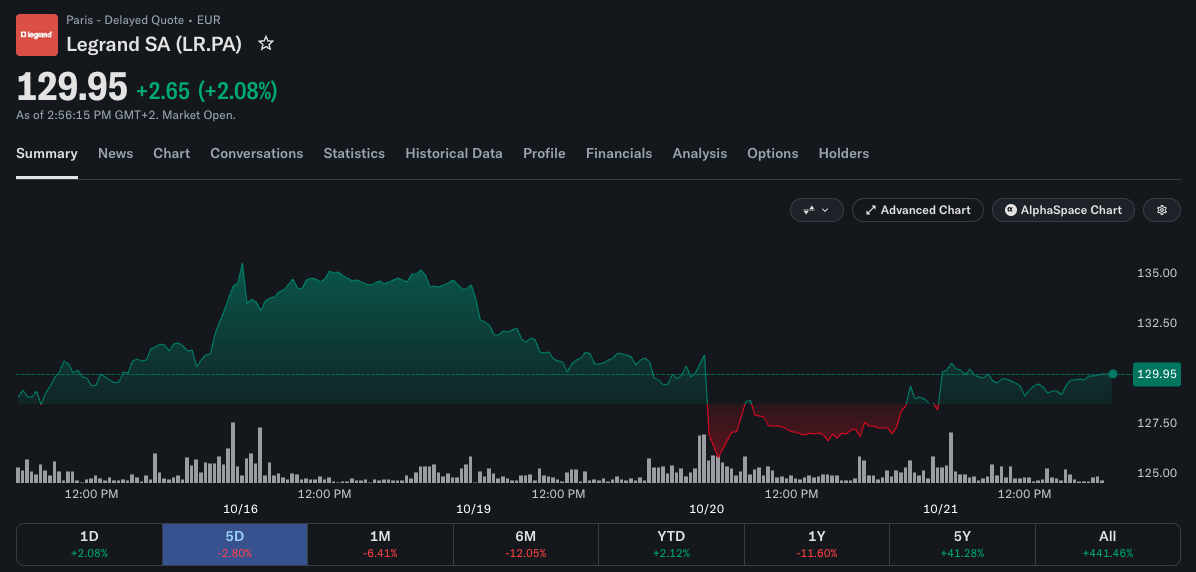
Prior to the upgrade, shares closed near €127.30 before advancing 2.04% to trade near €129.90. Over prior trailing cycles, the stock lagged broader industry benchmarks, declining 9% while covering sector peers gained 10% overall.
Data Center Revenue Exposure and High-Voltage Infrastructure Transitions
Data center infrastructure hardware represents approximately 32% of total group sales, marking the highest revenue concentration among European electrical component peers covered by major brokerages.
Industry sentiment softened previously due to market anxieties surrounding 800VDC data center architecture shifts and elevated interest rates dampening traditional European construction, particularly in France, which generates 12% of enterprise sales.
However, recent product disclosures confirmed that the business is exceptionally well-positioned for high-voltage direct current transitions, providing advanced power distribution systems that exceed market expectations.
Content Expansion Per Megawatt and Enterprise Revenue Projections
Corporate disclosures reveal that equipment content supplied per megawatt is projected to expand from $2.5 million to over $3 million for hybrid low-voltage direct current designs. Incorporating solid-state transformers further elevates equipment content potential up to $3.8 million per megawatt.
Driven by institutional projections of a 43% compound annual growth rate in global data center capital expenditures, research models project enterprise revenue reaching €11.13 billion, up significantly from €9.48 billion in prior financial cycles. These estimates sit 1%, 4%, and 8% above consensus top-line forecasts across upcoming reporting periods.
Exceptional Operating Margin Durability Across Economic Cycles
Demonstrating notable operational resilience, the manufacturer maintains a decades-long record of protecting profitability during challenging macroeconomic environments. Historical financial data shows that operating EBITDA margins have never contracted by more than 200 basis points over nearly 30 years of continuous operations.
Analysts project adjusted operating margins at the upper boundary of the company’s upgraded 21%-22% target range, supported by pricing power and operational efficiency that offset broader construction softness across European and North American markets.
Outperformance Expectations for Earnings and Operating Profit
Strong demand for specialized data center equipment underpins projections for adjusted operating profit to exceed market consensus by 6% and 9% in multi-year forward forecasts. Operating leverage gained from scaling high-margin digital infrastructure hardware provides a sustainable buffer against muted residential and commercial building activity.
Converting strong order backlogs into delivered equipment ensures steady cash flow generation, reinforcing balance sheet strength and enabling continued strategic bolt-on acquisitions.
Key Risk Factors Influencing Institutional Investment Thesis
While structural growth drivers remain compelling, equity analysts highlight five primary operational risks that could impact the investment thesis. Persistent high interest rates prolonging commercial construction weakness and macroeconomic instability across core European markets represent ongoing headwinds.
Additionally, challenges in executing bolt-on acquisitions at reasonable prices, project execution delays within data center construction, or rapid technical shifts that disadvantage proprietary product lines could influence future valuation trajectories.
Capital Deployment Tactics for Grid Modernization Plays
Equity desks are rebalancing asset mixes by shifting funds from traditional cyclical building suppliers into specialized electrification plays. Overweighting equipment producers tailored to server rack power density gains offers a direct avenue to monetize AI compute expansion without bearing direct semiconductor exposure.
Tracking real-time megawatt installations, backlog conversion rates, and copper price trends serves as a vital blueprint for timing exposure adjustments in high-capacity electrical equipment equities.
Long-Term Outlook for High-Density Power Suppliers
Capitalizing on electrification tailwinds demands separating temporary macro slowdowns from multi-decade digital infrastructure expansion. Securing discount entry prices during market mispricings allows institutional funds to build durable long-term stakes in market-leading component producers.
Sustaining sharp product innovation alongside rigorous operational discipline guarantees that specialized grid suppliers maintain pricing power while delivering robust equity returns for institutional capital holders.