

During the time that major investment houses were releasing new research coverage that praised the steady market share capture and corporate platform evolution, there was a brisk buying activity in online broking shares.
Obtaining essential quantitative insights into the reasons why digital trading hubs earn premium valuation multiples can be accomplished by dissecting analyst rating initiations, revised price target models, and new consumer fintech offerings.
Analyzing consumer trading platforms involves checking user funding velocity, net cash additions, and global user acquisition metrics.
Proprietary market analysis provided by a market analyst at Librrova notes that consumer-facing brokerage brands generate substantial shareholder wealth when successfully transitioning from standalone trading tools into full-service digital wealth hubs.
Even following temporary share price pullbacks, high operating leverage and lean cost bases allow core earnings power to expand over multi-year cycles.
Bullish Wall Street Initiation and Aggressive Price Target
Wall Street research firm Rosenblatt initiated coverage on retail brokerage pioneer Robinhood Markets with a Buy rating and a 12-month price target of $135 per share. The research team described the platform as one of the most compelling long-term expansion stories across the entire financial services sector.
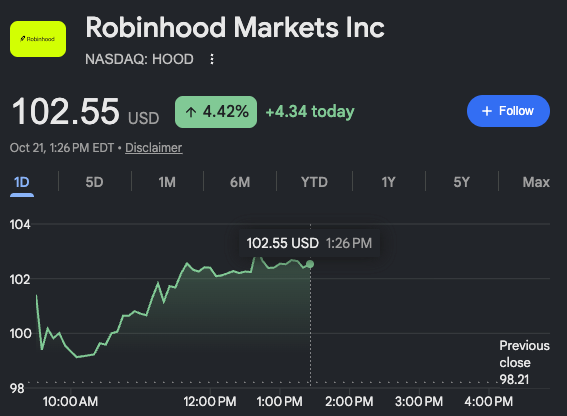
Analyst Chris Brendler emphasized that the company’s multi-generational growth narrative fully justifies trading at a premium valuation relative to legacy brokerage competitors, driving a 4.14% advance in equity shares during active trading sessions.
Disruptive Market Influence and Brokerage Industry Transformation
Research dispatches noted that the platform fundamentally altered the retail investing landscape by introducing zero-commission, mobile-first trading, which ultimately forced legacy industry incumbents to eliminate trading fees.
Few financial technology firms can legitimately claim to have reshaped an entire global industry, but the platform successfully achieved that structural shift.
Market participants do not fully appreciate how the corporate strategy has transformed into a comprehensive financial ecosystem, as noted by investment analysts.
Core Brokerage Share Gains and Regulatory Tailwinds
Despite its already massive scale, the core brokerage division continues taking active market share from traditional financial institutions. Expanding user engagement across equities, options, and digital assets demonstrates deep platform stickiness among active retail market participants.
Furthermore, proposed reforms to Pattern Day Trading rules are expected to eliminate a primary trading constraint for the company’s highest-value active traders, unlocking higher transaction volumes and boosting overall platform monetization metrics.
Diversified Product Suite Expansion and International Scaling
Revenue growth is increasingly propelled by deeper client relationships and continuous product line expansion, including high-yield cash accounts, retirement plans, and advanced trading tools. These product introductions increase average revenue per user while extending customer lifetime value metrics.
Wall Street analysts see a substantial runway for future growth, particularly as international market expansion gathers momentum, allowing the business to capture global retail investing flows across new geographic regions.
Fixed Cost Operating Leverage and Capital Allocation Frameworks
Operating with a largely fixed technology cost base enables significant profit margin expansion as overall transaction volumes and interest income scale upward. Incremental revenue streams drop efficiently to the bottom line, generating substantial operating cash flow.
Combined with shareholder-friendly capital allocation strategies, including strategic equity repurchases, the business structure supports trading at a valuation premium compared to slower-growing traditional wealth management peers.
Valuation Considerations Following Recent Market Pullbacks
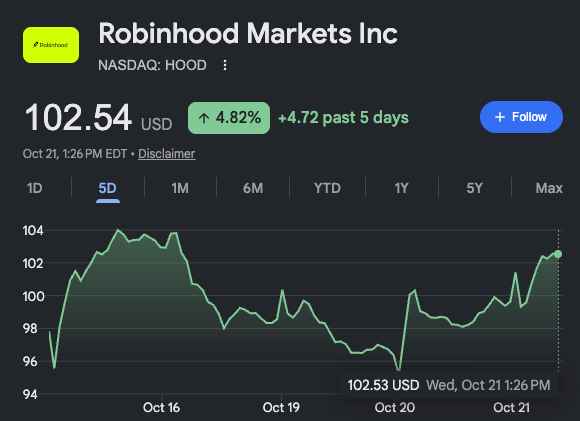
Acknowledging that equity shares are not statistically cheap, analysts highlighted that a recent 20% stock price pullback provided an attractive entry opportunity for long-term growth investors. The substantial gap between current market prices and the $135 target price reflects strong upside potential.
Re-evaluating valuation multiples during market pullbacks allows institutional investors to build strategic positions in market-leading financial technology franchises before forward earnings acceleration materializes.
Capital Deployment Tactics for Next-Gen Consumer Finance Plays
The equity weights of institutional portfolio managers are being actively adjusted in order to take into account the ongoing shift towards the accumulation of wealth through digital retail.
Strong structural participation in expanding retail market volume can be achieved by directing funds into scalable financial ecosystems. This allows for the elimination of dependence on the overhead costs of legacy bank branches.
When it comes to consumer fintech platforms, monitoring monthly active account metrics, net deposit growth, and international client acquisition velocity serves as an indispensable blueprint for effectively timing position adjustments.
Multi-Year Trajectory for Consumer Financial Ecosystems
Selecting platforms that are able to drive multi-product adoption across a variety of market environments is necessary in order to unlock superior risk-adjusted returns across all financial technology assets.
The ability of institutional investors to construct resilient positions in category-defining platforms is enabled by the utilisation of market dips for the purpose of inventory accumulation.
In order to guarantee that next-generation broking models generate exceptional long-term capital appreciation for equity investors, it is necessary to maintain continuous software innovation while simultaneously expanding international footprints.