

The euro slipped below 1.1630 against the US dollar following the European Central Bank’s decision to raise interest rates for a second time since the Middle East conflict began.
The pair touched an intraday low near 1.1596 earlier in the week before stabilising around 1.1615, as investors weighed competing forces from both sides of the Atlantic.
Brokers from Financial Real Time examine the macro forces shaping the pair’s near-term outlook, from ECB policy signals to the impact of rising energy costs on eurozone inflation expectations.
Over the past month, the euro has gained a modest 0.74% against the dollar, but the pair remains down roughly 0.90% on a twelve-month basis.
The weekly range has tightened between 1.1596 and 1.1648, reflecting a market caught between two competing tightening cycles. Neither central bank has signalled a pause, leaving traders to parse each data release for relative hawkishness.
ECB Delivers Rate Hike but Fails to Lift the Euro
The ECB delivered its expected rate increase, warning that inflation is likely to remain well above the 2% target for an extended period. The central bank maintained its 2026 inflation forecast at 3.0% but revised its 2027 and 2028 projections upward to 2.5% and 2.1% respectively.
GDP growth forecasts were also upgraded, with 2026 now expected at 0.9% and 2027 at 1.4%. Despite the modestly hawkish tone, the euro failed to gain traction. Renewed energy price pressures, with Brent crude surging past $108 per barrel and European gas prices reaching fresh multi-year highs, weighed on risk sentiment across the eurozone.
Dollar Strength Compounds Euro Weakness
On the other side of the equation, the US dollar gained ground after August PPI data came in hotter than expected, with annual producer inflation at 5.4%. The print reinforced expectations of a Fed rate hike at the upcoming September meeting, where markets now assign a greater than 70% probability.
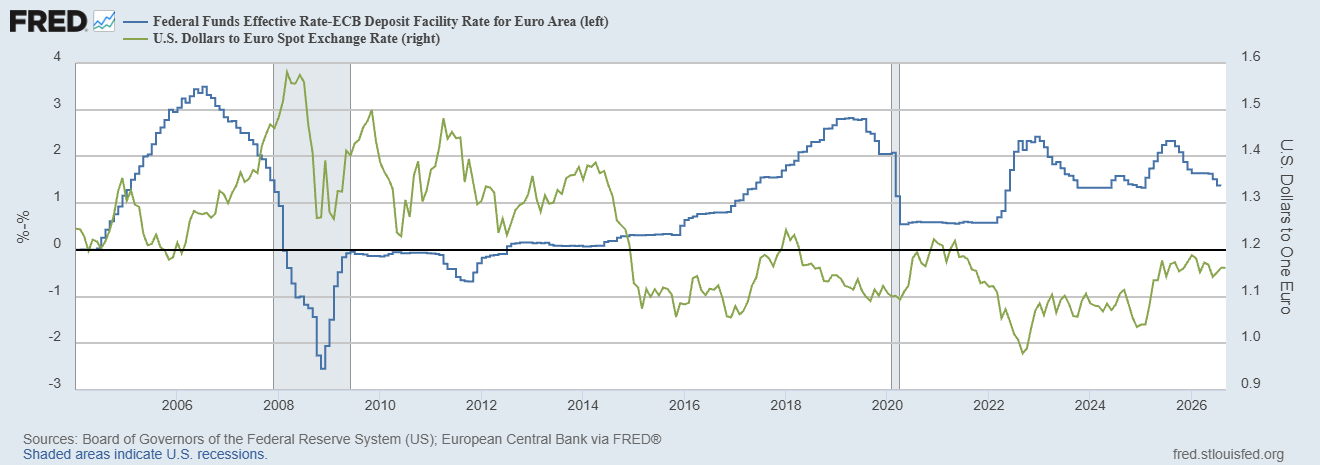
The interest rate differential between the Fed and the ECB remains a key driver. While both central banks are tightening, the Fed’s more aggressive posture continues to favour dollar demand, particularly as rising oil prices act as a quasi-tax on the energy-importing eurozone economy.
European natural gas prices have also surged to their highest levels since late 2022, compounding the inflationary drag on the eurozone.
The energy shock feeds directly into producer input costs, squeezing margins for European manufacturers already contending with sluggish demand from China.
For the ECB, the dilemma is acute: tighter policy is needed to contain inflation, but higher rates risk tipping the bloc’s fragile recovery into contraction.
The ECB’s deposit rate currently stands at 2.40%, well below the Fed’s 3.50% to 3.75% target range.
That 135-basis-point gap continues to channel yield-seeking flows toward dollar-denominated assets, particularly as short-term US Treasury bills offer increasingly attractive returns relative to their eurozone counterparts.
Technical Picture Tilts Bearish, but Support Holds
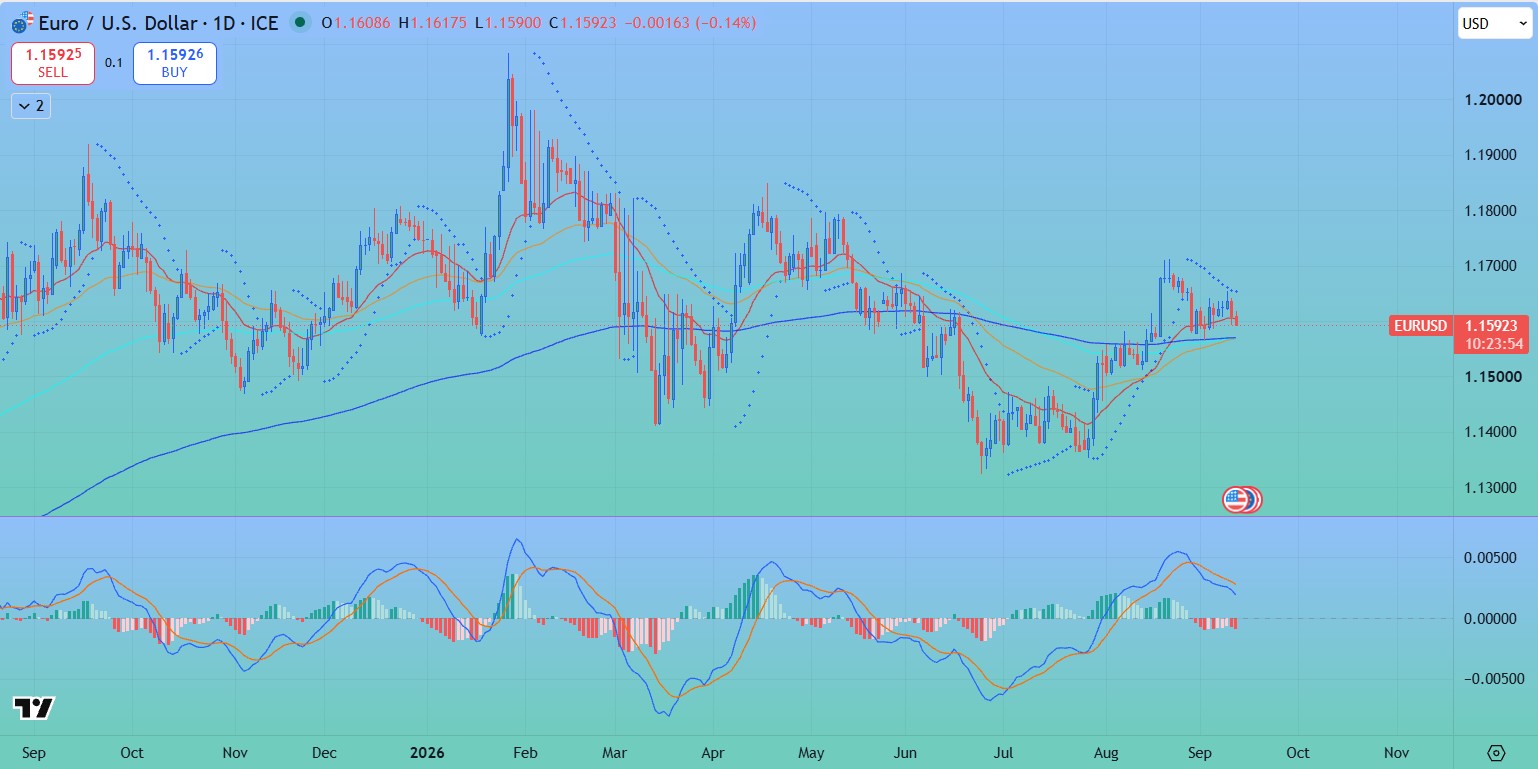
The RSI (14) on the 4-hour chart sits at approximately 43, reflecting a gradual erosion of buying momentum without yet reaching oversold territory.
The indicator has been drifting lower since the pair’s rejection near the 1.1680 resistance earlier in the month, and a sustained move below 40 would signal that sellers are firmly in control of the near-term direction.
The MACD remains above its signal line with a downward slope, reinforcing the short-term bearish bias.
On the weekly chart, the pair continues to hold above the 200-day SMA near 1.1599, a level that has provided reliable dynamic support since late July.
A weekly close below this average would mark a significant technical deterioration and likely accelerate the move toward 1.1500. The Stochastic oscillator has also crossed below 50, adding to the weight of evidence pointing toward further near-term softness.
Key support rests at the 50-day SMA around 1.1508, followed by the 1.1460 level that served as a base in late June. On the upside, the 1.1680 zone and the psychological 1.1700 threshold remain the barriers for any meaningful recovery.
Speculative positioning data shows that net long euro bets among leveraged funds have been trimmed for three consecutive weeks, suggesting that momentum traders are unwinding bullish exposure.
The options market tells a similar story, with risk reversals tilting in favour of euro puts for the first time since June, reflecting growing hedging demand against further downside.
The upcoming US CPI release and further developments in the Middle East will shape the pair’s direction.
A softer inflation read could relieve some dollar strength and allow EUR/USD to reclaim the 1.1650 to 1.1700 range.
An escalation in oil prices, by contrast, would compound the eurozone’s inflation challenge and likely drag the pair toward the 1.1500 handle.