

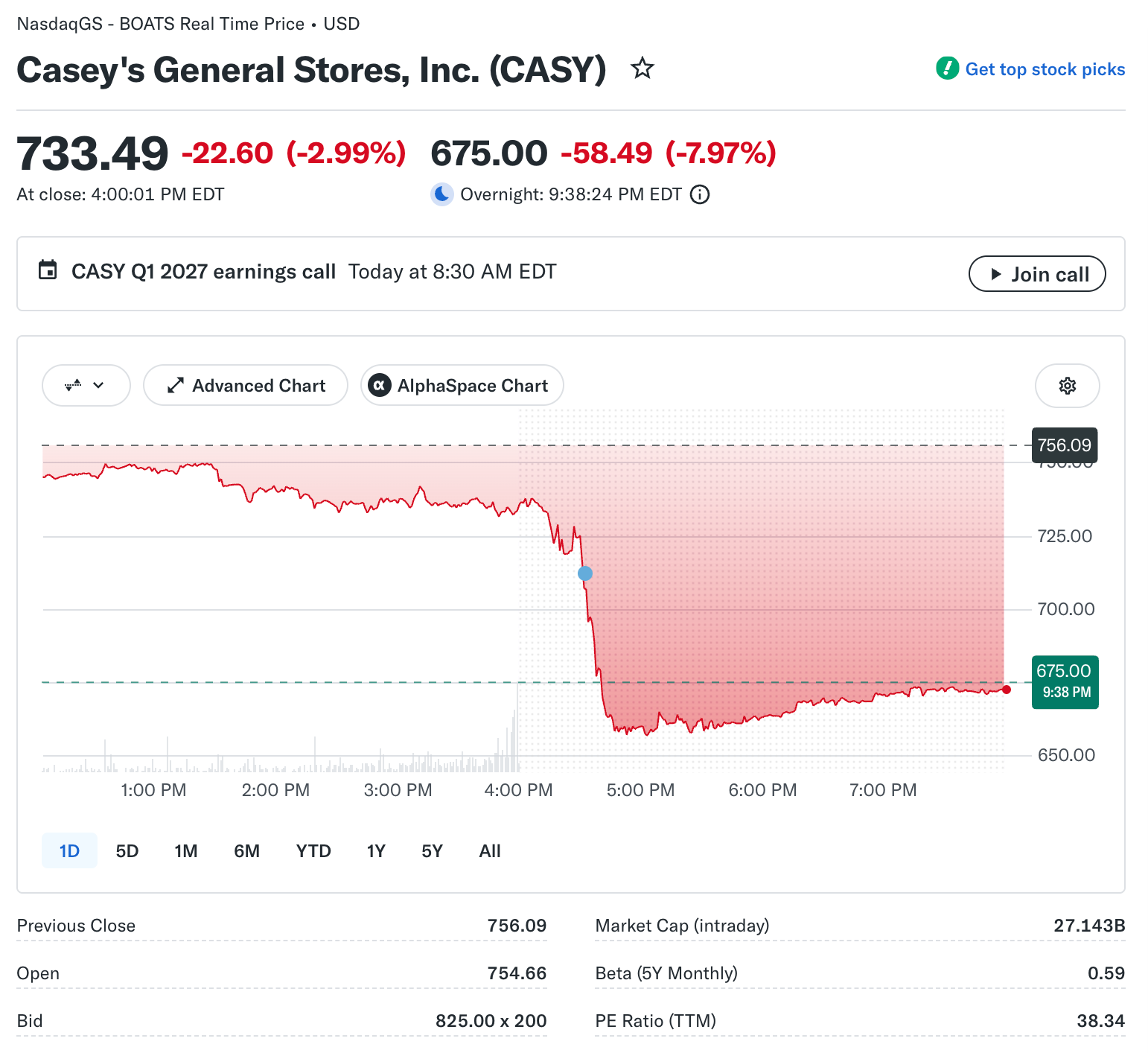
Beating analyst expectations should send a stock higher. Casey’s General Stores did exactly that this week, posting a profit well above market forecasts and generating more revenue than the consensus expected. The stock fell anyway. Understanding why requires looking past the headline numbers and into how premium valuations process even positive information.
A senior financial analyst at Gammance says Casey’s result this week is one of the clearest illustrations of a dynamic that trips up investors who focus too much on whether a company beat or missed and too little on what the market had already priced in before the announcement. Both matter, and this week at Casey’s they pointed in opposite directions.
A Business Running Well Above Expectations
Casey’s Q1 results delivered on multiple fronts. Adjusted profit per share came in at $7.37, comfortably above the analyst consensus figure of $6.78.
On the revenue side, the quarterly total reached $5.68 billion, clearing the $5.56 billion estimate that had been the midpoint of street expectations heading into the report. The spread between actual and expected on both lines was meaningful enough to qualify as a genuine beat rather than a marginal one.
The business generating those numbers operates nearly 3,000 locations across the central and southern United States. Its product offering spans fuel, packaged groceries, and freshly prepared food, with a pizza program large enough to rank it among the country’s largest pizza chains.
That breadth of revenue streams is one structural advantage that has helped the company maintain consistent performance across varying consumer spending environments.
The prior fiscal year established a demanding baseline. Full-year earnings per share reached $19.16, up 31 percent. Net income topped $714 million. EBITDA came in at $1.5 billion, growing 23 percent. The Q1 result this week landed above what analysts expected even against those strong prior-year comparables, which is a harder task than beating a depressed baseline.
Why Strong Numbers Produced a Negative Reaction
The stock entered the earnings release carrying a price-to-earnings multiple of approximately 39 times. At that valuation, the market is not paying for what the business earns today.
It is paying for what the business is expected to earn over the next several years, discounted back to the present.
When the implied growth story is that rich, a quarter that beats expectations on the numbers but does not materially change the multi-year earnings trajectory can still disappoint because the bar was set by the future, not the present. The technical picture reinforces that framing.
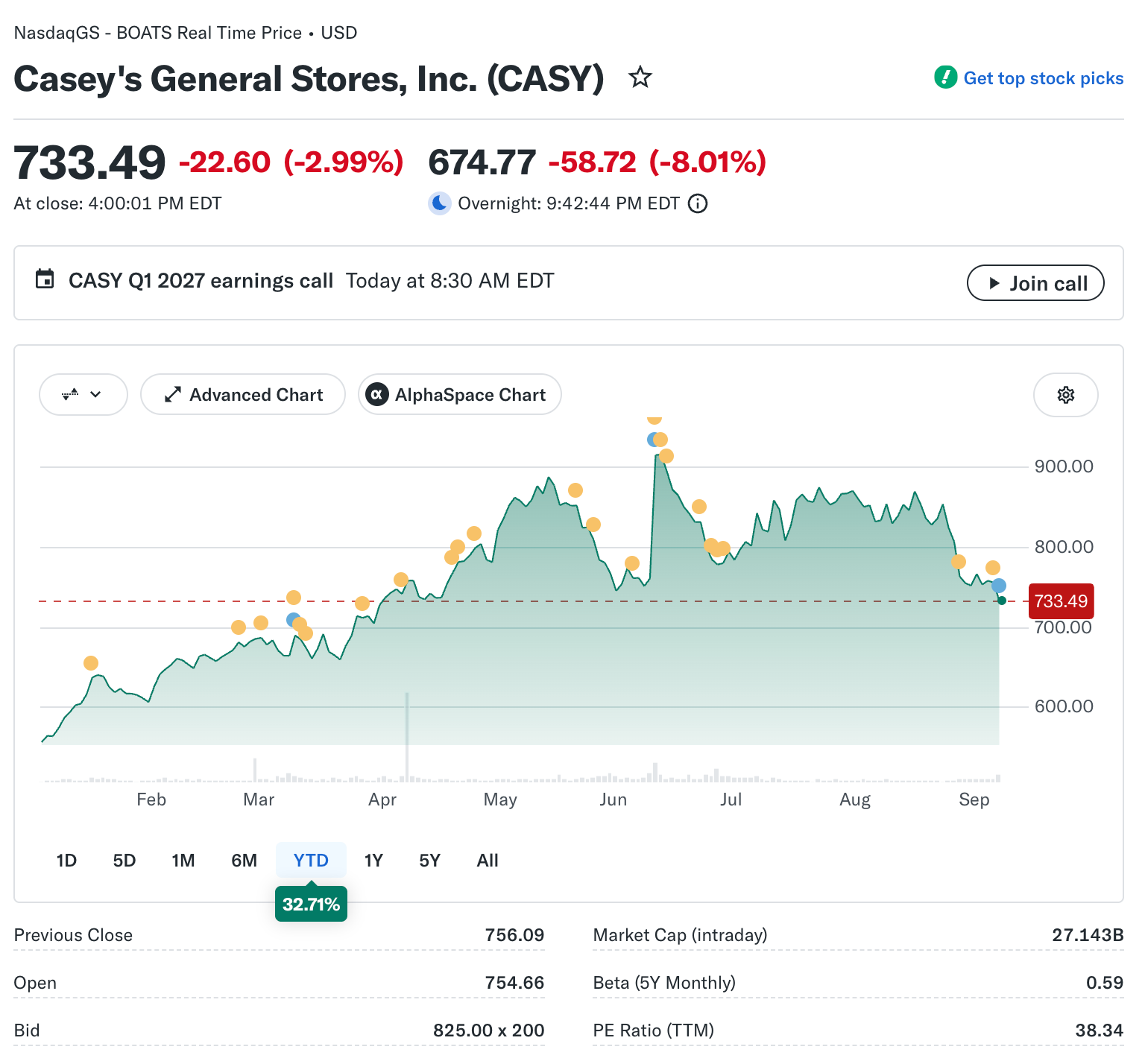
The stock’s 50-day average had been tracking near $826, and its 200-day average near $786, both significantly above where the stock has been trading heading into this week. Those averages represent a market that had been pricing the stock against higher expectations than the current level reflects.
The post-earnings drop to $733.49 widened the gap further, confirming that the market is resetting its forward assumptions rather than responding to any deterioration in the underlying business.
Return on equity of 18.73 percent and net margin slightly above 4 percent are respectable figures for a convenience operator. They are not unusual enough to justify the historical premium on their own, and the premium requires a compelling growth story. This week’s result, while solid, did not dramatically accelerate that story.
What Management Said About the Year Ahead
Management maintained fiscal 2027 targets that reflect a growing business. Management reiterated same-store sales growth of 2 to 5 percent and EBITDA expansion of 8 to 10 percent.
The company plans at least 120 new store openings for the full year. That new-store program is the mechanism through which Casey’s converts its operating model into compounding top-line growth, since each new location adds to the revenue base without proportional increases in overhead.
The 8 to 10 percent EBITDA growth target, if achieved, would represent meaningful absolute earnings expansion on top of a record prior-year base.
That is the growth investors are paying for at a 39-times multiple. Whether those targets are hit, and whether the new store opening pace delivers on schedule, will determine whether the stock rerates back toward its prior highs or continues to trade at a discount to its moving averages.
What This Result Reveals About the Current Consumer Environment
Casey’s inside same-store sales performance is a useful data point for investors trying to read the broader consumer landscape.
While premium apparel brands, entertainment companies, and discretionary retailers have been reporting declining traffic and lower comparable sales, the convenience category is showing the kind of stability that tends to characterize necessity-adjacent spending.
The explanation is intuitive. Households cutting back on aspirational purchases do not stop buying fuel or prepared food.
Those categories sit close enough to daily routine to be treated as non-discretionary even when the household budget is being actively managed. The consistency of Casey’s earnings beats, averaging a 23 percent positive surprise in recent quarters, reflects that stable structural demand.