

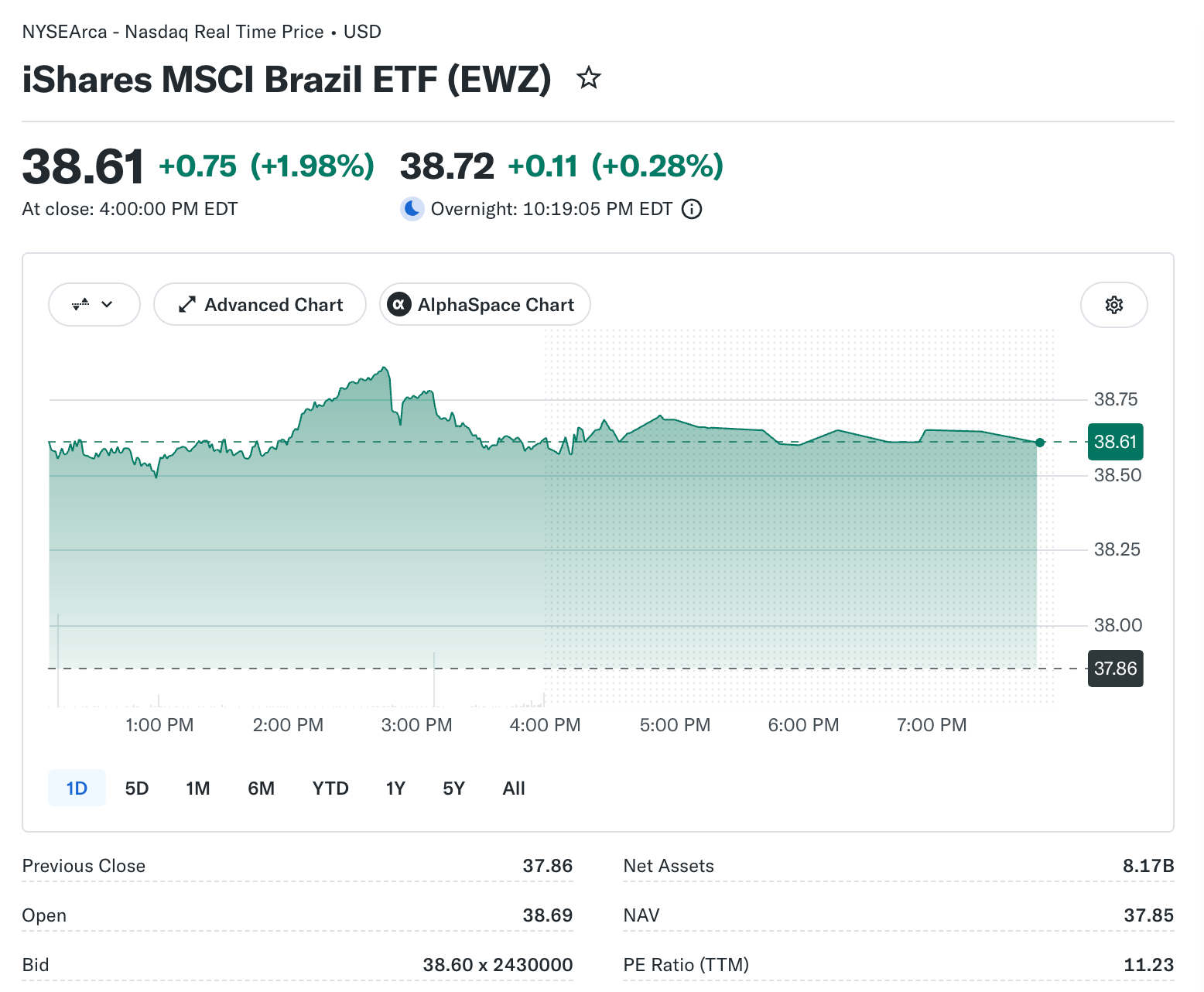
Brazilian stocks surged this week, with the iShares MSCI Brazil ETF jumping nearly 4 percent in a single session and trading more than 6.8 percent higher over the week. The move put the fund on pace for its best daily performance in roughly five months.
The jump coincided with market attention on the country’s political outlook, which investors interpreted as a signal of near-term policy continuity in the region’s largest economy.
A junior financial expert at Gammance points out that Brazil’s equity market has been tracking a mix of domestic political signals, commodity price dynamics, and external monetary conditions, making it one of the more complex emerging market positions to evaluate in the current global environment.
The nearly 4 percent single-session move in the ETF reflects how quickly capital flows can shift when the political risk premium in an emerging market economy adjusts.
Why Political Signals Move Brazilian Equities
Brazil’s equity market is deeply sensitive to political developments because government policy directly shapes the operating environment for the country’s largest businesses. State-controlled energy company Petrobras, for example, has historically traded as much on government dividend-policy decisions as on the underlying oil price.
Brazilian banks respond to government credit programs and interest rate policy in ways that US or European financial stocks do not. When polling or political news shifts the market’s assessment of the near-term governance landscape, capital priced around a particular policy scenario rapidly reprices.
Investors who had been discounting a higher political risk premium reduced that discount this week as the signals shifted toward a more predictable near-term policy environment. The speed of the move confirms how much of the recent valuation had been attributable to political uncertainty rather than operational weakness at the underlying companies.
Commodity Exposure as a Brazilian Equity Driver
Brazil’s equity market has significant commodity exposure through Petrobras in oil and gas, Vale in iron ore and nickel, and several agricultural commodity producers. The current global environment of elevated oil prices tied to the Iran conflict sends mixed signals for Brazil.
As a major oil producer, higher crude prices directly boost Petrobras revenues. But as an economy that imports significant manufactured goods and energy inputs, elevated commodity prices also increase input costs for the broader industrial base.
Iron ore prices tied to Chinese infrastructure demand are the other major variable for Brazilian equities. Vale’s performance tracks Chinese steel production closely, and the state of Chinese economic growth is therefore a persistent background factor for anyone holding broad Brazilian equity exposure. Weak Chinese economic data creates headwinds for Vale that can partially offset whatever Petrobras gains from elevated oil prices in the same week.
The External Rate Environment Matters for Emerging Markets
The Federal Reserve’s rate path is a significant variable for Brazilian equities even though the US central bank has no direct authority over Brazilian monetary policy. When the Fed raises rates, the US dollar typically strengthens against emerging market currencies.
A stronger dollar increases the cost of Brazil’s dollar-denominated external debt service, reduces the dollar value of Brazilian equity returns for international investors, and can trigger capital outflows as investors move toward higher-yielding dollar assets.
The Brazilian real’s direction this week will partly depend on whether strong US jobs data and the associated Fed rate-hike expectations maintain their current intensity.
If the dollar continues to strengthen after the payrolls report, emerging market currencies, including the real, will face additional pressure that could offset some of the domestic political tailwind driving the current equity rally. Investors should actively monitor the interaction between Fed policy and Brazilian equity performance, rather than treating it as background noise.
Comparing Brazil to Other Emerging Market Equity Moves
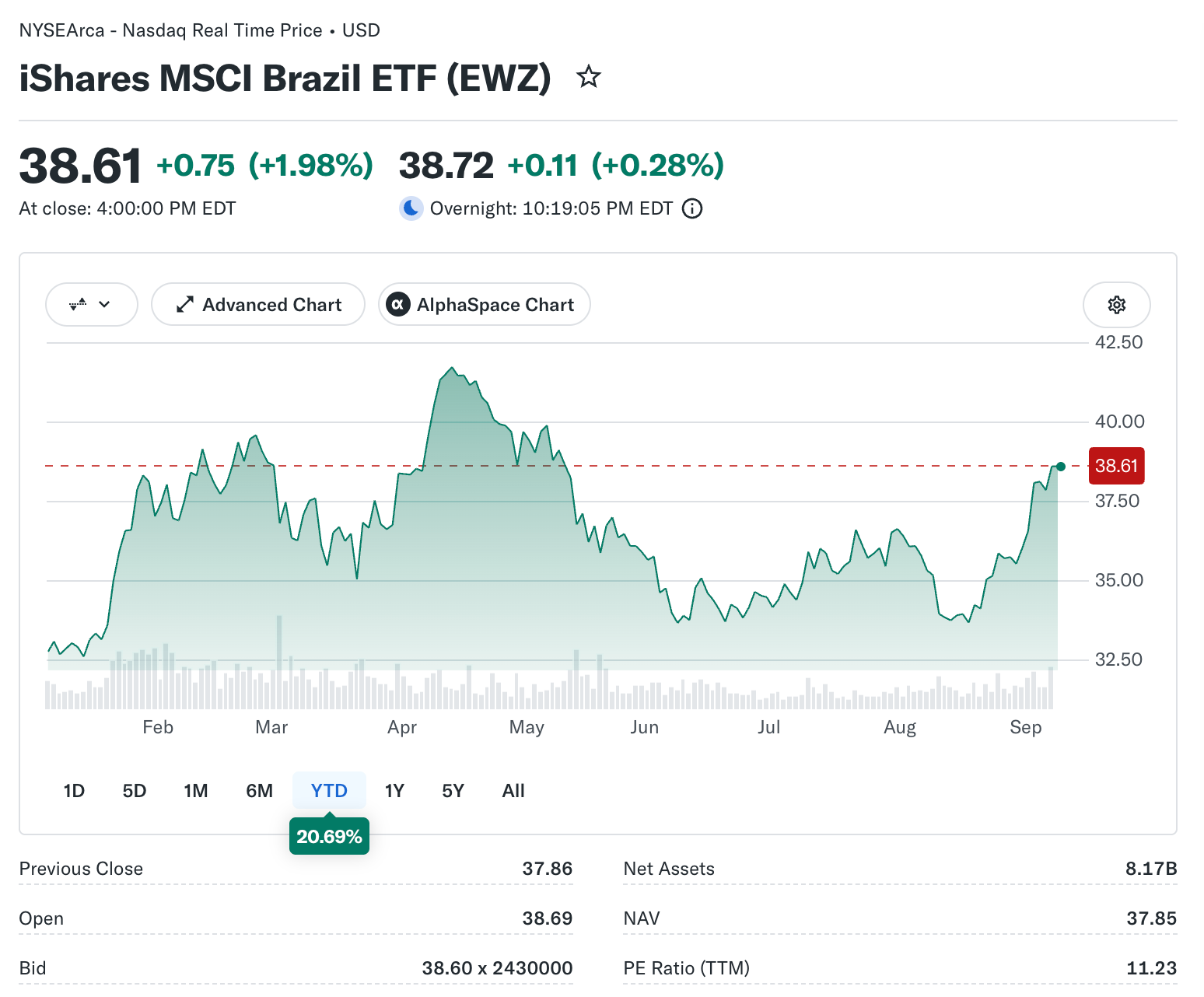
The iShares MSCI Brazil ETF’s nearly 4 percent daily gain and 6.8 percent weekly gain represent one of the stronger emerging market performances of the current period. That relative strength reflects Brazil’s specific combination of commodity exposure, improved political clarity, and a valuation that compressed significantly during earlier periods of uncertainty.
Markets that have absorbed the most selling during uncertainty phases often produce the sharpest recoveries when that uncertainty partially resolves. That mechanism is at work in Brazil this week.
For investors assessing emerging market allocations, Brazil’s current position illustrates the importance of distinguishing between country-specific risk premiums that are compressing and those that are expanding. Countries where political risk is reducing and commodity exposure is an earnings tailwind are producing stronger equity performance than those where the opposite is true.
Brazil currently sits in the favorable category, though the Fed rate path and Chinese demand trajectory remain the two external variables most likely to reverse that positioning. A sustained dollar-strengthening episode or a slowdown in Chinese infrastructure spending would quickly shift the commodity earnings picture.