

Most equity markets absorb Federal Reserve rate signals gradually. Hong Kong does not have that luxury. The city’s currency has been fixed to the US dollar for decades, which means every shift in Fed policy lands directly on local borrowing costs without any buffer from an independent central bank.
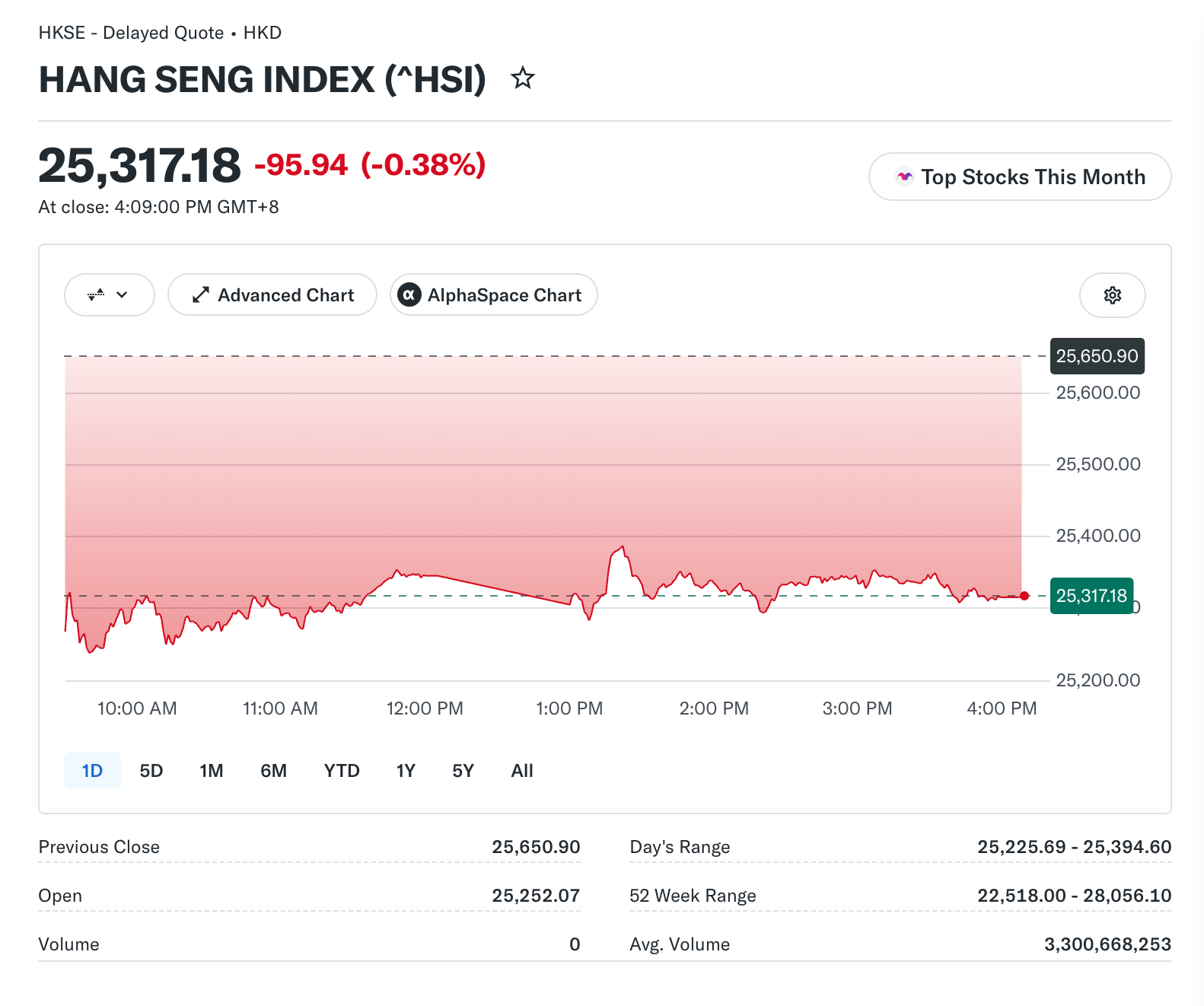
That structural reality explains why the Hang Seng sold off this week while other regional benchmarks showed far more resilience to the same global macro backdrop. A financial analyst at Chilli Markets notes that this week’s Hang Seng weakness is not a sentiment story. It is a plumbing story.
The pipes connecting Fed decisions to Hong Kong asset prices are shorter and wider than anywhere else in Asia, and the current rate environment is running through them at full pressure.
A Market Built for Low Rates, Operating in High Ones
The Hang Seng’s composition reflects decades of investment in a low-rate world. Property developers, banks, and financial holding companies occupy large portions of the index’s weighting. These businesses were built around assumptions of cheap financing, long loan books, and compressing cap rates across Hong Kong’s famously expensive real estate.
None of those assumptions hold comfortably when the Federal Reserve is pricing a 58 percent probability of a rate hike at its next meeting. When rate hike probability jumps nearly nine percentage points in a single trading day following a jobs report, the sectors most leveraged to cheap money feel it immediately.
Banks face margin pressure as deposit competition increases faster than loan repricing. Property developers face valuation headwinds as higher discount rates compress asset values on their balance sheets. Both dynamics played out in this week’s Hang Seng session simultaneously.
The Technology Selloff Added to the Pressure
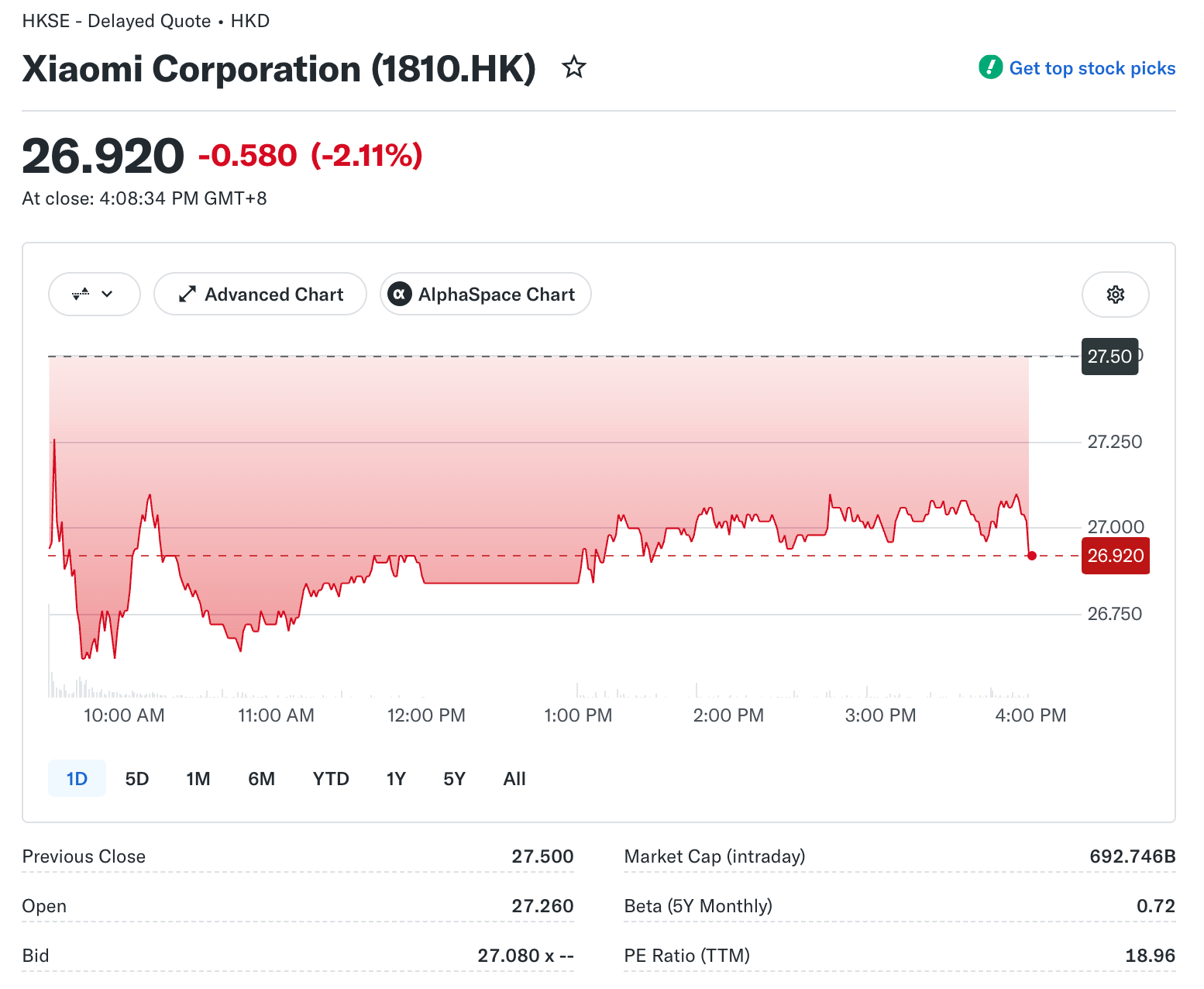
Beyond the rate-sensitive sectors, technology names were also under pressure this week. Xiaomi shed 3.9 percent as selling spread from financial names into the broader market.
Technology stocks in Hong Kong carry a dual exposure that makes them particularly vulnerable in the current environment: they are growth stocks sensitive to rising discount rates, and they are businesses with significant operational ties to a Chinese economy navigating its own structural headwinds. The selling across technology was not driven by any company-specific news from Xiaomi or its peers.
It reflected the same macro repricing that was hitting financial names from a different angle. When rate expectations move this quickly, investors simplify their portfolios by reducing exposure to anything carrying valuation risk.
Mainland China Held Its Ground
While Hong Kong dropped, the picture on the mainland was notably different. The CSI 300 moved in a range around 4,549 and the Shanghai Composite tracked near 3,919, both considerably more contained than the Hang Seng’s decline.
That divergence reflects the fundamentally different operating environment that separates the two markets despite their geographic proximity. China’s renminbi does not float freely. Capital moving in and out of mainland Chinese equities faces controls that slow the transmission of external shocks.
The People’s Bank of China sets policy according to domestic economic conditions rather than in lockstep with any foreign central bank. When the Fed moves aggressively, mainland equities absorb the news through sentiment rather than through any mechanical rate transmission, which means the impact is slower and smaller.
Oil Is Making the Situation More Complex
The Hang Seng’s energy stocks fell roughly 0.73 percent this week even though WTI crude remained above $90 a barrel. That seems contradictory on the surface. In practice it reflects the same rate logic that hit financial and technology names.
Elevated oil prices are not just a revenue story for energy companies. They are an inflation story, and inflation strengthens the case for the Fed to act at its September meeting.
Investors holding Hong Kong energy names had to weigh whether the direct revenue benefit of $90 oil outweighs the rate headwind that $90 oil helps create. This week the market answered no, with rate pressure dominating as the key factor and energy stocks falling alongside the rest of the index.
What Could Change the Direction
Two developments would materially improve the Hang Seng’s near-term outlook. The first is any signal from the Federal Reserve suggesting it will hold rates at the September meeting despite the stronger jobs data.
That would immediately reduce the rate hike probability that has been compressing valuations across the index’s most sensitive sectors. The second is progress on the US-Iran standoff that pushes oil prices lower.
Cheaper oil reduces inflation pressure, which reduces the Fed’s urgency to hike, which reduces borrowing costs in Hong Kong through the peg mechanism. Both variables are live and could shift within days. Investors positioning around the Hang Seng should watch the Fed communications calendar and any Middle East diplomatic developments as the two most actionable near-term signals available.
Neither development requires a full resolution to move the market. Even a tone shift from the Fed toward caution, or a reduction in oil price pressure, would begin unwinding the valuation compression that has built up across Hong Kong’s most rate-sensitive sectors.