

Tesla shares fell to approximately $359 on November 9, deepening a November decline that has now erased more than 13% of the stock’s value and pushed it roughly 24% below its year-to-date peak.
The electric vehicle maker was caught in a broad technology rout on November 5 that sent shares tumbling 10.8% in a single session, the steepest daily drop since March 2026, as investors reassessed valuations across the artificial intelligence and high-growth spectrum.
Rubinax evaluates the technical damage and fundamental questions facing Tesla as it attempts to find a floor above the $340 support zone.
With the company’s robotaxi ambitions scaled back significantly and core automotive margins under pressure from aggressive pricing strategies in multiple geographies.
The stock’s premium valuation is being tested by a market that increasingly demands near-term earnings visibility rather than distant optionality and speculative upside.
Technical Breakdown Exposes the $340 to $350 Support Zone
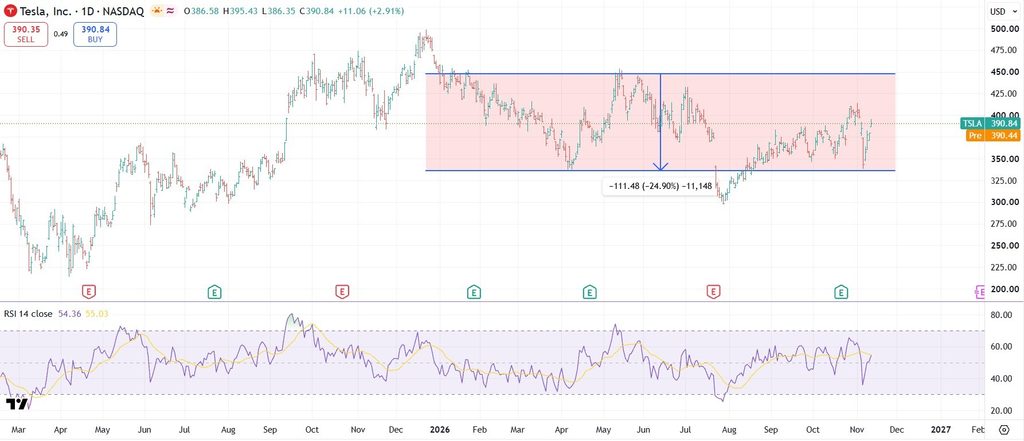
Tesla’s daily chart shows a sharp deterioration following the November 5 gap lower, which sliced through the 50-day simple moving average and the $388 support level in a single candle on exceptionally heavy volume.
The stock closed that session at $343.69, briefly touching the lower end of a support zone that extends from $340 to $350.
This range corresponds to the August consolidation lows and a horizontal shelf visible on the weekly timeframe that has attracted buying interest on two previous occasions this year.
While this reading suggests that the pace of selling may slow in the near term, it does not guarantee a reversal; during Tesla’s March 2026 correction.
If the RSI remains in oversold territory for nearly two weeks before a meaningful bounce materialises, demonstrating that oversold can persist in high-beta names during broad de-risking events.
The stock’s 52-week range of $297.38 to $498.83 places the current price in the lower third of its annual distribution, a positioning that could attract value-oriented buyers but also reflects genuine fundamental uncertainty about the growth trajectory.
Earnings Pressure and Robotaxi Delays Cloud the Growth Narrative
Tesla’s third-quarter 2026 results highlighted the tensions within the business. Revenue came in essentially flat at $28.05 billion, while earnings per share of $0.48 beat consensus estimates.
However, net income declined 44% year on year and operating income fell 56%, reflecting the margin compression that has accompanied aggressive pricing strategies and rising production costs at the Berlin and Austin gigafactories where ramp-up inefficiencies have persisted longer than management initially guided.
Perhaps more damaging to the long-term narrative, the company’s robotaxi programme has been significantly scaled back.
Tesla confirmed that its initial autonomous fleet deployment would consist of approximately 60 vehicles, a fraction of the 500-unit target that management had outlined at the 2025 investor day.
Regulatory hurdles in multiple states and the technical complexity of achieving full self-driving capability without LiDAR have forced a more cautious rollout timeline, removing a key catalyst that had supported the stock’s premium multiple and differentiated it from legacy automotive peers.
Analyst price targets reflect the division in outlook. The consensus range spans from $268 to $480, with the highest concentration of estimates clustered between $400 and $415.
The wide dispersion underscores how sensitive Tesla’s valuation is to assumptions about autonomous driving, energy storage revenues, and the pace of the global EV adoption curve that has decelerated in several key markets including Europe and China.
Catalysts and Key Levels to Watch This Week
The broader AI selloff that triggered Tesla’s November 5 decline reflected a sector-wide repricing of growth expectations rather than a Tesla-specific event.
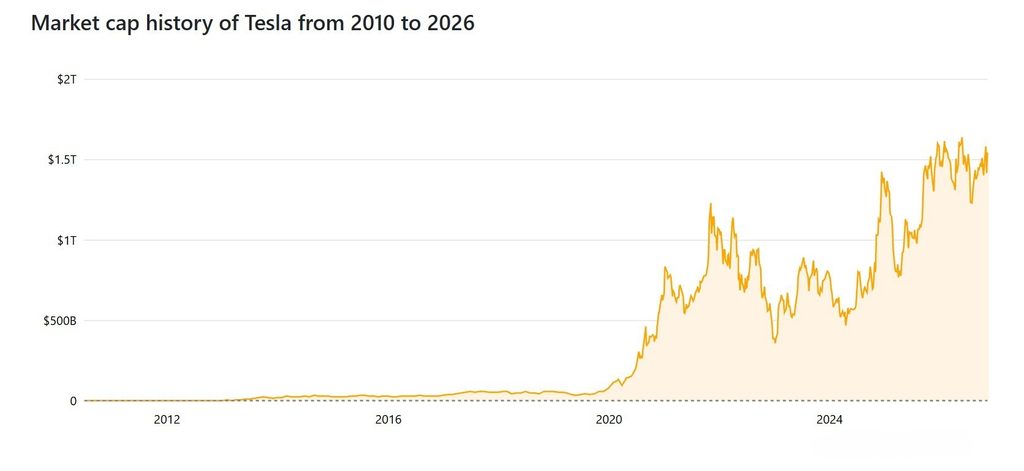
Nevertheless, the stock’s $1.4 trillion market capitalization still embeds significant AI and robotics optionality, making it vulnerable to further multiple compression if risk sentiment across the technology sector continues to deteriorate.
Traders should monitor the $340 level as the line in the sand for the current leg lower. A weekly close below it would constitute a fresh breakdown and could trigger a move toward the $297 52-week low, a decline of roughly 17% from current levels.
Conversely, a reclaim of $390 on above-average volume would suggest that the selling pressure has been absorbed, opening a path back toward the $415 50-day SMA.
Tesla’s November correction has repriced the stock from growth-premium to show-me territory. The $340 support zone will determine whether this is a buying opportunity or the beginning of a deeper de-rating; until earnings momentum improves or the robotaxi timeline firms, the burden of proof rests squarely on the bulls.