

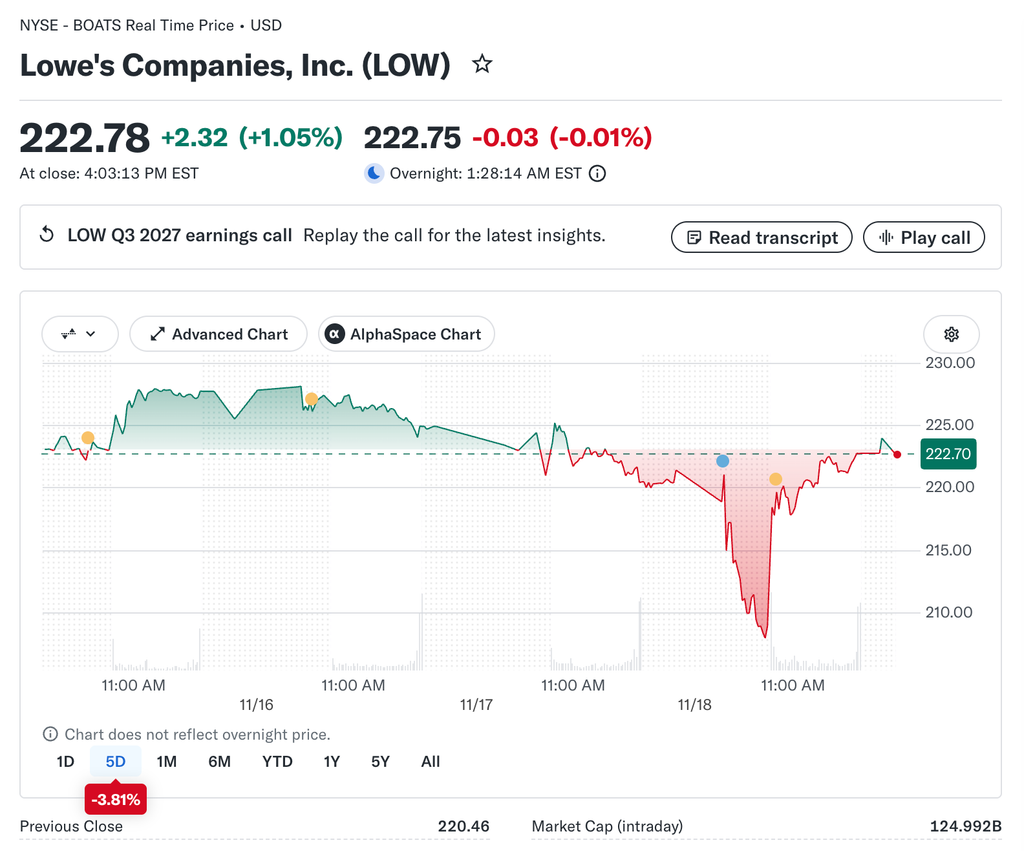
A junior broker at Chilli Markets said the quarter looks better on paper than in the aisles. Operating profit rose about 3.8%, helped by a one-time tariff windfall. Shares slid about 5% in early trading.
Without that windfall, operating profit would have fallen roughly 6%. Revenue still climbed by about $1.9 billion. Investors weighed the two stories and chose caution.
A Profit Gain That Needs the Refund
Operating income reached $2.58 billion, up from $2.48 billion. The refund contributed roughly $250 million before tax. That is nearly 10% of the quarter’s operating profit.
Net earnings rose about 3.5% to $1.67 billion. Subtract the refund’s after-tax value of about $189 million and the result falls near $1.48 billion. That is a decline of roughly 8%.
What the Refund Is
Tariff refunds return duties paid earlier on imported goods. Lowe’s recognized them as a one-time gain. It did not remove them from its adjusted results.
The company strips out only acquisition amortization of about $96 million. The refund therefore supplies roughly 11% of adjusted profit per share. Without it, the underlying result slipped about a tenth from last year.
Margin Pressure Beneath the Surface
Operating margin eased to 11.32% from 11.92%. A basis point is one hundredth of a percentage point. The refund added about 1.1 points, so margin without it falls near 10.2%.
That is roughly 170 basis points below last year. Gross margin lost about 1.2 points and landed just under 33%. The release gives no reason and does not say where the refund sits.
If the refund sits in cost of goods, underlying gross margin is near 31.9%. Lower overhead recovered about a point, as expenses fell to 19.04% of sales. Depreciation climbed to 2.59% from 2.28%, which ate up about a third of that gain.
Why Investors Looked Past the Headline
Reported earnings per share rose about 3.5%, from $2.88 to $2.98. Remove the refund and the figure lands near $2.64. That is a decline of roughly 8%.
Buyers of the stock had to accept that gap. The headline suggested steady growth. The detail showed a business leaning on a one-time gain.
Sales Growth in Context
Same-store growth added only about $0.4 billion to the revenue increase. The other $1.5 billion came from outside the comparable base. The two building-products acquisitions likely explain much of it.
Online sales grew 17.4%, the fastest disclosed line. It was the sixth straight quarter of positive same-store sales. Management called professional and home services solid but gave no figures.
At that growth rate, online share of sales rises each quarter. The release gives no online sales base, though. Investors cannot size the shift yet.
Debt and Interest
Net interest cost was $358 million. Operating income covers that bill about 7.2 times. Without the refund, coverage drops to roughly 6.5 times.
Total debt is near $37.5 billion, against about $3.4 billion of cash. Net debt therefore sits near $34.1 billion. Lowe’s repaid $2.4 billion in nine months.
The full-year interest outlook now sits near $1.5 billion, down from $1.6 billion. Lower debt explains the trim. It gives a small lift to later profit.
Inventory and Cash Flow
Inventory reached $18.3 billion, up about 6.6%. That is slower than total revenue growth. Same-store sales grew slower still, so stock deserves a watch.
Nine-month operating cash flow was $8.7 billion. Capital spending took $1.7 billion, leaving free cash flow near $7.0 billion. Dividends absorbed only about 29% of that.
Dividends Instead of Buybacks
The quarterly dividend rose to $1.25 from $1.20, a gain of 4.2%. The quarter’s dividend bill was $701 million. That equals about 42% of net earnings, or 47% without the refund.
The company recorded no repurchases in the quarter. The share count stayed flat near 560 million. Per-share results therefore got no lift from buybacks.
Lowe’s keeps its status as a long-running dividend raiser. The refund adds a one-time cushion this year.
Guidance Shifts Slightly
Full-year sales are now seen near $92.5 billion, up from $92.0 billion. Same-store sales are guided to about 0.5% growth, up from flat. Adjusted operating margin slips to 11.5% from 11.6%.
Nine-month sales work out to about $71.8 billion, based on the reported overhead ratio. That implies final-quarter sales near $20.7 billion. Guided earnings of $11.75 imply about $1.61 a share for the same period.
What Portfolio Holders Should Track
Three items deserve attention. They are same-store sales, operating margin without refunds, and the coming investor conference. Soft same-store growth alongside heavy debt would raise concern.
Position sizing should reflect a stock that fell on a mixed report. Staged entries reduce timing risk. Diversified holders can pair housing exposure with steadier sectors.