

Target reported third-quarter net sales of $27.1 billion, up 7.1%, ahead of the $26.5 billion forecast. A junior broker at Chilli Markets said the traffic gain is the part worth trusting. Earnings per share reached $2.65, but $0.50 of it came from tariff refunds.
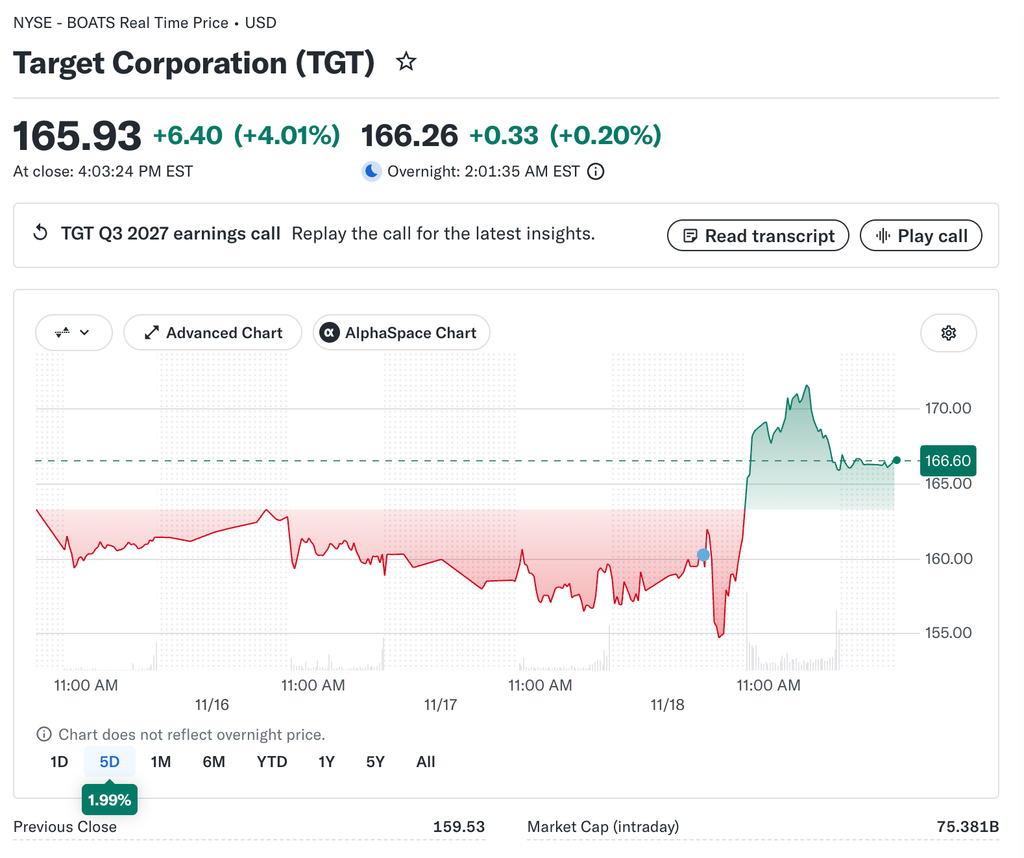
Shares rose about 4% after the report. Refunds are one-time cash returned on duties paid earlier. The business underneath still improved, though by less than the headline suggests.
The Refund in Plain Terms
Tariff refunds return duties paid earlier on imported goods. The $301 million pretax benefit became $228 million after tax. At $0.50 a share, that implies about 456 million shares outstanding.
The refund lifted gross margin by roughly 1.1 points. It also pushed operating margin from about 5.1% to 6.2%. Neither gain repeats unless more refunds arrive.
Traffic Does the Work
Comparable sales rose 5.6%, and 5.0 points of that came from traffic. Average ticket added only 0.6 points. Nearly 90% of the gain therefore came from more visits, not higher prices.
That mix is healthier than price-led growth. Shoppers chose to return in larger numbers. Price increases fade quickly, while habits tend to last.
Digital Takes a Third of the Gain
Digital comparable sales grew 9.8% against 4.6% in stores. Digital orders were 19.8% of merchandise sales, up from 19.3%. At that weight, digital supplied about a third of the total comparable gain.
The shift raises fulfillment costs. Store-based pickup and same-day delivery keep those costs in check. Investors should watch whether margins hold as digital grows.
Stripping Out the Refunds
Operating income was $1.67 billion, a margin of 6.2%. A refund benefit of $301 million sits inside that figure. Without it, profit was near $1.37 billion, a margin of about 5.1%.
Last year’s adjusted operating income was $1.11 billion, a margin of 4.4%. Underlying profit therefore grew about 23%. The margin gain was roughly 0.7 points.
Gross Margin Against Costs
Gross margin reached 30.5%, up from 28.2%. Excluding refunds, the improvement was about 1.2 points. Selling and administrative costs ran at 21.9% of sales, 0.6 points above last year’s adjusted rate.
That overhead increase offsets half of the gross margin gain. The net result is close to the 0.7-point margin improvement. The company did not break out the drivers.
The Earnings Beat Without Refunds
Earnings per share of $2.65 beat the $2.08 consensus by 27%. Removing the $0.50 refund leaves $2.15. That still clears the consensus by 3%.
Last year’s adjusted figure was $1.78, so underlying growth was about 21%. A 21% gain is strong. The 49% reported gain overstates it.
Inventory and Capital Spending
Inventory reached $16.1 billion, up 8% from $14.9 billion. That is slightly faster than the 7.1% sales gain. Capital spending was $1.4 billion, $0.4 billion above last year.
Nine-month capital spending totals $3.8 billion. Management plans spending of $5 billion to $6 billion for next year. Heavier building will absorb cash that buybacks might otherwise use.
Reading the Stock Reaction
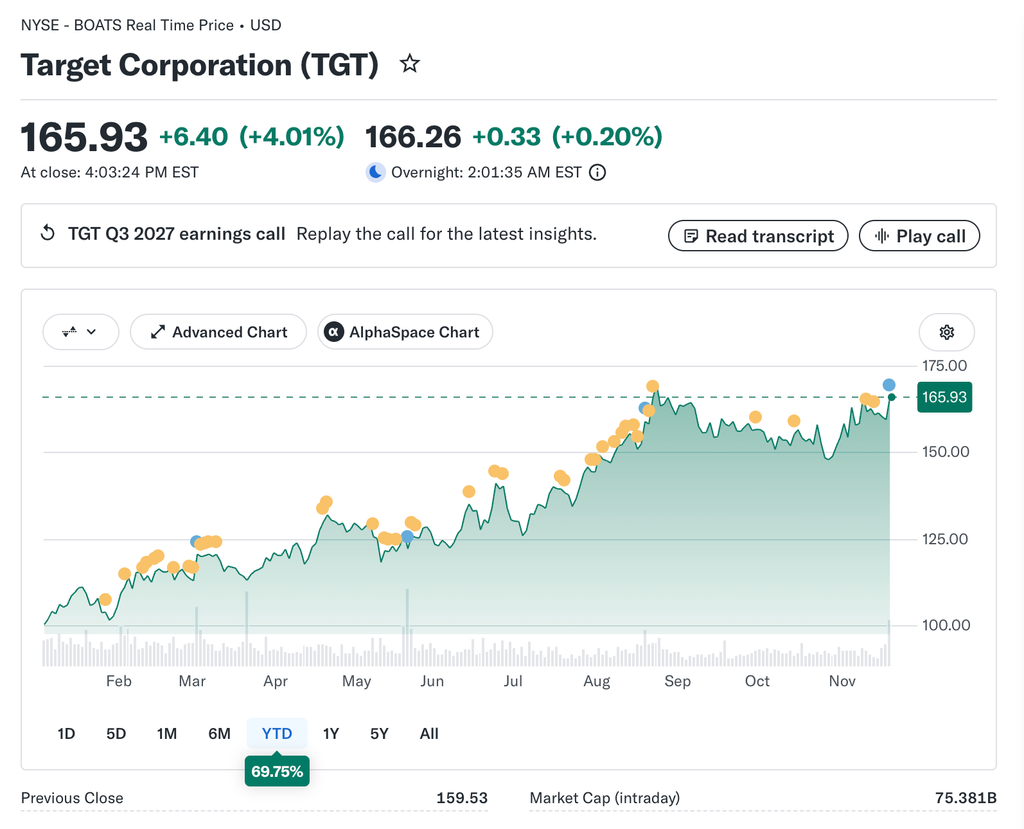
Shares gained about 4% even though the refund-free earnings beat was only 3%. Comparable sales told a bigger story, at 5.6% against forecasts near 3.5%. The market paid for traffic, not for accounting.
A comparable-sales beat of two full points is rare for a company of this size. It suggests store and online visits are holding up. That is the number worth tracking closely in later reports.
Margin Path Ahead
Full-year operating margin is guided near 6.2%, including about 1.1 points from refunds. Underlying margin therefore sits near 5.1%. That matches the quarter’s refund-free figure.
A steady 5.1% means no further gain is planned. Margin improvement would need to come from mix and advertising. Cost control alone is unlikely to deliver it.
Cash and Returns
Nine-month operating cash flow was $5.7 billion, up from $3.5 billion. Cash ended at $4.5 billion. The quarter returned $527 million in dividends and $251 million in buybacks.
Buybacks retired 1.6 million shares at about $155 each. About $8.0 billion remains authorized. Dividends cost twice as much as repurchases this quarter.
Nine-month free cash flow is about $1.9 billion, after $3.8 billion of capital spending. That is only slightly above the roughly $1.6 billion of dividends paid over three quarters at this rate.
What Portfolio Holders Should Track
Three items deserve attention. They are traffic growth, the margin without refunds, and inventory against sales. A traffic slowdown would be the first warning.
Return on invested capital of 16.5%, up from 13.4%, offers a quality check. Position sizing should reflect a stock that rose on one strong report. Staged entries reduce timing risk.