

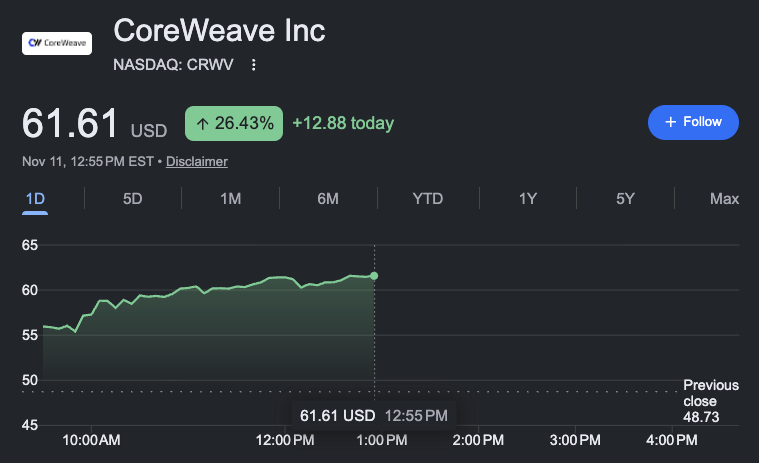
The broader neocloud sector received a much-needed boost from cloud provider CoreWeave’s outstanding quarterly financial report, which restored optimism in the financial markets across various segments of artificial intelligence infrastructure.
An equity strategist and researcher at Rubinax highlighted that long-term enterprise value within digital infrastructure portfolios depends heavily on maintaining robust computing capacity and securing diversified customer revenue streams.
While broader semiconductor valuations faced temporary headwinds, robust revenue expansion among specialized cloud operators helped alleviate investor anxieties surrounding near-term capital expenditure sustainability.
Participants in the market kept a close eye on premarket trading activity as specialised infrastructure providers demonstrated strong operational leverage despite the fact that macroeconomic uncertainties continued to maintain their presence.
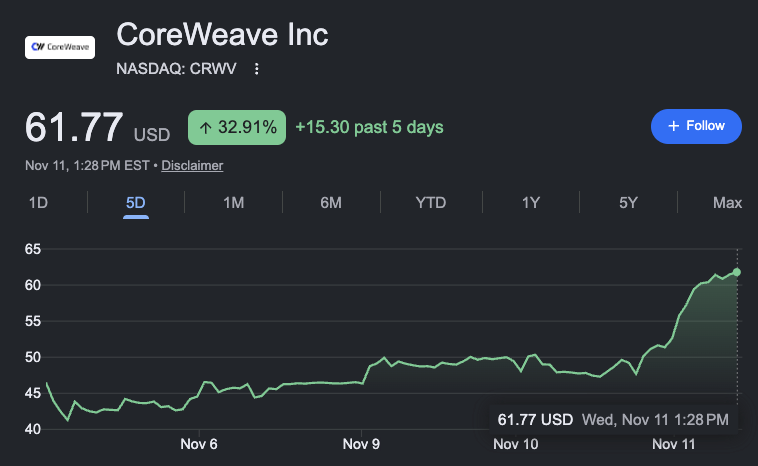
As a result of the disclosure of outstanding quarterly metrics, CoreWeave shares experienced a significant amount of upward movement, which in turn drove sympathetic gains across other technology equities and major semiconductor designers.
Analysts emphasized that accelerating enterprise adoption of specialized accelerated computing clusters continues to validate high capital intensity models across the artificial intelligence ecosystem today.
The forthcoming financial disclosures come at a crucial juncture, when providers of digital infrastructure are required to demonstrate sustained cash generation in addition to aggressive infrastructure scaling.
Institutional investors continue evaluating capital allocation strategies as specialized cloud operators navigate complex debt financing structures and expanding global data center footprints across strategic international markets. Maintaining liquidity discipline remains essential for long-term operational success and enterprise stability.
CoreWeave Earnings Surge and Guidance Upward Revision
Revenue for the 3rd quarter came in at $3.66 billion for specialised cloud infrastructure provider CoreWeave Inc. (NASDAQ:CRWV), an astounding 168% year-over-year growth that beat even the most optimistic consensus estimates.
Increasing the number of data centre deployments around the world led to an increase in operational efficiency, which in turn led to an increase in operating income that reached $207 million.
In response to this outperformance, management increased its guidance for the full year, estimating that annual revenue will fall somewhere between $13.0 billion and $13.3 billion, while simultaneously increasing its total revenue backlog to approximately $133 billion.
Strong operational cash generation and surging demand from enterprise AI labs bolstered investor confidence, despite the fact that concerns regarding high capital expenditures and heavy interest expenses continue to fester.
Furthermore, leadership announced innovative financing frameworks aimed at optimizing capital structures without placing excessive reliance on traditional high-yield debt instruments, providing vital reassurance to institutional equity holders globally across financial markets.
Nvidia Governance Scrutiny and Semiconductor Recovery
Simultaneously, semiconductor bellwether Nvidia Corp. (NASDAQ:NVDA) staged a notable premarket recovery, helping lift peer chip designers including Broadcom, Advanced Micro Devices, and Intel. Trading volumes expanded noticeably across major equity exchanges as institutional funds repositioned within premier technology holdings.
The rebound occurred even as corporate governance scrutiny intensified following board-level inquiries into executive compliance and internal information handling. Industry analysts maintain that fundamental demand for advanced graphics processing units remains resilient despite transient regulatory and administrative headwinds facing major industry participants.
Executives from corporations emphasised the importance of maintaining a close working relationship with enterprise customers in order to guarantee uninterrupted delivery schedules for next-generation accelerated computing hardware across commercial data centres all over the world.
Anticipation Surrounding Upcoming Anthropic Public Offering
The primary equity markets prepared for a major landmark flotation as artificial intelligence pioneer Anthropic launched the formal roadshow for its initial public offering. The enterprise established an indicative share price range of $70 to $78, targeting an aggregate market valuation of up to $1.4 trillion.
Market strategists highlighted that retail investors will gain unprecedented access to roughly 20% of the offering through major online brokerages, marking a historic shift for individual participation in foundational artificial intelligence model developers. Financial advisors anticipate robust institutional subscription demand as trading debut dates approach.
As a result of the successful execution of this massive public listing, market analysts have observed that a definitive valuation benchmark will be established for the artificial intelligence sector as a whole across international capital markets.
Macroeconomic Pressures and Equity Market Evolution
Broader macroeconomic sentiment remained cautious as legislative battles unfolded in Washington, including congressional debates regarding executive appointments and heightened geopolitical tensions involving international energy corridors. Currency markets and sovereign debt yields fluctuated in response to unfolding fiscal policy developments.
Concurrently, financial technologists continue exploring the tokenization of traditional equity instruments, signaling potential structural evolution in market settlement mechanics and underlying asset custody frameworks across global exchanges.
Innovation in market plumbing promises enhanced liquidity and streamlined transaction processing for institutional participants.
The leaders of the industry believe that these technological advancements will modernise the infrastructure of securities trading for decades to come, thereby ensuring the long-term efficiency of markets and the resilience of global financial systems.