

The research team at Librrova examines the US dollar against the Swiss franc, a pair that bounced strongly on Tuesday after touching its lowest point in almost two months. USD/CHF now trades near 0.8250, and the next few sessions will show whether this recovery has real strength behind it.
Dollar Bounces Back From A Two-Month Low
The pair gained about 0.74% during the North American session, a large daily move for a currency cross that is usually calm.
The rebound began after the price touched 0.8127, the weakest level since early September, and buyers have been steadily pushing it back since then. This shows how quickly sentiment can change when the outlook for interest rates shifts, and it keeps traders alert to further surprises.
At its highest point of the day, the pair reached 0.8270 before easing slightly. The current price is the strongest in roughly a week, which suggests that the sellers who dominated the previous sessions have lost some control.
Fed Comments And Inflation Support The Greenback
Two ingredients explain the strength of the dollar. First, several Federal Reserve officials spoke in a firm tone, making clear that they are not in a hurry to relax policy. Second, the latest US inflation report came in at a high level, which strengthened the argument for tighter policy.
As a result, investors increased their bets that the Fed will raise interest rates again in December. Higher expected US rates make dollar deposits more attractive than assets in Swiss francs, where borrowing costs are much lower. This gap in returns often draws money toward the American currency, and it helps explain why the pair climbed so sharply.
The Franc’s Role As A Refuge
The Swiss franc is traditionally treated as a safe place to hold money when markets are nervous. That quality can slow any rise in USD/CHF, because demand for the franc often returns when risk appetite falls. For now, though, the interest rate story is stronger than the search for safety, and the dollar is the side benefiting from it.
Daily Chart: Buyers Retake The Average
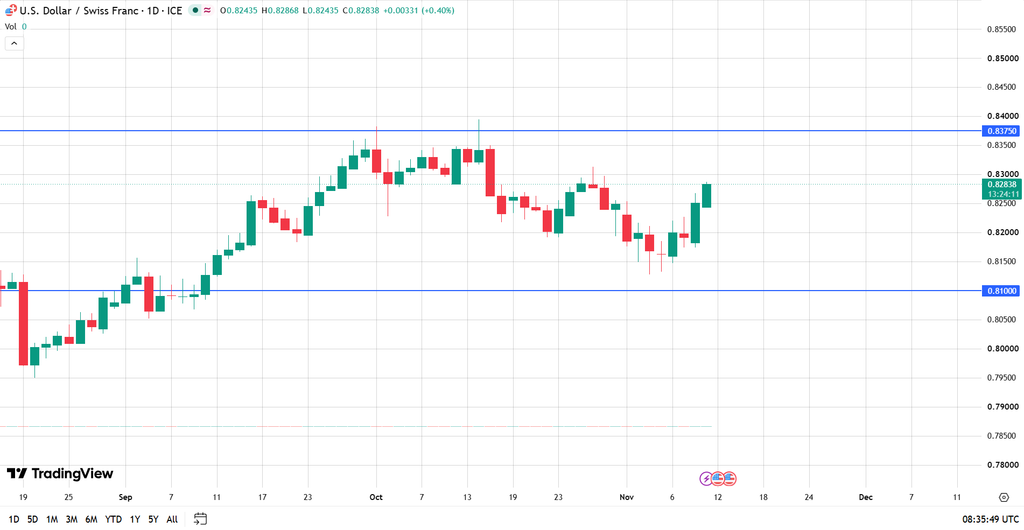
On the daily chart, the pair has moved back above its 50-day simple moving average, which stands near 0.8227. This line is a popular measure of the medium-term trend, and a return above it shows that the recent drop has been at least partly reversed.
Even so, the picture is not complete. The price must show that it can stay above the average over several days, because a single strong session is not always enough to change the direction of a market.
Momentum Moves Into Positive Territory
The Relative Strength Index, which measures the speed of recent price changes on a scale from 0 to 100, has risen over the neutral level of 50. This indicates that buying strength now exceeds selling strength, and it adds weight to the idea of a further advance.
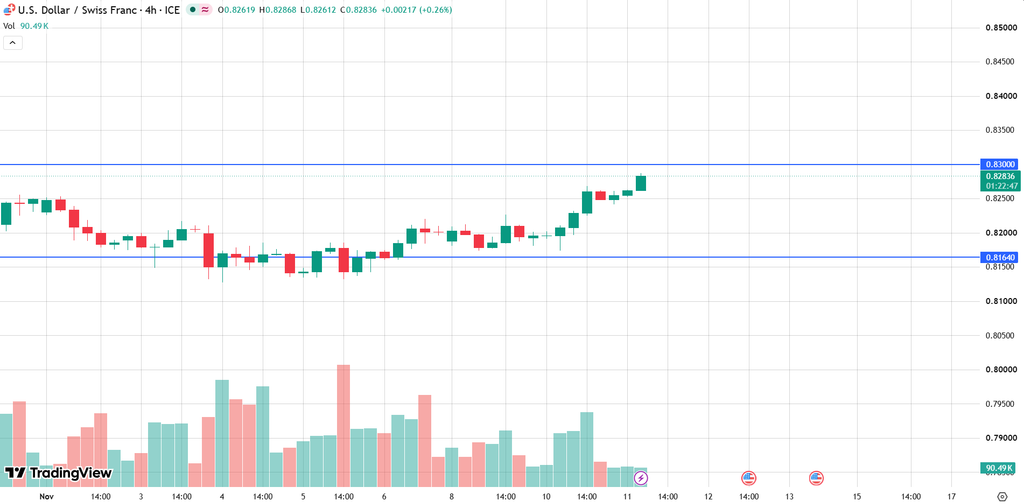
The condition for the next step is simple. A daily close above 0.8250 would strengthen the recovery and open the way toward 0.8300. Beyond that round figure, the target is 0.8382, the highest price of the year, which the pair reached on October 1.
Support And Resistance Levels
On the upside, the first resistance is the round number of 0.8300, followed by the yearly peak at 0.8382. A break above that high would put the pair in a new area for 2026 and would be a strong sign for buyers.
On the downside, the 50-day average near 0.8227 is the first support. Below it, traders will look at the daily low of 0.8174 and then at the 100-day average close to 0.8164. If those fail, the round level of 0.8100 and the 200-day average near 0.8009 become the next areas of interest.
What Traders Can Do
Buyers may prefer to wait for a daily close over 0.8250 before entering, since a move that cannot hold is common after a sharp jump. If that close arrives, a long position could target 0.8300, with a stop-loss placed under the 0.8227 average to limit the risk.
Sellers may look for a return below 0.8164, which would erase the recent bounce and bring the lower levels back into view. Position size should stay moderate, because comments from central bank officials and economic reports can change expectations within minutes.
It is also useful to watch the US dollar index and Treasury yields. These two measures often move together with USD/CHF, and a change in either can confirm or weaken a signal on the chart.
Conclusion
USD/CHF has recovered from a two-month low, helped by firm comments from the Fed and a high inflation report. The 0.8250 area and the 0.8300 resistance are the levels to follow, while 0.8227 and 0.8164 are the key supports.
Traders following Forex strategies should watch US inflation expectations, the Fed outlook and the reaction at these levels, since these factors are likely to guide the next move in the pair.