

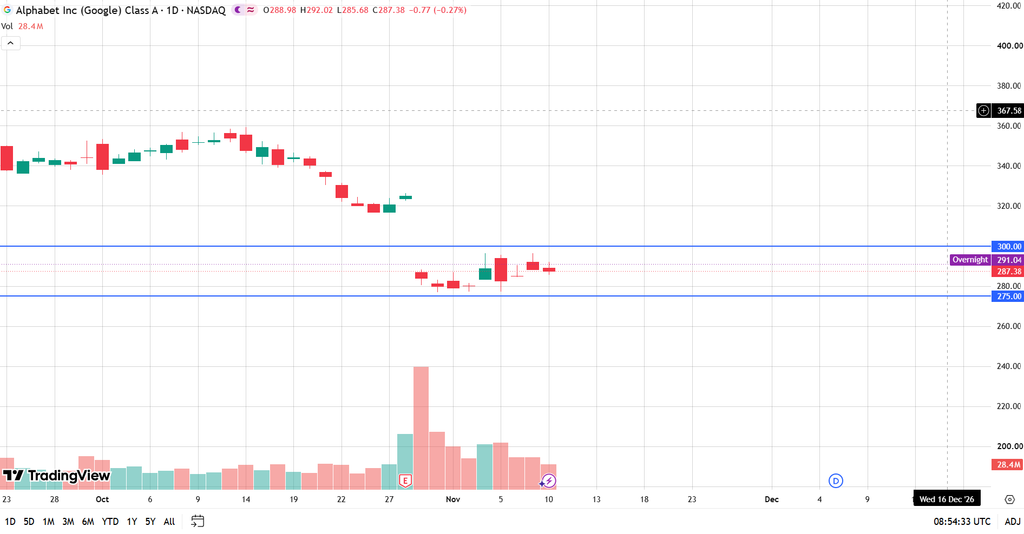
The parent company of Google remains in the spotlight after the sharpest drop in its trading history, and the shares are still struggling to regain lost ground. The research team at Librrova reviews GOOGL, which closed Tuesday near $287, and the levels that could shape the next phase of the recovery.
Where The Stock Stands Today
Before the quarterly report, Alphabet closed at $324.89. The days that followed brought the biggest single-session decline the company has ever recorded, erasing nearly $500 billion of its market value. Around ten days later, the price has regained only about 1.5%, so the shares are still about 11% below that earlier close.
The weak rebound deserves attention. After a drop of this size, many traders assume that bargain hunters will step in fast, but the buying has been timid. This tells us that large investors are not yet ready to assume that the selling has ended.
Growth That Did Not Calm The Market
What makes the episode unusual is the quality of the report. Sales rose by about 25%, marking a thirteenth quarter in a row with double-digit expansion. Revenue at Google Cloud, the unit that rents computing power and AI tools to businesses, more than doubled from a year earlier.
Even so, the market reacted with fear. Expectations had climbed so high that any hint of doubt about the cost and payoff of artificial intelligence was enough to trigger heavy selling. The report became the first visible crack in the enthusiasm that had lifted technology stocks for months, and investors began to ask whether other companies in the sector might face similar reactions.
The cloud numbers are especially relevant, because they show that demand for AI services is turning into real revenue and not only into promises.
For a company with such a large base of customers, growth at this speed is rare, and it explains why many analysts still view the long-term story as intact. The challenge is that the market now wants proof that heavy spending will keep paying off, and a single quarter cannot provide it.
Why Some Investors Remain Optimistic
Those who see a buying chance argue that the business is strong enough to absorb these doubts. They also point to a fresh development: earlier this week, the company showed two new computing systems that run on its own TPU processors, evidence that its technology keeps moving forward.
Another argument is based on proportions. A fall of this magnitude, coming right after such healthy growth, can look exaggerated, and optimists believe that part of it may be reversed once nerves settle. This view does not require the original concerns to disappear. It only requires that the company’s results remain strong enough to outweigh them.
Events That Could Test The Rebound
Several events in the coming days may affect the stock. Nvidia will publish its own quarterly figures on November 17, and the reaction could influence the mood across the whole artificial intelligence sector, including Alphabet.
Other factors are also worth following. Interest rates matter because growth stocks are sensitive to borrowing costs. Energy prices can influence both inflation and the expenses of large data centers. Finally, the growing attention on how data centers are built and powered adds another pressure for companies that invest heavily in this infrastructure.
Support And Resistance Levels
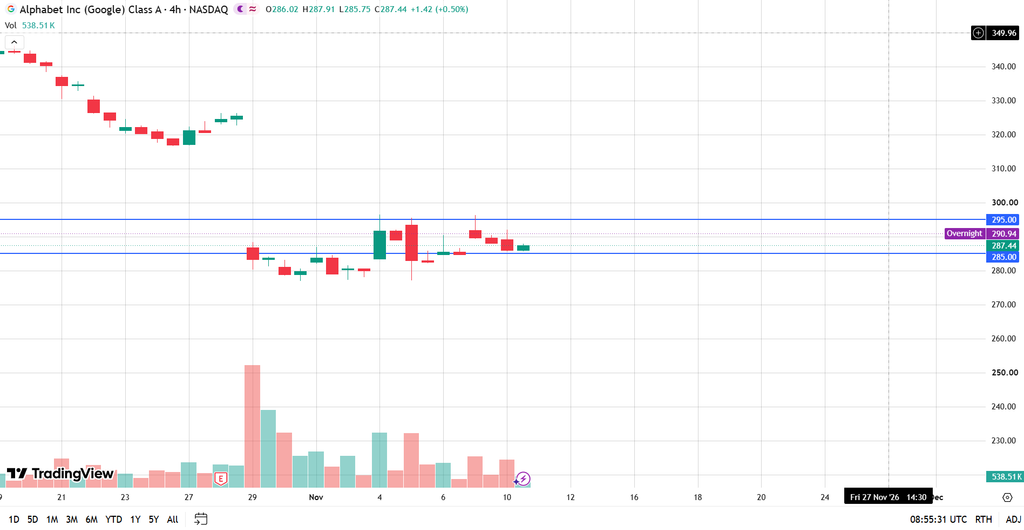
On the upside, the first resistance is $295, a round number close to the current price. Next comes $300, a more important psychological barrier. The big objective is $324.89, the pre-report close. Reaching it would cancel the entire decline, so it is a distant target for now.
On the downside, $285 is the nearest support, followed by $280. The lowest area reached after the report, near $275, is the main floor. A close under it would suggest that sellers are still in control and that the correction may continue.
What Traders Can Do
With a strong company and a hesitant market, a patient approach seems reasonable. Buyers may wait for a daily close over $295 before acting, then look toward $300 with a protective stop-loss below $285. A close above $300 would improve the outlook and could invite a larger move.
Sellers may prefer to wait for a daily close under $285, targeting $280 and later $275. Because the Nvidia report arrives on November 17, volatility could rise before and after that date. Position size should stay moderate, and taking partial profits near each resistance can help protect gains if the rebound loses steam.
Conclusion
Alphabet has regained just a fraction of its record loss, even though its business keeps growing at a fast pace. The $295 and $300 resistances and the $285 and $275 supports are the levels to follow.
Traders following Stocks strategies should watch the Nvidia results, interest rates and the reaction at these levels, since these factors are likely to guide the next move in Alphabet.