
The Indian Rupee (INR) strengthened sharply against the US Dollar (USD) on Wednesday following the previous day’s market holiday, pushing the USD/INR exchange rate toward a fresh six-week low near 96.30. Risance’s brokers provide professional perspectives and in-depth analysis of key issues.
The rally reflects broad-based Dollar weakness, declining expectations of further Federal Reserve (Fed) monetary tightening, and continued Reserve Bank of India (RBI) intervention to stabilise foreign exchange markets.
The US Dollar Index (DXY) traded near 101.77, close to its recent three-week low of 101.50. Weakness reflects reduced demand for Dollar-denominated assets, declining US Treasury yields, and uncertainty surrounding technology-sector valuations.
Although these developments support near-term INR appreciation, persistent external-sector vulnerabilities could constrain sustained gains.
AI Valuation Risks and Fed Repricing Pressure the Dollar
Weakness across US artificial intelligence (AI)-related equities has become a significant driver of Dollar underperformance. Expectations for AI-driven productivity, capital expenditure, and corporate earnings have supported US equity valuations and growth projections.
Renewed technology-sector volatility is prompting investors to reassess these assumptions, increasing the risk of portfolio reallocation and reduced exposure to US assets.
A deeper correction in AI-linked stocks could weaken the Greenback through declining equity inflows, lower growth expectations, and falling Treasury yields. The concentration of market capitalisation in major technology companies also increases the potential for equity-market volatility to affect broader financial conditions.
Scotiabank strategists identify scope for further DXY depreciation as markets reassess near-term Fed tightening risks. Their projected downside region of 100.80–101.30 implies a potential decline of approximately 0.5%–1.0% from 101.77.
Renewed selling in technology stocks could accelerate this adjustment by weakening expectations for US investment and economic growth.
Federal Reserve Expectations Reshape Interest-Rate Differentials
Repricing of Federal Reserve interest-rate expectations has reduced the Dollar’s yield-based support. According to the CME FedWatch Tool, markets increasingly anticipate that the Fed will maintain its current policy rate at its upcoming meeting, reducing expectations of another interest-rate increase.
Short-term interest-rate differentials influence international capital allocation and currency valuations. When expected US policy rates decline, the relative return advantage of Dollar-denominated securities can narrow, reducing demand for the Greenback. Falling US Treasury yields reinforce this mechanism by lowering prospective returns on government debt.
The Dollar’s direction remains sensitive to US inflation, employment data, Treasury yields, and Fed forward guidance. Stronger inflation could revive expectations of monetary tightening and trigger a Dollar recovery, while softer economic indicators could extend the depreciation cycle.
RBI Intervention Supports Rupee Stability
The Reserve Bank of India continues deploying a multi-layered foreign exchange defence strategy to manage Rupee volatility. Measures include spot and forward-market intervention, regulatory adjustments, liquidity management, administrative measures, and efforts to moderate import-related Dollar demand.
These measures address immediate market imbalances and underlying currency pressures. Spot intervention influences near-term supply and demand, while forward transactions can help manage expectations and smooth exchange-rate volatility.
Regulatory and liquidity measures may also reduce speculative positioning and excessive foreign-currency demand.
The RBI prioritises orderly exchange-rate adjustment rather than indefinitely defending a specific exchange-rate level. Its effectiveness depends on foreign-exchange reserves, capital flows, and external shocks.
DBS Group Research maintains a cautious medium-term INR outlook, citing manufacturing competitiveness, uncertain portfolio investment, and sensitivity to crude oil prices.
USD/INR Technical Outlook: Bearish Momentum and Oversold Conditions
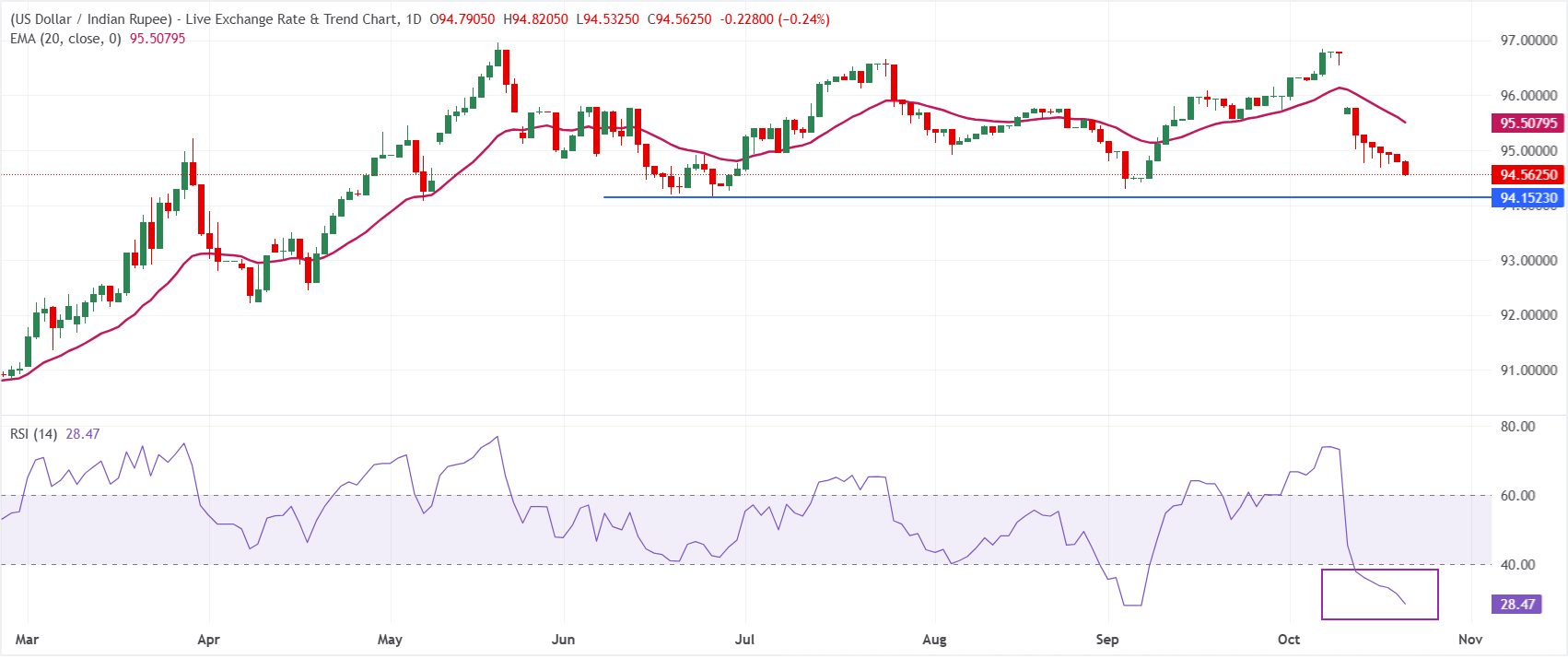
The supplied technical indicators suggest USD/INR remains bearish, trading below its 20-period Exponential Moving Average (EMA) at 95.5079. This positioning indicates a downward short-term trend, with the EMA acting as potential dynamic resistance during corrective rebounds.
The Relative Strength Index (RSI) at 28.47 signals oversold conditions, reflecting substantial selling pressure. An RSI below 30 suggests increased potential for profit-taking or a technical rebound, although it does not independently confirm a trend reversal. Continued selling can sustain oversold readings.
A recovery toward 95.51 would bring the pair into a significant resistance zone, where renewed selling could reinforce bearish momentum. Traders should monitor price stabilisation, emerging support levels, price action, and Treasury yields before establishing directional positions.
The supplied figures contain a market-data discrepancy: the narrative identifies USD/INR near 96.30, while the technical reading is 94.5625. Both levels should be verified against a consistent market feed before informing trading decisions.
Conclusion
The Indian Rupee’s rally reflects US Dollar weakness, reduced expectations of further Fed tightening, volatility in AI-related equities, and continued RBI intervention. The DXY’s proximity to 101.50 and the projected 100.80–101.30 downside region indicate potential for additional Dollar depreciation.
Meanwhile, an RSI below 30 signals stretched USD/INR selling momentum and the possibility of a corrective rebound. The medium-term outlook depends on US interest-rate expectations, foreign portfolio flows, crude oil prices, and RBI policy measures.
Sustained Rupee appreciation will ultimately require supportive global conditions and stronger Indian external-sector fundamentals.