
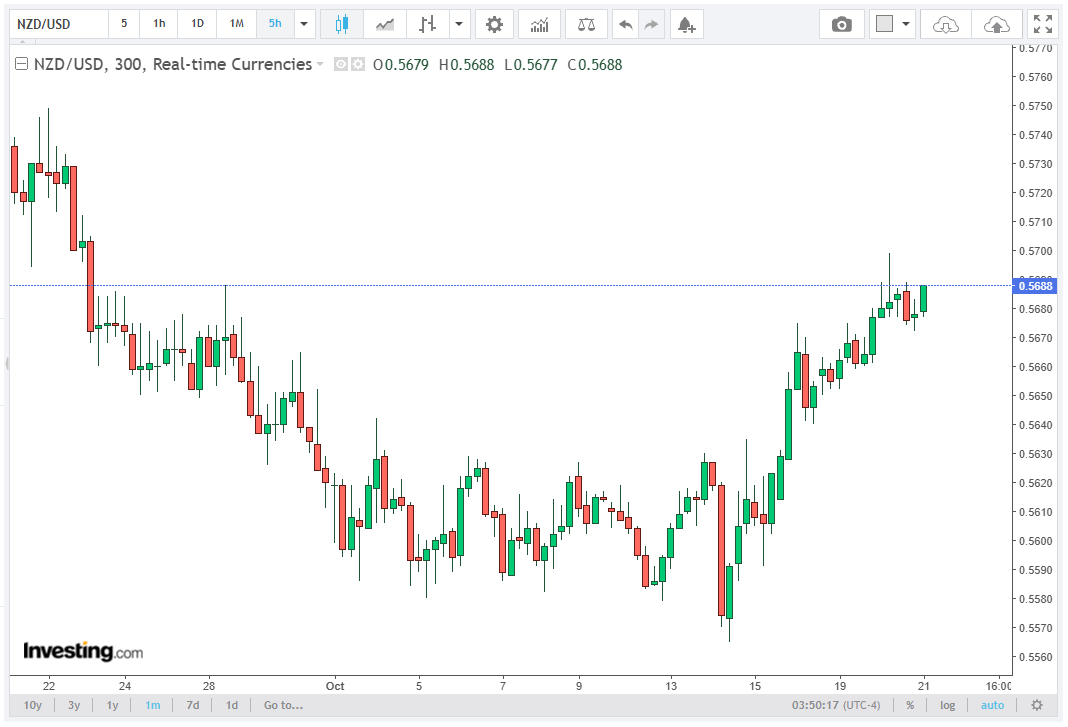
The NZD/USD currency pair declined to approximately 0.5680–0.5681 during Wednesday’s early Asian session, ending its four-session winning streak as traders repositioned ahead of New Zealand’s third-quarter Consumer Price Index (CPI) release. Risance’s team delivers informed insights and a thorough examination of the subject.
The pair remains below the psychologically significant 0.5700 threshold, reflecting technical resistance and uncertainty surrounding the monetary policy outlook in New Zealand and the United States.
Despite increasing expectations of monetary tightening by the Reserve Bank of New Zealand (RBNZ), the New Zealand Dollar has struggled to sustain its recovery against the US Dollar. Investors are assessing whether domestic inflation will justify further rate increases while monitoring the Federal Reserve’s policy trajectory.
The upcoming inflation report represents a critical catalyst for near-term price action, with deviations from forecasts potentially triggering adjustments in currency positioning, interest-rate expectations and market volatility.
CPI Forecasts Indicate Persistent Inflationary Pressures
New Zealand’s annual CPI inflation rate is projected to moderate to 3.8% year-over-year (YoY) from 4.1%, while quarterly inflation is expected to decline to 0.8% quarter-over-quarter (QoQ) from 1.5%. The RBNZ’s projections indicate annual inflation of approximately 3.9% and quarterly inflation of 0.8%.
The anticipated 0.7-percentage-point decline in quarterly inflation would indicate moderating price pressures. Annual inflation at 3.8% would remain 0.8 percentage points above the upper boundary of the RBNZ’s 1%–3% target range, complicating the central bank’s efforts to restore price stability.
A reading below the 0.8% QoQ consensus forecast could weaken near-term rate-hike expectations. An upside surprise, by contrast, could strengthen the Kiwi by increasing the anticipated scale or duration of the RBNZ tightening cycle.
RBNZ Tightening Expectations Support the New Zealand Dollar
Interest-rate derivatives indicate an approximately 80% probability of a 25-basis-point RBNZ rate increase, which would lift the official cash rate to 3.00% at the forthcoming policy meeting. This pricing reflects concerns that inflation could remain above target despite previous monetary tightening.
RBNZ Chief Economist Paul Conway has highlighted upside risks to the fourth-quarter inflation outlook, particularly from oil prices and currency movements. His assessment suggests that the balance of risks may favor higher interest rates, although the final policy decision remains data-dependent.
With approximately 80% of a 25-basis-point increase already priced in, an anticipated hike may generate limited additional appreciation. A more hawkish policy statement or indications of further tightening could provide stronger support, while weaker CPI data could reduce rate-hike expectations and increase downside exposure.
Federal Reserve Policy Expectations Influence USD Performance
The US Dollar remains sensitive to expectations for the Federal Reserve’s federal funds rate. Recent remarks from Fed Chair Kevin Warsh prompted traders to reduce expectations of an immediate rate increase while leaving subsequent tightening possible.
Warsh emphasized investment growth, artificial intelligence-driven economic activity, and price stability, maintaining a cautious policy stance without committing the Federal Open Market Committee (FOMC) to a predetermined decision.
Market estimates indicate an 83.9% probability of the Federal Reserve holding rates unchanged at its next meeting, compared with approximately 90% odds of a rate increase in December. These expectations point to near-term policy stability followed by potentially tighter monetary conditions.
Technical Analysis: Resistance at 0.5691 Limits Recovery
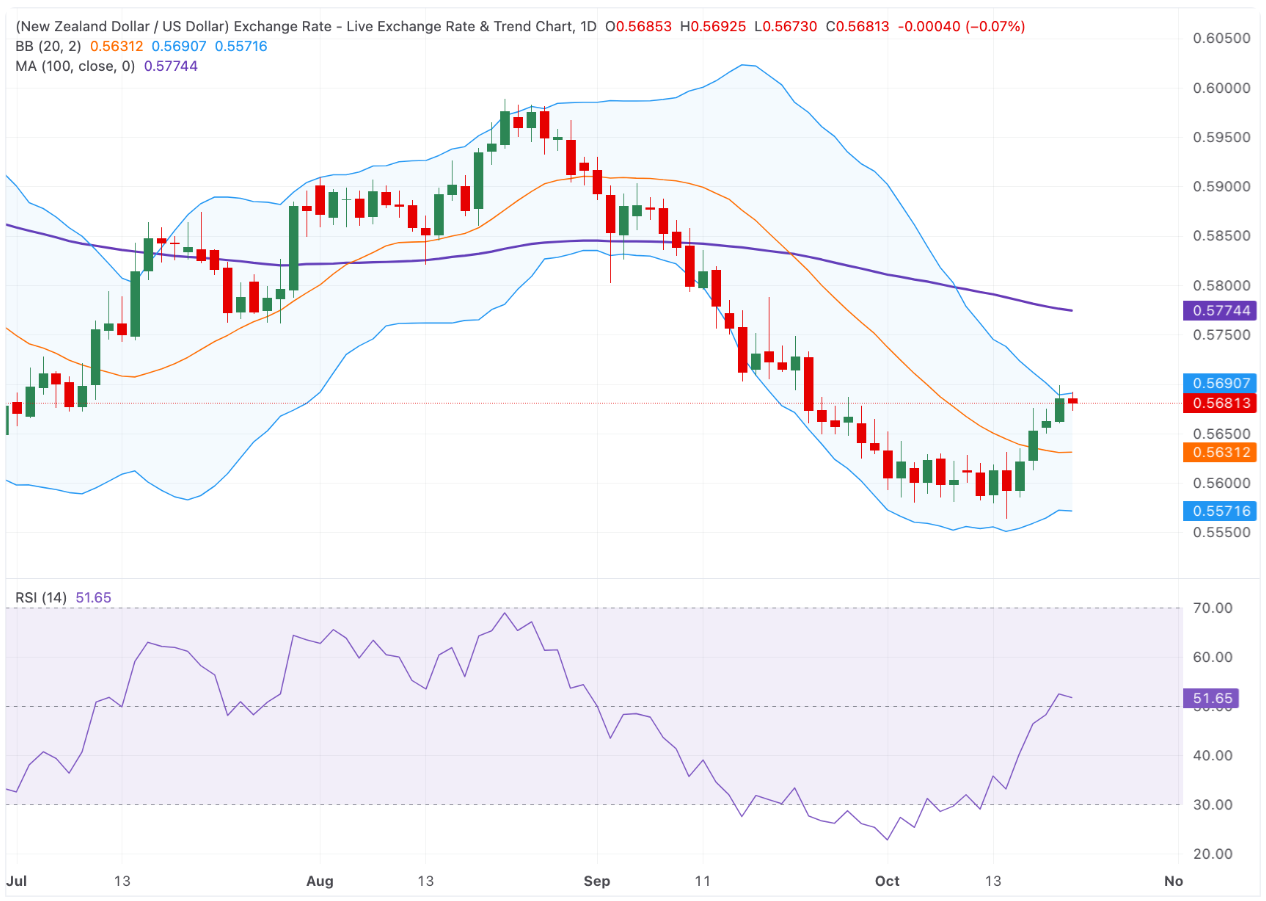
The daily chart indicates that NZD/USD retains a bearish near-term bias, trading below its 100-day simple moving average (SMA) at 0.5774 and the upper Bollinger Band at 0.5691.
A sustained break above 0.5691 could expose the 0.5774 moving-average resistance. A decisive daily close above the 100-day SMA would weaken the bearish structure and improve prospects for an extended recovery.
On the downside, the middle Bollinger Band at 0.5631 provides initial support. A daily close below this level could expose the lower Bollinger Band at 0.5572, approximately 1.9% below the 0.5681 reference price.
The Relative Strength Index (RSI) at 51.7 remains close to its neutral midpoint of 50, indicating stabilizing momentum without confirming a bullish reversal. An RSI decline below 50 would strengthen the bearish signal, while a sustained move above 60 would indicate improving buying pressure.
Conclusion
The New Zealand Dollar remains vulnerable below 0.5700, despite an approximately 80% probability of an RBNZ rate increase to 3.00%. The projected 3.8% annual CPI inflation rate and 0.8% quarterly increase will help determine whether tightening expectations strengthen or unwind.
Persistent inflation and rising oil prices could support the Kiwi, while weaker data could trigger renewed selling. Technically, 0.5691 and 0.5774 define resistance, while 0.5631 and 0.5572 mark key support levels. The near-term direction will depend on inflation surprises, central bank expectations, US Dollar performance, and technical momentum.