
The USD/CHF exchange rate weakened toward 0.8240 during Asian trading, as declining expectations of further Federal Reserve (Fed) monetary tightening undermined demand for the US Dollar (USD).
This article offers a clear explanation of the topic from Fonndure’s brokerage team.
Despite opening with a bullish price gap, the pair failed to sustain its upward momentum, reflecting a deterioration in short-term dollar sentiment and increased selling pressure near intraday resistance.
The primary fundamental driver is the repricing of US interest-rate expectations following neutral policy guidance from Federal Reserve Chair Kevin Warsh. His comments emphasized a data-dependent approach to monetary policy without signaling an imminent rate increase.
According to the CME FedWatch Tool, markets now assign an 83.9% probability to the Federal Reserve maintaining its current policy rate at its upcoming meeting, compared with 49% approximately one month earlier. The 34.9-percentage-point increase in the probability of a rate pause represents a significant adjustment in market pricing.
Swiss National Bank Policy and Carry-Trade Dynamics
The Swiss National Bank (SNB) is widely expected to maintain its policy rate at 0% through year-end, preserving Switzerland‘s position as a low-interest-rate funding jurisdiction.
This monetary configuration supports the franc’s structural role in carry-trade strategies, whereby investors borrow in low-yielding currencies and allocate capital to higher-yielding assets.
The profitability of a carry trade depends on the interest-rate differential, transaction costs, and exchange-rate movements. When the franc serves as the funding currency, investors may benefit from the difference between Swiss borrowing costs and foreign investment yields.
A substantial appreciation of the franc can erode these returns by increasing the cost of repaying franc-denominated liabilities. The current decline in USD/CHF illustrates the interaction between relative monetary policy expectations and currency valuation.
Although the SNB’s 0% policy rate provides an incentive to fund positions in francs, falling expectations for US monetary tightening reduce the prospective yield advantage of dollar assets. This combination can support CHF appreciation even when Swiss interest rates remain exceptionally low.
UOB Technical Outlook: 0.8200 in Focus
UOB Group has identified a strengthening bearish bias in USD/CHF, with the pair’s decline accelerating beyond its previous short-term projections.
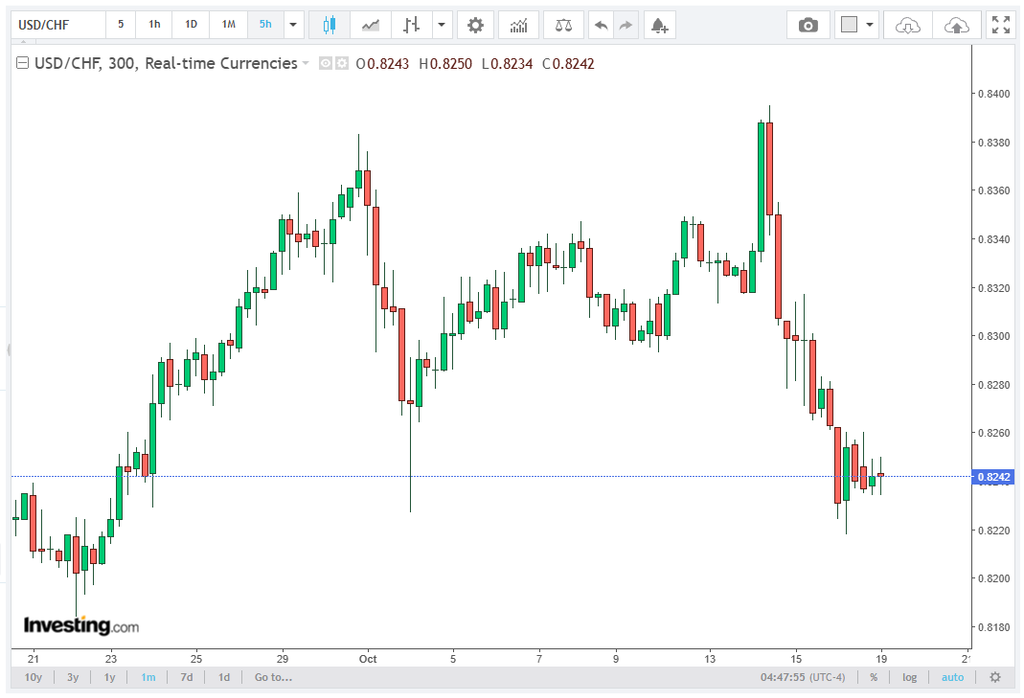
The break below 0.8245 validated the initial downside scenario toward 0.8225, while subsequent price action extended the decline to 0.8215 before the pair closed near 0.8239, recording a session loss of approximately 0.34%.
UOB now identifies 0.8200 as the next potential downside objective, while 0.8300 represents strong resistance. The difference between the current exchange rate near 0.8240 and the downside target is approximately 40 pips, assuming the conventional four-decimal quotation used for USD/CHF.
A sustained move below 0.8215 would reinforce the bearish structure and increase the probability of a test of the 0.8200 psychological support level. A failure to break lower, by contrast, could trigger short-covering and a corrective rebound toward 0.8280–0.8300.
Moving Averages and Momentum Indicators
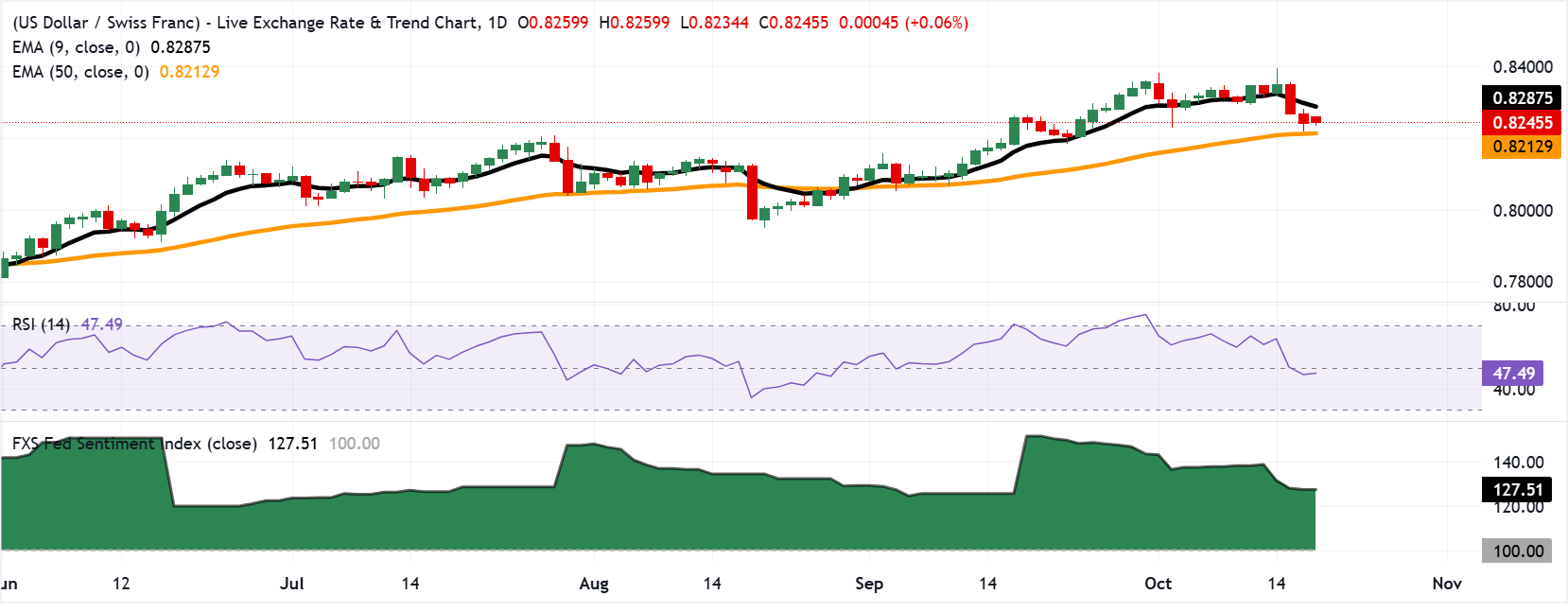
On the daily chart, USD/CHF trades near 0.8240, positioned below the nine-day Exponential Moving Average (EMA) at 0.8288 but above the 50-day EMA at 0.8213. This configuration indicates that short-term momentum has weakened, while the medium-term price structure retains a nearby technical support reference.
The distance between spot and the nine-day EMA is approximately 48 pips, suggesting that the exchange rate remains under pressure from recent selling activity. Meanwhile, the 50-day EMA is approximately 27 pips below spot, creating a critical technical level for assessing whether the pullback develops into a broader bearish continuation.
The 14-day Relative Strength Index (RSI) stands near 47, below the neutral threshold of 50. This reading indicates modest bearish momentum rather than an established oversold condition.
A further decline in the RSI alongside a break beneath 0.8213 would strengthen downside confirmation, particularly if accompanied by expanding trading volume and persistent dollar weakness.
On the upside, a daily close above 0.8288 would signal a recovery above the short-term EMA. A subsequent break through 0.8300 would weaken the immediate bearish bias and potentially shift the technical structure toward consolidation or recovery.
Conclusion
The USD/CHF outlook remains tilted to the downside as an 83.9% market-implied probability of a Federal Reserve rate pause reduces expectations for additional US monetary tightening.
The repricing of interest-rate differentials, combined with the franc’s established role as a low-cost funding currency, provides a fundamental basis for continued CHF strength. Technically, 0.8213 is the key initial support, followed by 0.8200, while 0.8288 and 0.8300 define the immediate resistance zone.
A decisive break below support would strengthen the bearish outlook, whereas a recovery above resistance would indicate diminishing selling pressure.
The next directional move will depend on US economic data, Federal Reserve guidance, SNB policy expectations, and changes in global capital allocation.