
The EUR/JPY cross trades near 177.70, down modestly during early European trading, as the pair remains capped below the 178.00 psychological threshold. The article offers an in-depth look at this topic, explained by Risance’s brokers.
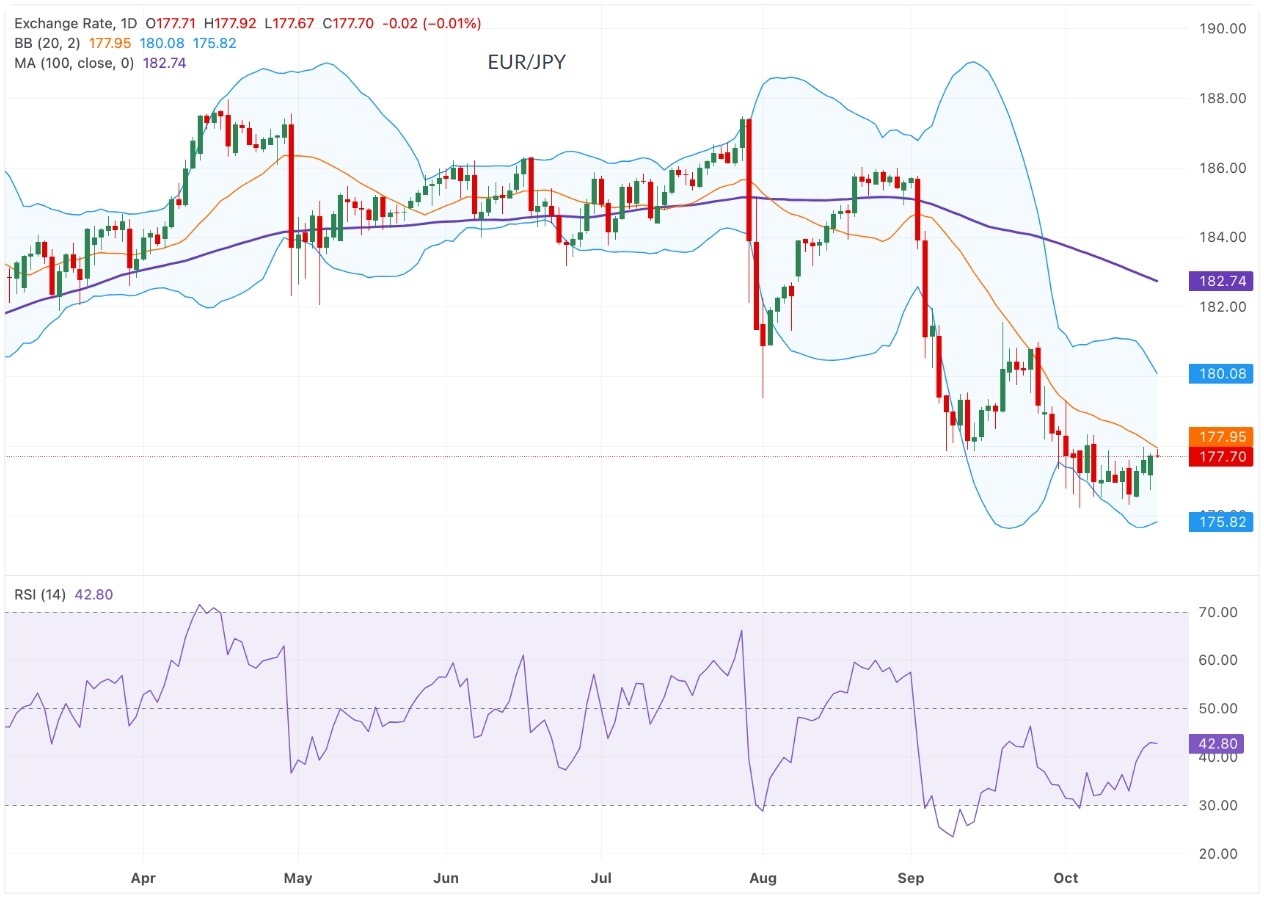
The short-term technical structure continues to favor sellers, with the exchange rate trading beneath its 20-period Bollinger Bands simple moving average (SMA) and the significantly higher 100-day SMA at 182.75. Weak momentum, European political uncertainty, and a cautiously hawkish Bank of Japan (BoJ) outlook reinforce the downside bias.
The Euro faces pressure amid renewed political instability in France following widespread riots and looting. Curfews imposed in selected urban areas have heightened concerns about public order and the broader political environment.
The euro may see increased volatility as German and Eurozone sentiment data and ECB official José Luis Escrivá’s comments shape monetary policy expectations.
BoJ Policy Expectations Provide Fundamental Support for the Yen
The Japanese Yen retains a potential fundamental advantage as BoJ officials signal reduced reluctance toward additional interest-rate increases. Policymaker Junko Koeda has emphasized the significance of persistent upside inflation risks, while Governor Kazuo Ueda has indicated that underlying inflation is approaching the central bank’s 2% target.
Robust global demand associated with artificial intelligence investment, a tight domestic labor market, and sustained capital expenditure could reinforce inflationary pressures. These factors support expectations of gradual monetary policy normalization, potentially increasing the relative attractiveness of Yen-denominated assets.
For EUR/JPY, the critical variable is the relative interest-rate outlook between Japan and the Eurozone. A narrowing yield differential, particularly if Japanese yields rise relative to European yields, could reduce the appeal of carry trades funded through the Yen.
Technical Analysis: EUR/JPY Remains Bearish Below Key Moving Averages
The daily chart maintains a bearish technical configuration, with EUR/JPY trading below the 20-period Bollinger SMA and the 100-day SMA at 182.75. The separation between the current price near 177.70 and the 100-day average highlights the persistence of the broader downside structure.
The 14-period Relative Strength Index (RSI) stands at 42.80, below the neutral 50.00 threshold. This reading indicates negative momentum, although the indicator remains above the conventional oversold level of 30.00.
The absence of an oversold signal suggests that bearish pressure could extend further without necessarily requiring an immediate technical rebound.
Price action beneath the middle Bollinger Band also indicates that rallies remain vulnerable to selling pressure. A sustained recovery above the moving average would be necessary to improve the short-term momentum profile, while a break below established support could confirm renewed downside continuation.
Downside Levels: 176.52 and 175.80
The initial downside objective is 176.52, corresponding to the October 15 swing low. Relative to the current price of 177.70, this level represents a potential decline of approximately 118 pips, using the standard EUR/JPY convention of one pip equaling 0.01 yen.
A decisive daily close below 176.52 would strengthen the bearish continuation signal and expose the lower Bollinger Band near 175.80. This secondary support lies approximately 190 pips below 177.70 and could act as a potential area for short-covering or temporary consolidation.
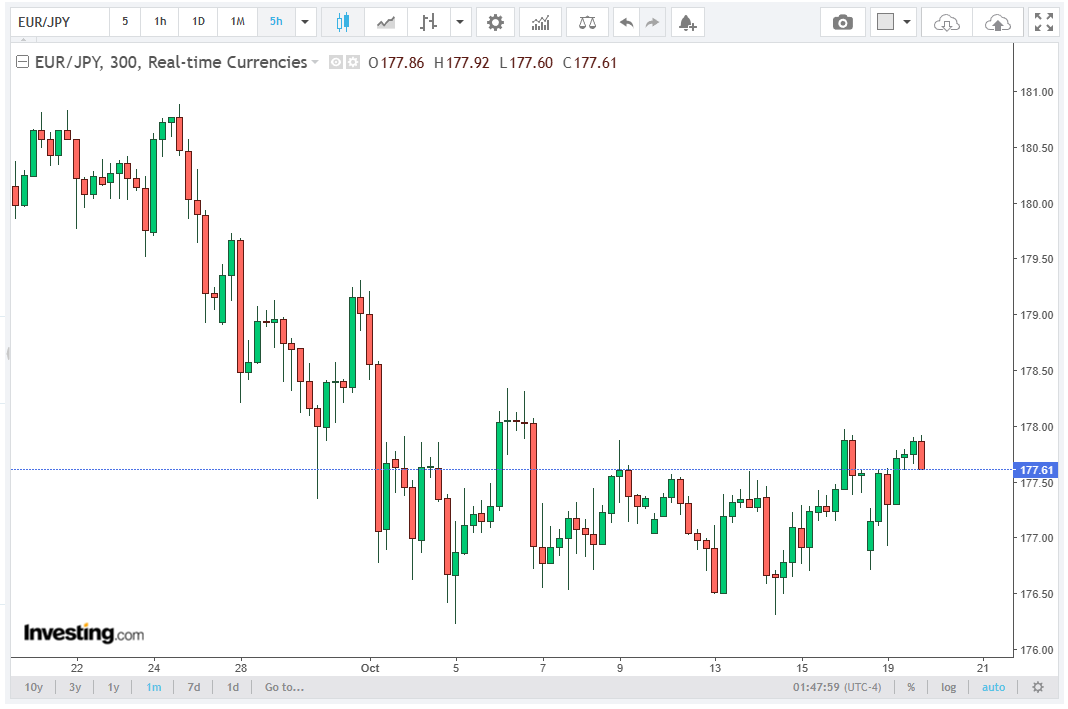
A break beneath 175.80 would indicate further deterioration in the technical structure, although additional confirmation from momentum and subsequent price action would be needed before assessing the likelihood of an extended decline. Failure to breach 176.52, meanwhile, could leave the pair vulnerable to range-bound trading.
Resistance Levels: 178.00, 180.10 and 182.75
Immediate resistance is concentrated in the 177.95–178.00 zone, where the 20-period Bollinger SMA converges with the psychological price barrier. The zone is approximately 25–30 pips above 177.70, making it the first level bulls must reclaim to weaken immediate selling pressure.
A sustained move above 178.00 could open the way toward 180.10, the upper Bollinger Band. This represents a potential recovery of approximately 240 pips from the current market level and would indicate a more substantial corrective advance.
The principal trend-defining resistance remains the 100-day SMA at 182.75, approximately 505 pips above 177.70. A decisive break above this moving average would be required to materially reduce the broader bearish bias. Until then, rallies toward intermediate resistance levels may attract renewed selling interest.
Conclusion
The EUR/JPY outlook remains bearish below 178.00, with the exchange rate trading beneath its 20-period Bollinger SMA and 100-day SMA at 182.75. The RSI at 42.80 confirms subdued momentum without signaling oversold conditions.
A break below 176.52 would expose 175.80, while resistance at 178.00 and 180.10 defines the principal recovery barriers. The broader bearish structure remains intact unless buyers establish sustained acceptance above key moving averages.
Incoming Eurozone data, BoJ policy signals, and changes in relative bond yields will remain important catalysts for the pair’s next directional move.