
The Indian Rupee (INR) opened on a firm footing against the US Dollar (USD) on Tuesday, reflecting a combination of supportive domestic and global macroeconomic triggers. The USD/INR pair traded lower around 94.58, extending its recent corrective move as improving risk sentiment and declining crude oil prices continued to underpin the domestic currency. In this article, Rubizio brokers present a detailed and easy-to-understand overview of the subject.
Overall, the Rupee’s resilience is being driven by a convergence of factors, including lower global oil prices, improving Foreign Institutional Investors (FIIs) inflows, and expectations of a steady stance from the US Federal Reserve (Fed) in its upcoming policy decision.
Oil Price Softness Supports INR Outlook
One of the key drivers behind the Rupee’s strength is the recent moderation in crude oil prices, which has eased pressure on India’s external account.
The MCX Crude Oil contract expiring on June 18 rose marginally to around ₹7,640, but remained close to its recent eight-week low of ₹7,550. This subdued oil price environment is particularly supportive for India, given the country’s heavy reliance on energy imports.
Currencies of oil-importing economies like India tend to perform better when global crude prices decline, as it reduces the import bill, improves the current account balance, and strengthens overall macroeconomic stability.
US–Iran Peace Deal Eases Geopolitical Risk Premium
A major catalyst behind the decline in oil prices has been geopolitical de-escalation in the Middle East. On Monday, the US administration announced a peace agreement with Iran, alongside the reported reopening of the Strait of Hormuz, a critical global oil transit route.
According to the announcement, Iran has agreed to halt nuclear weapon ambitions, although market participants remain cautious and are awaiting detailed implementation clarity.
The reopening of the Strait of Hormuz has significantly reduced fears of supply disruption, thereby easing the geopolitical risk premium embedded in crude oil prices. If normal shipping flows continue, oil prices are likely to remain capped, which in turn provides sustained support to the Indian Rupee.
FIIs Return as Net Buyers Boost Market Sentiment
Another important supportive factor for the INR has been the shift in the behaviour of Foreign Institutional Investors (FIIs) in the Indian equity markets.
After a period of sustained selling pressure, during which FIIs offloaded equities worth approximately ₹46,430 crore in the first half of June, foreign investors turned net buyers on Monday, purchasing shares worth around ₹200 crore.
This reversal in flows signals improving confidence in Indian financial assets, driven by a broader global risk-on sentiment following easing geopolitical tensions. Stronger FII inflows typically support the Rupee through increased foreign currency conversion into INR, enhancing demand for the domestic currency.
The return of foreign capital also reflects a renewed appetite for emerging market equities, with India remaining a key beneficiary due to its strong growth outlook and relative macroeconomic stability.
Market Awaits Federal Reserve Policy Decision
On the global macroeconomic front, investor attention is firmly focused on the Federal Reserve’s upcoming monetary policy meeting on Wednesday.
Market expectations, as reflected in the CME FedWatch Tool, indicate near certainty that the Fed will maintain interest rates in the 3.50%–3.75% range, signaling a pause in the tightening cycle.
While no immediate policy shift is expected, traders will closely analyze the forward guidance, particularly under the leadership of new Fed Chairman Kevin Warsh. His policy tone, inflation outlook, and growth projections will be critical in shaping the direction of the US dollar.
USD/INR Technical Analysis: Bearish Bias Persists
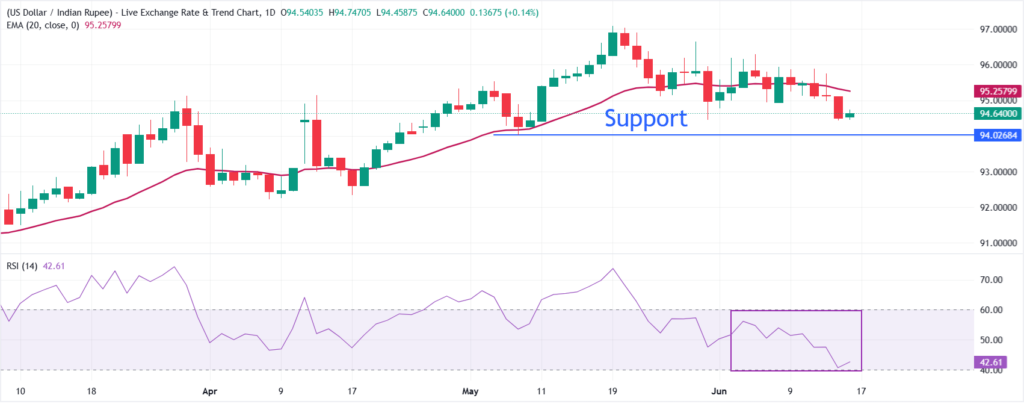
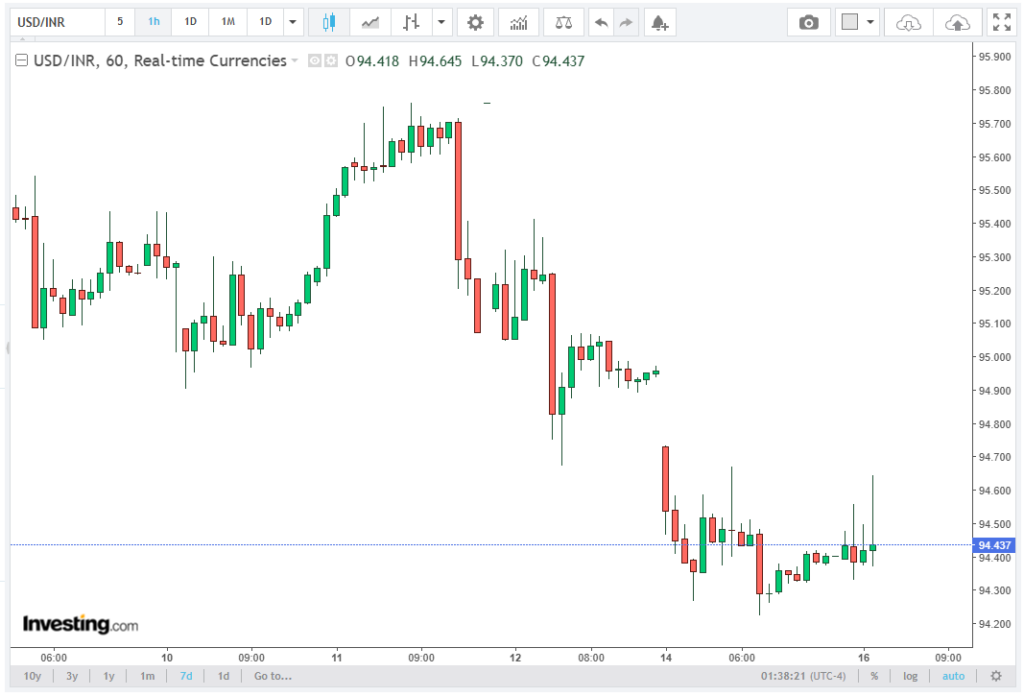
From a technical perspective, the USD/INR pair continues to exhibit a weak short-term structure, trading near 94.58 and extending its corrective phase below key resistance levels.
The pair remains below its 20-day Exponential Moving Average (EMA) positioned at 95.26, which now acts as an immediate resistance barrier. This suggests that the near-term bias remains tilted towards the downside unless a strong breakout occurs above this level.
The Relative Strength Index (RSI) stands at 42.6, remaining below the neutral 50 mark. This indicates waning bullish momentum and reinforces the view that sellers continue to dominate short-term price action.
Conclusion: INR Supported by Macro and Flow-Driven Tailwinds
The Indian Rupee’s recent strength is underpinned by a powerful combination of favorable global energy dynamics, improving foreign investor sentiment, and expectations of a steady US monetary policy stance.
While near-term volatility may persist ahead of the Fed decision, the broader outlook for the Rupee remains constructive as long as oil prices stay subdued and FII inflows continue to stabilize or improve.
In the near term, the USD/INR pair is likely to remain range-bound with a mild bearish bias, closely tracking global risk sentiment and macroeconomic policy cues from the United States.