
The GBP/USD exchange rate continues to trade in a narrow consolidation band, currently fluctuating around 1.3400 with intraday prints near 1.3410. Price action remains structurally confined within a 1.3300–1.3500 range, reflecting a prolonged phase of volatility compression and directional indecision. The brokers at Marbrisse present a thorough and easy-to-follow overview of the subject in this article.
Macro Drivers: Policy Expectations and Risk Uncertainty
Monetary policy divergence between the US Federal Reserve and the Bank of England remains the key macro driver, with both expected to keep interest rates unchanged (Fed: 5.25%–5.50%, BoE: 5.00%).
Markets are increasingly pricing potential Fed policy easing over the next 6–12 months, which is capping the US dollar upside but not triggering a sustained decline, keeping GBP/USD range-bound in consolidation.
In the UK, BoE forward guidance, especially voting splits and meeting minutes, will be critical for shaping expectations around future rate cuts.
Geopolitical risks have eased modestly but remain in the background, sustaining safe-haven demand for USD and continuing to limit GBP/USD upside momentum and volatility expansion.
Price Structure: Range-Bound with Defined Boundaries
From a technical perspective, GBP/USD remains firmly within a multi-week consolidation channel, bounded by 1.3300 support and 1.3500 resistance, representing a range width of approximately 200 pips.
Spot price at 1.3410 sits almost exactly at the 50% Fibonacci midpoint of the recent swing structure, reinforcing the notion of mean reversion behavior rather than trending price discovery.
Volatility metrics confirm this compression phase. The Average True Range (ATR 14-day) has declined toward approximately 65–75 pips, significantly below its 3-month average, indicating low realized volatility conditions and increasing probability of a future volatility expansion event.
Momentum Indicators: Neutral Drift with Weak Bias
Short-term momentum remains unconvincing. On the 4-hour timeframe, the Relative Strength Index (RSI 14) is fluctuating around 48–52, indicating a strictly neutral momentum regime with no persistent overbought or oversold conditions.
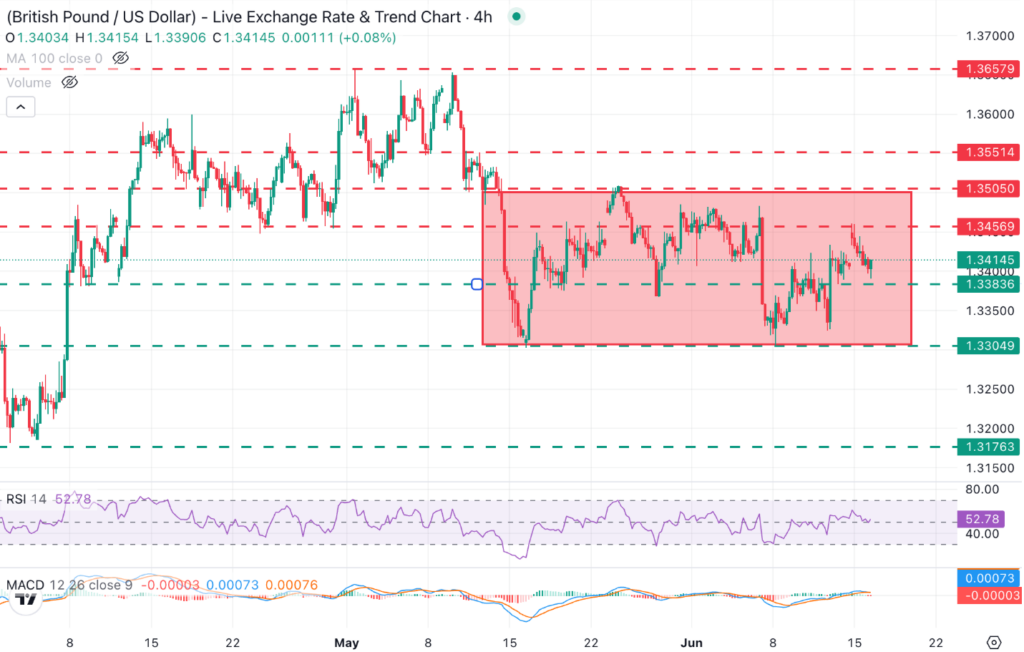
Meanwhile, the MACD histogram is hovering slightly below the zero line, with a marginally negative spread between signal and MACD lines. This reflects a subtle bearish bias within an overall neutral structure, but without sufficient divergence to signal breakdown conditions.
The absence of strong directional momentum aligns with the broader range-trading regime, where oscillators tend to revert around midline thresholds rather than sustain trending behavior.
Resistance Structure: Key Levels at 1.3485–1.3550
On the upside, initial resistance remains defined at 1.3460, where recent intraday rejection occurred following a failed breakout attempt. However, the more structurally significant resistance zone lies between 1.3485 and 1.3505, which has repeatedly capped price advances since mid-May.
This zone represents a high-density order supply region, where repeated failures suggest the presence of systematic selling interest or profit-taking liquidity clusters.
A sustained breakout above 1.3500, particularly on a daily closing basis, would shift short-term structure toward bullish expansion, exposing the next technical objective at 1.3550, corresponding to the previous swing high region.
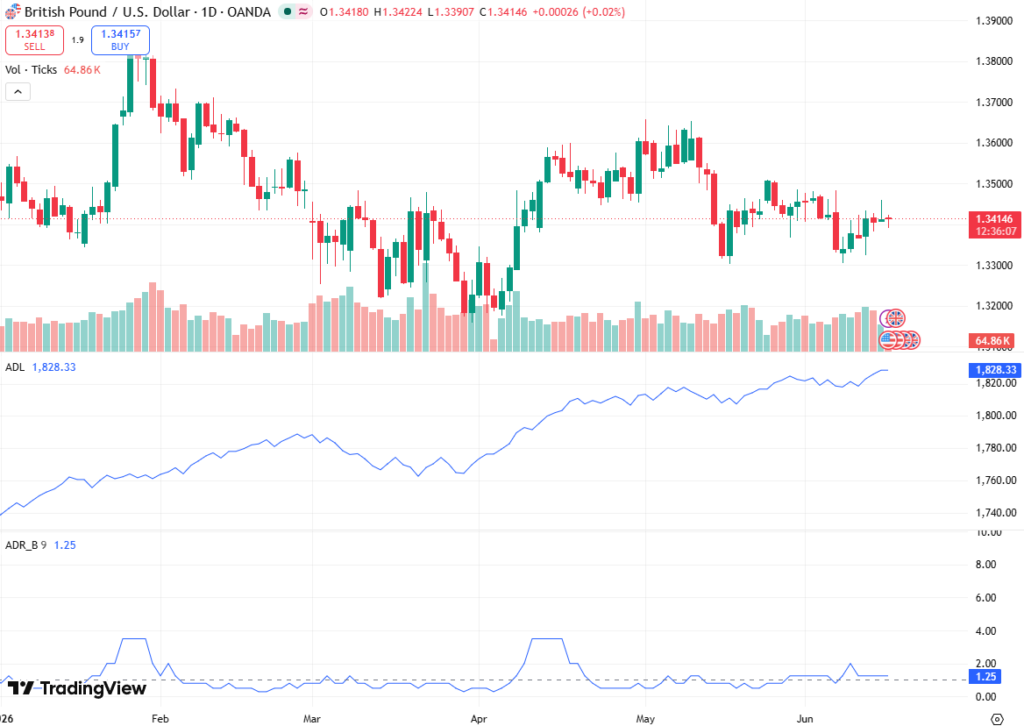
Beyond this, extension projections open toward 1.3600, although such a move would require a clear fundamental catalyst aligned with USD weakness and GBP strength simultaneously.
Support Structure: 1.3380 and 1.3300 Critical Levels
On the downside, immediate support is observed at 1.3380, representing the most recent intraday swing low and a short-term liquidity reference point.
Below this, the primary structural floor remains at 1.3300, a level tested multiple times, including lows recorded on May 18 and June 8. This zone functions as a high-timeframe demand area, where historical buying interest has repeatedly emerged.
A decisive breakdown below 1.3300 would represent a significant structural shift from consolidation to bearish continuation, potentially triggering stops and exposing the next downside liquidity cluster around 1.3250, followed by a deeper technical target near 1.3170, which aligns with prior lows from late March to early April.
Conclusion: Neutral Regime with Event-Driven Breakout Risk
Overall, GBP/USD remains in a clearly defined neutral consolidation regime, with price action anchored between 1.3300 and 1.3500 and centered around the 1.3400 equilibrium zone.
Technical indicators continue to confirm range-bound behavior, with RSI near 50, MACD marginally negative, and ATR suppressed. Meanwhile, macro drivers are dominated by central bank policy expectations and geopolitical uncertainty, both of which are currently insufficient to break the existing structure.
The market remains in a pre-breakout state, where directional conviction is absent but latent volatility risk is elevated. A sustained move outside 1.3300–1.3500 will be required to establish a new trend phase, with upside requiring a break above 1.3500–1.3550, and downside triggered by a failure of 1.3300 support.
Until then, GBP/USD is expected to continue exhibiting range-bound, mean-reverting price behavior centered around 1.3400.