
The NZD/USD pair is sustaining a modest recovery above the 0.5600 handle, supported by a broad-based US Dollar (USD) correction and reduced expectations of aggressive Federal Reserve (Fed) tightening. The brokers at Fonndure break down this topic in detail, offering valuable insights throughout the article.
Price action remains confined within a tight consolidation structure, reflecting positioning uncertainty ahead of the upcoming US Non-Farm Payrolls (NFP) release.
Spot is stabilizing after recent downside exhaustion, with the pair attempting to build a short-term base between 0.5580 and 0.5650, while broader volatility remains suppressed as traders await macro confirmation from US labor data.
US Dollar Index Weakness and Rate Repricing
The US Dollar Index (DXY) trades near 101.35, easing from 101.80, marking a 0.45% correction from the cycle high. The pullback reflects recalibration in US rate expectations, with derivatives pricing showing reduced terminal hawkish positioning.
Market-implied probability of at least two additional rate hikes has declined from 50.2% to 41.7%, an 8.5 percentage point drop, indicating a shift in forward rate expectations. This repricing has reduced USD momentum across G10 currencies, including the NZD.
Despite this, the USD remains supported above the 101.00 threshold, suggesting a retracement rather than a trend reversal move.
JPY Correlation and USD Broad Softness
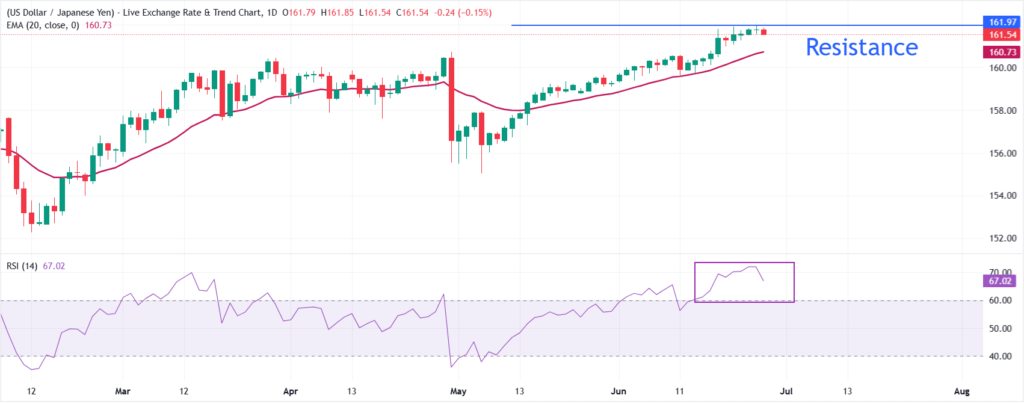
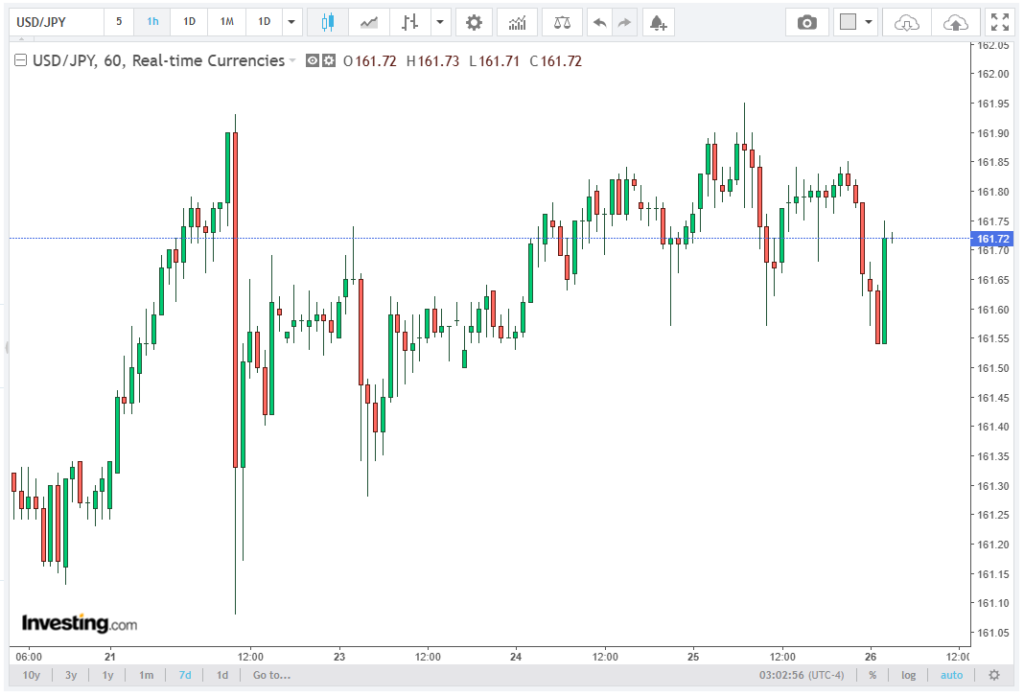
The USD/JPY pair trading near 161.55, down from recent highs above 162.00, reinforces the broader USD correction narrative. Price rejection at the 162.00 resistance zone highlights exhaustion in USD bullish momentum at higher yields.
Simultaneously, expectations of continued policy normalization from the Bank of Japan (BoJ) are supporting JPY appreciation bias, with market pricing increasingly reflecting a gradual shift toward higher Japanese policy rates over the medium term.
This cross-currency dynamic contributes to a generalized USD weakening impulse, which indirectly supports NZD/USD stabilization above 0.5600.
NZD/USD Technical Structure
From a technical perspective, NZD/USD remains in a corrective recovery phase after extending losses toward the 0.5480–0.5520 demand zone. The current rebound has reclaimed the 0.5600 pivot level, which acts as a short-term equilibrium point.
Price action is oscillating above the 20-period exponential moving average (EMA) on intraday frameworks, located near 0.5595–0.5605, indicating marginal bullish control in the near term. Upside progress remains capped by layered supply zones between 0.5650 and 0.5685, where repeated rejection signals persist overhead liquidity.
Momentum indicators show recovery strength but not trend confirmation. The Relative Strength Index (RSI) is estimated in the 55–60 range, recovering from oversold conditions near 40–45 earlier in the cycle. This reflects improving momentum but remains below breakout thresholds associated with sustained bullish continuation (65–70).
Volatility Compression and Range Formation
NZD/USD volatility has contracted significantly, with intraday ranges narrowing to approximately 40–70 pips, compared to prior expansions above 100–120 pips during USD trend phases. This compression signals a market indecision phase, typically observed ahead of high-impact macro catalysts such as NFP.
The pair is effectively forming a short-term consolidation band between 0.5580 and 0.5650, with breakout probability increasing as volatility builds toward the data release.
Support and Resistance Mapping
Immediate support remains anchored at 0.5600, which aligns with both psychological positioning and short-term moving average confluence. A sustained breakdown below this level would expose 0.5580, followed by a deeper liquidity zone near 0.5520, where previous demand absorption occurred.
On the upside, initial resistance is concentrated at 0.5650, with stronger supply layers extending toward 0.5680–0.5700. A clean breakout above 0.5700 would be required to re-establish a medium-term bullish structure and open the path toward the 0.5750–0.5800 zone.
NFP Sensitivity and Catalyst Risk
The upcoming US Non-Farm Payrolls (NFP) print represents the primary directional catalyst for NZD/USD. Market sensitivity is elevated due to its direct impact on Fed policy repricing, USD liquidity conditions, and yield curve expectations.
A stronger-than-expected labor print would likely reinforce USD demand, potentially driving NZD/USD back below the 0.5600 support cluster, with downside extension toward 0.5550 and 0.5520.
Conversely, a softer labor outcome would accelerate USD correction dynamics, potentially enabling a breakout above 0.5650 and extending recovery momentum toward higher resistance bands.
Conclusion
NZD/USD remains in a technically constructive but fragile recovery phase above 0.5600, driven primarily by a US Dollar correction from 101.80 toward 101.35 and a measurable decline in Fed rate hike expectations from 50.2% to 41.7%.
However, the structure remains range-bound rather than trending, with key resistance between 0.5650 and 0.5700 limiting upside extension. The market is effectively in pre-NFP equilibrium, where directional conviction is suppressed until US labor data provides a volatility trigger.
Overall bias remains mildly bullish above 0.5600, but confirmation of trend continuation requires a break above 0.5700 or a decisive macro-driven USD breakdown post-NFP.