
Cheap stocks are getting harder to find. Four years into the AI bull market, the S&P 500 now trades at a price-to-earnings ratio of 27, and on a CAPE-ratio basis, the index is as expensive as it’s ever been outside the dot-com bubble.
The Nasdaq-100 is pricier still, sitting at a P/E of 34. Brokers from Byronixel went looking for exceptions to that trend and found two large-cap names trading like the market has already given up on them.
Netflix: Down 41%, But the Moat Looks Fully Intact
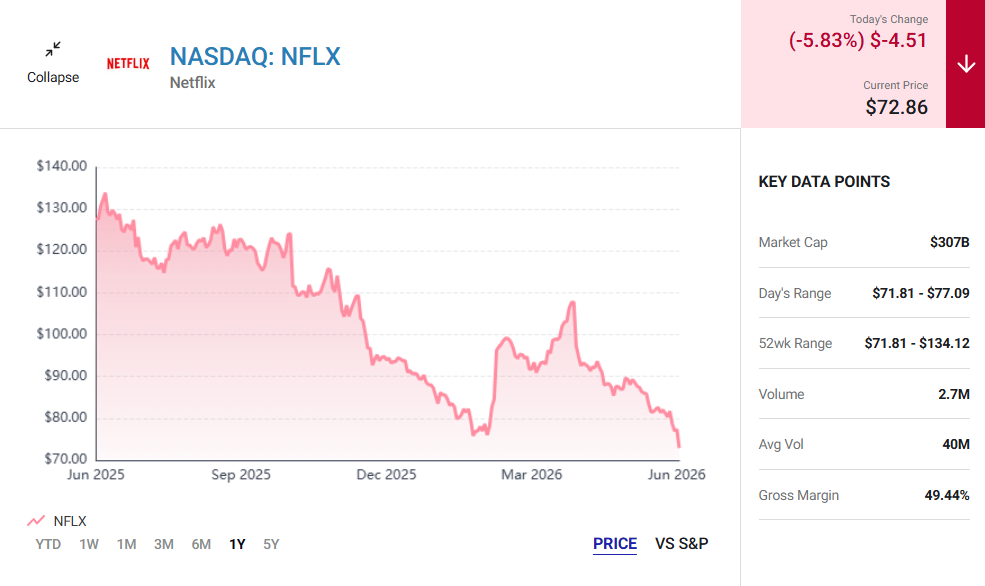
Netflix (NFLX) built the streaming category from scratch, and it’s been one of the best-performing stocks of the century because of it. That history hasn’t stopped the stock from falling 41% over the past year.
Part of the slide traces back to investor skepticism over Netflix’s pursuit of Warner Bros. Discovery. The stock briefly recovered when Netflix dropped out of the bidding war against Paramount Global, only to slide again after a disappointing earnings report in April.
Strip out the one-time $2.8 billion gain tied to the WBD termination fee, and Netflix now trades at a P/E of about 28, essentially in line with the S&P 500, despite growing faster and holding a set of advantages competitors can’t easily replicate: global scale, a pure-play streaming model, and real pricing power.
The underlying numbers back that up. First-quarter revenue rose 16% to $12.3 billion, with an operating margin of 32.3% well above what Disney or WBD can currently produce.
What spooked investors wasn’t the quarter itself; it was guidance. Netflix forecast revenue growth slowing to 13.5%, and that deceleration, combined with the failed WBD bid and a reported attempt to acquire Roku, which Fox ultimately bought instead, seems to have soured sentiment more than the actual business performance warrants.
Viewership remains strong, the advertising business keeps expanding, and Netflix continues pushing into new content categories like the World Baseball Classic. The stock is now sitting at an 18-month low and at its cheapest valuation since 2022, which looks like an overreaction to a guidance number rather than a genuine deterioration in the business.
Microsoft: The Cheapest Big Tech Stock Nobody Wants to Touch
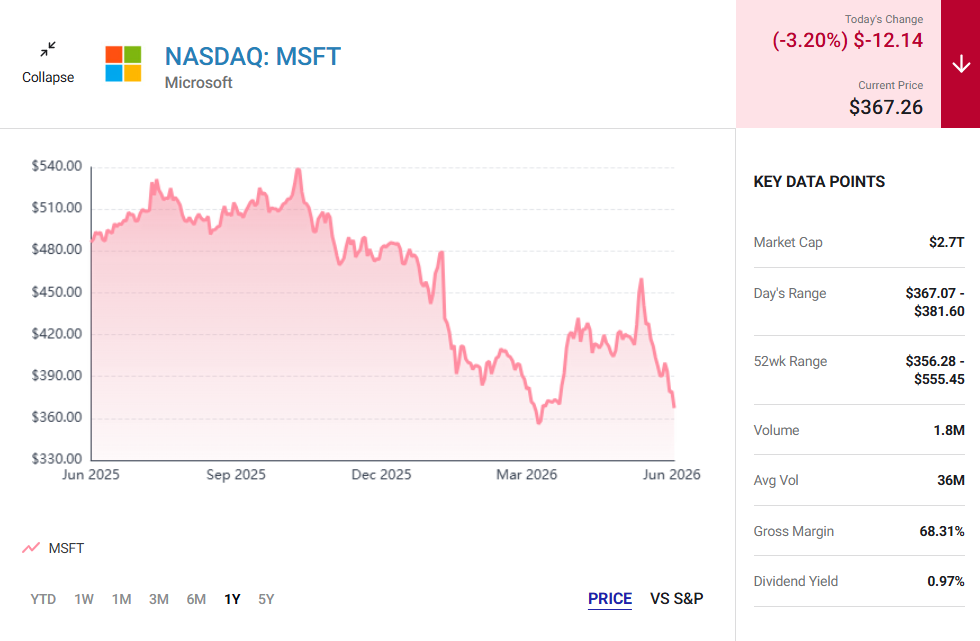
Microsoft (MSFT) has fallen further than any other large-cap tech name over the past year, now down roughly a third from its peak last October.
The driving fear isn’t a weak quarter; it’s disruption anxiety, as AI-native tools like Anthropic’s Claude have raised questions about whether Microsoft’s software franchise can hold up against a new generation of AI-first competitors. Investors have also expressed frustration with the pace of Microsoft’s own AI progress.
The underlying results paint a much stronger picture than recent sentiment suggests. Microsoft generated $82.9 billion in third-quarter revenue, representing 18% year-over-year growth (15% on a currency-neutral basis), while adjusted earnings per share also climbed 18% to $4.27.
At the same time, Azure continues to post robust growth, reinforcing Microsoft’s leadership in cloud computing. Importantly, Microsoft 365 remains highly resilient, showing little evidence that emerging AI competitors are materially impacting demand for the company’s core productivity software.
The Productivity and Business Processes segment, which includes Microsoft 365, generated 13% currency-neutral revenue growth, a figure that hardly suggests a franchise under immediate competitive pressure.
Valuation also appears unusually compressed. Microsoft currently trades at a P/E ratio of just 21, its lowest valuation since before the pandemic.
That multiple looks particularly conservative given the company’s broad diversification across multiple markets, including LinkedIn in professional networking, the Xbox ecosystem and Activision Blizzard in gaming, and Windows’ enduring dominance in desktop operating systems.
If Microsoft can maintain anything close to its current mid-teens growth rate, today’s valuation may look less like fair value and more like a meaningful discount to the company’s long-term earnings potential.
Outlook: Patience Pays When the Market Is Panicking on Guidance, Not Fundamentals
Both stocks share a common thread: their sell-offs appear to be driven more by investor sentiment and near-term guidance concerns than by any meaningful deterioration in business fundamentals.
While Netflix’s growth is naturally slowing from an exceptionally high base and Microsoft’s AI story remains a subject of debate among investors, neither company is experiencing the type of revenue slowdown or margin erosion that would typically justify trading at valuations comparable to or below a historically expensive broader market.
What makes the situation notable is the disconnect between market perception and underlying business quality. Both companies continue to benefit from strong competitive advantages, global scale, and significant cash-generation capabilities. Yet recent price action suggests investors are focusing more on short-term uncertainty than on long-term earnings power.
For patient investors willing to look beyond current market skepticism, Netflix and Microsoft may represent rare opportunities to own wide-moat, industry-leading businesses at valuations that appear disconnected from their competitive strength and long-term positioning.