
The traditional automotive manufacturing sector is executing a profound technological pivot as legacy industrial enterprises seek direct exposure to the accelerating artificial intelligence infrastructure boom.
Institutional asset managers are closely monitoring how prominent vehicle fabricators leverage internal battery engineering capabilities to address severe power constraints across global data network developments.
A financial expert at Gammance indicates that this strategic diversification provides industrial manufacturing firms with a highly credible vector to capture high-margin infrastructure outlays. While near-term corporate balance sheets will remain tethered to consumer vehicle sales, these alternative energy initiatives significantly enhance the long-term investment profile of industrial equity holdings.
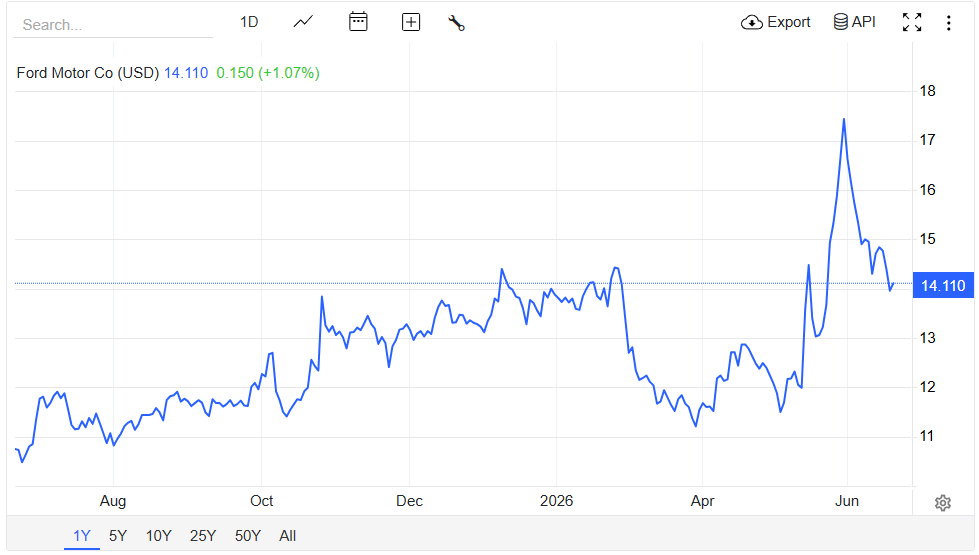
Market enthusiasm surrounding the manufacturer’s dedicated energy storage subsidiary initially triggered an aggressive capital inflow, driving equity valuations to a pronounced multi-year high above $17.00 per share. This sharp upward move materialized from a depressed baseline below $14.00 prior to the formal subsidiary launch.
However, subsequent trading sessions witnessed a localized profit-taking contraction, pulling the underlying equity back down to exactly $13.96 per share. Financial commentators emphasize that this pricing retracement creates a highly attractive entry point for macro allocators who anticipate a synchronized decline in global crude oil overhead and domestic borrowing costs.
Data Center Power Proliferations And Renewable Grid Integration Priorities
The underlying commercial opportunity is expanding rapidly as the massive construction of artificial intelligence data complexes outpaces traditional localized electrical grid capacities. Modern high-density computational hubs operate under zero-downtime mandates, creating an insatiable institutional demand for industrial-grade backup battery arrays to ensure continuous uptime.
Concurrently, utility-scale renewable energy installations require massive, synchronized storage frameworks to normalize power delivery when wind and solar generation efficiency experiences localized drops. The vehicle manufacturer plans to address this critical supply deficit by establishing a target output of at least 20 gigawatts of annual battery storage capacity.
Initial commercial shipments to primary infrastructure clients are officially projected to commence during the final quarters of the year 2027. Financial analysts caution that this lengthy engineering timeline dictates that the alternative energy segment will not impact near-term corporate net earnings metrics.
Consequently, near-term equity valuations will continue to be anchored by the transactional velocity of commercial utility trucks and passenger vehicles. However, patient capital allocators are treating the long-term energy pipeline as a vital structural buffer against the inherent cyclicality of the automotive retail market.
Long Term Strategic Valuations And Portfolio Exposure Guidelines
As industrial corporations increasingly overlap with advanced technology supply lines, the ability to successfully monetize non-automotive battery deployments will dictate multi-year capital compounding rates. Competitor engineering firms are similarly racing to secure utility-scale grid infrastructure agreements, sparking a highly coordinated battle for energy storage dominance.
Risk managers must continue to track localized manufacturing yield metrics while evaluating how effectively the incoming storage backlog offsets broader macroeconomic headwinds affecting retail consumer auto loans. Ultimately, the success of this industrial storage rollout will determine if legacy manufacturers can permanently trade their low-multiple automotive labels for premium energy technology valuations.
Final Section: Technical Analysis And Key Price Levels
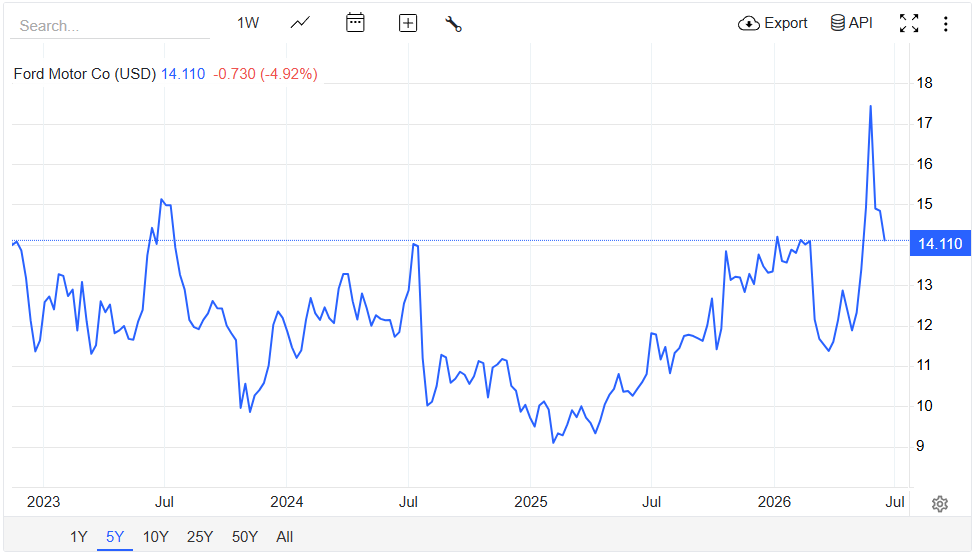
A structural review of the daily candlestick data details a definitive cyclical trend, transitioning from a historical macro accumulation floor near $11.00 per share into a series of ascending steps.
This multi-month consolidation pattern successfully absorbed market distribution before triggering a vertical, high-volume expansion during the late spring. The tracking data shows that this parabolic buying surge drove the equity to a distinct multi-year peak of approximately $17.60 per share.
The subsequent cooling cycle generated sharp profit-taking, forcing a swift technical retracement back into a vital, historical congestion pocket at $13.96 per share.
This specific area represents previous structural ceiling resistance that is now being tested by market participants as a primary support line. Defending this localized floor is crucial to the broader bullish continuation thesis, as it directly aligns with major high-volume transaction nodes.
Should selling volume accelerate and force a decisive daily close below this immediate inflection point, it will invalidate the near-term stabilization pattern. The technical layout indicates that a breakdown here will open a direct path for a deeper corrective descent toward the secondary structural defensive band at $13.00 per share.
Conversely, a steady decrease in daily selling volume suggests an emerging pause in downward momentum as supply begins to dry up.
The charting metrics indicate that the price is currently attempting to solidify an equilibrium accumulation base near the $14.10 mark. If institutional bids successfully absorb the remaining float at these discounted levels, it will construct a powerful launching pad for a secondary breakout campaign.
To validate a true bullish reversal, recovery programs must aggressively clear the overhead supply barrier resting heavily at the $15.50 threshold.