
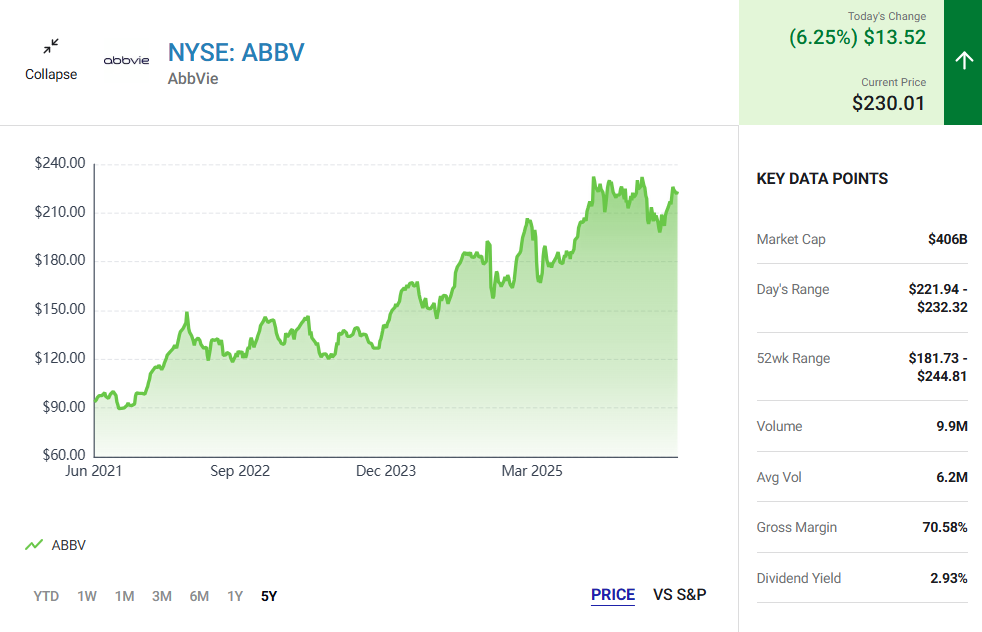
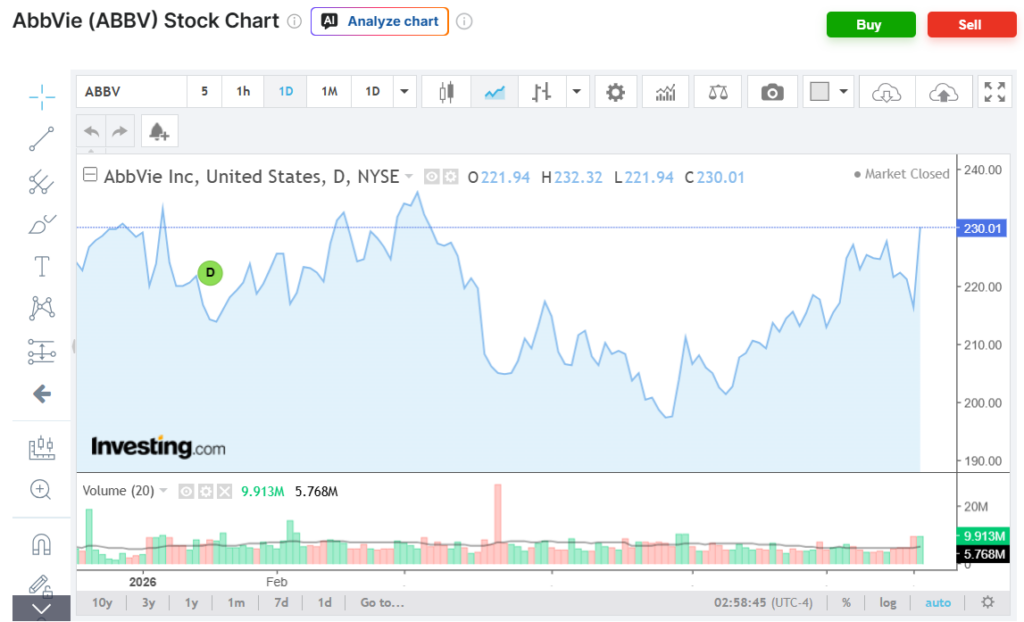
Shares of AbbVie (ABBV) jumped 6.25% on Monday after the pharmaceutical giant announced a deal to acquire clinical-stage biotech Apogee Therapeutics (APGE) for $10.9 billion, a move that sent Apogee’s own stock soaring 46.66% on the news.
Brokers from Byronixel broke down what AbbVie is actually buying, and why the market reacted so strongly to a deal whose financial payoff won’t show up for years.
The Deal: $135.11 a Share, a 49% Premium
Under the terms of the agreement, AbbVie will pay $135.11 per share in cash for Apogee, a 49% premium over Apogee’s closing price on Thursday before the announcement. That’s an aggressive premium even by biotech acquisition standards, and it signals how much conviction AbbVie has in the pipeline it’s paying for.
What AbbVie Is Actually Buying
Apogee Therapeutics brings with it a promising pipeline of experimental therapies targeting dermatologic, respiratory, and other immunological diseases. Its flagship asset is zumilokibart, a lead candidate that could emerge as a best-in-class treatment for atopic dermatitis.
Beyond its efficacy potential, the drug’s key differentiator is a significantly more convenient dosing schedule than that of many of the therapies currently dominating the market. In a treatment category where patient adherence is often influenced by dosing frequency and administration burden, greater convenience can translate into a meaningful competitive edge.
AbbVie CEO Robert Michael described the acquisition as a natural extension of the company’s established leadership in immunology. He highlighted Apogee’s portfolio as adding differentiated, clinical-stage assets aimed at areas of significant unmet medical need, particularly atopic dermatitis and asthma.
Michael also emphasized that AbbVie’s deep scientific and commercial expertise in inflammatory diseases could help accelerate these programs and potentially position them as future standards of care in their respective markets.
Why This Is a Long Game, Not a Quick Win
Investors should not expect this acquisition to have a meaningful impact on AbbVie’s earnings in the near future. While the deal is expected to close in the third quarter, subject to shareholder and regulatory approvals, AbbVie has indicated that it does not expect the transaction to contribute to adjusted earnings per share until 2032.
That represents an exceptionally long timeline, even by the standards of clinical-stage biotech acquisitions, and highlights just how early Apogee’s most valuable programs remain in their development journey.
Zumilokibart and the broader pipeline must still successfully navigate clinical trials, obtain regulatory approvals, and achieve commercial adoption before they can generate meaningful revenue and earnings contributions.
In other words, this acquisition is less about near-term financial results and more about strengthening AbbVie’s long-term immunology portfolio. The company is effectively making a strategic bet that today’s promising clinical assets can evolve into tomorrow’s blockbuster therapies, even if the financial benefits remain several years away.
The Real Reason: Reducing Reliance on Skyrizi and Rinvoq
The strategic rationale for the acquisition becomes much clearer when viewed through the lens of AbbVie’s revenue concentration. AbbVie generated $6.6 billion in first-quarter net revenue from Skyrizi and Rinvoq alone, underscoring the tremendous success of its immunology franchise.
However, that success also creates a degree of concentration risk, as heavy reliance on a small number of blockbuster products can leave a company vulnerable to future competitive threats, pricing pressure, or patent expirations.
By expanding its presence in immunology and inflammatory disease markets, AbbVie is taking steps to reduce that dependence before it becomes a problem. This is precisely where Apogee’s pipeline is positioned, with assets targeting conditions such as atopic dermatitis, asthma, and other immune-mediated diseases.
Rather than waiting for Skyrizi or Rinvoq to face meaningful erosion, AbbVie is investing now in a next-generation of potential growth drivers. If Apogee’s clinical programs prove successful, they could help broaden AbbVie’s revenue base, strengthen its long-term immunology leadership, and create new sources of growth well ahead of any future patent-related challenges.
Outlook: A Patient Bet on AbbVie’s Next Decade
This acquisition is not intended to boost AbbVie’s results in 2026 or even 2027. Instead, it is a long-term strategic move aimed at ensuring that AbbVie is not overly reliant on a small number of blockbuster drugs a decade from now.
The 49% acquisition premium signals AbbVie’s strong conviction in the commercial potential of zumilokibart and the broader value of Apogee’s pipeline. Beyond a single asset, the deal provides exposure to a range of immunology and respiratory disease programs, giving AbbVie multiple opportunities to develop the next wave of high-revenue therapies.
For investors, the key takeaway is not a change in the company’s near-term earnings outlook. Rather, it is evidence that AbbVie is proactively addressing a challenge that has affected many large pharmaceutical companies: overdependence on a handful of products that eventually face patent expirations and competitive pressure.
While Apogee’s pipeline may take years to generate meaningful financial returns, the underlying strategy appears well thought out. By investing early in future growth drivers, AbbVie is positioning itself to maintain leadership in immunology and diversify its revenue base long before its current blockbuster medicines face significant erosion.