
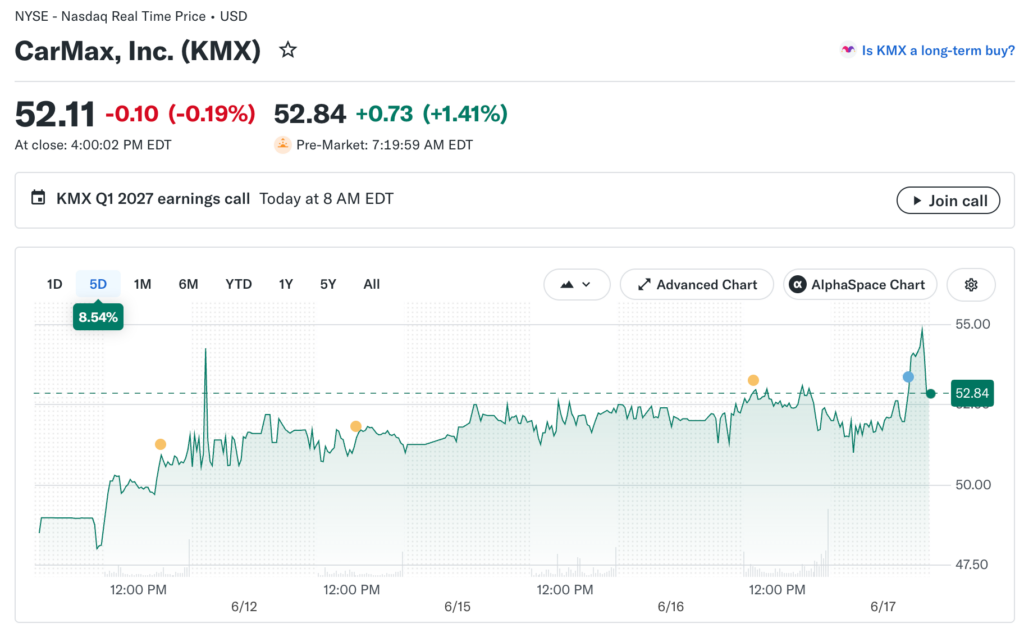
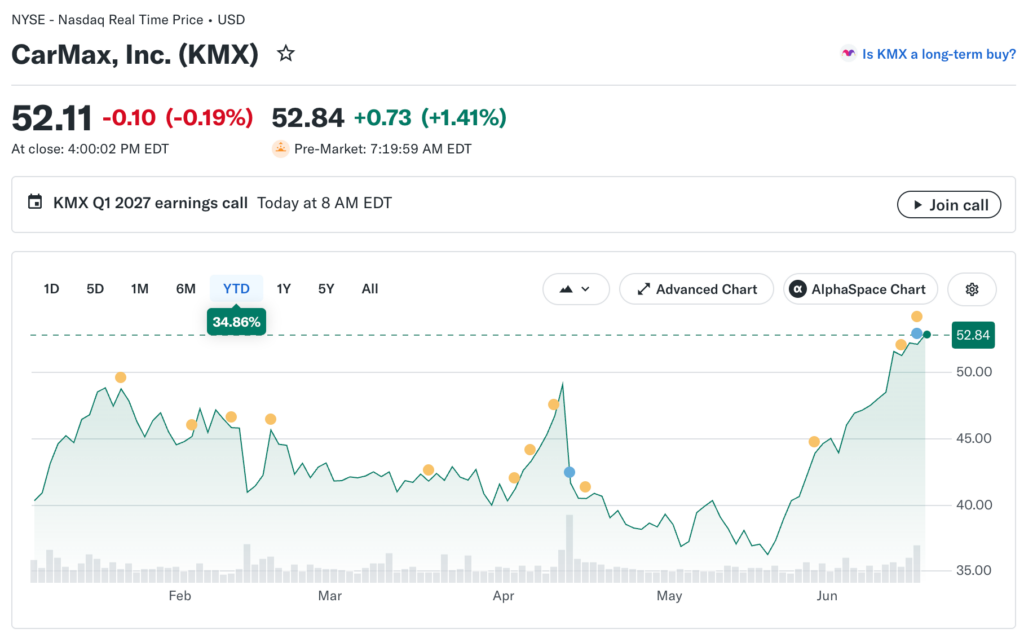
CarMax (KMX) reports its fiscal Q1 2027 earnings on June 17, 2026, with analysts projecting a 31.9% decline in earnings per share and a slight revenue drop from the prior year period. The report arrives at a genuinely difficult moment for the used vehicle market, with high interest rates compressing auto loan affordability, recent management changes attracting activist investor scrutiny, and a consumer environment that is cautious but not fully collapsed.
Byronixel‘s financial expert explores what the CarMax result tells investors about consumer credit health, discretionary spending behavior, and the broader auto retail sector heading into the second half of 2026.
Why a 31.9% EPS Drop Is Not the Whole Story
Consensus expectations for a 31.9% earnings per share decline sound alarming when read in isolation, but the context matters significantly for interpreting the result correctly. The comparison period includes a quarter when CarMax benefited from unusually elevated used vehicle prices that have since normalized as new car production recovered and dealer inventory constraints eased throughout 2025.
A decline against an inflated prior-year baseline is not the same as a structural deterioration in the underlying business model or long-term earning power. What matters more than the year-over-year EPS comparison is the sequential margin trend and any commentary on loan origination volumes through CarMax Auto Finance, the company’s well-established in-house lending arm.
If CarMax Auto Finance is seeing stable or improving credit quality metrics on new loan originations, it suggests consumers are managing their debt loads at current interest rates even if total unit sales volumes are running softer. Free cash flow generation tied to the $150 million SG&A cost reduction commitment tells investors more about management execution than the headline EPS figure alone.
The Interest Rate Problem in Plain Numbers
Used vehicle purchases are almost entirely financed through auto loans, making this sector uniquely sensitive to the interest rate environment. At current rates, a typical used car loan carries an interest rate between 8% and 11% depending on credit score, representing a monthly payment burden meaningfully higher than the 4% to 6% environment that prevailed before 2022 across the consumer lending market.
That cost increase has not destroyed demand outright, but it has shifted buyers toward lower-priced vehicles and pushed some prospective buyers out of the purchase market entirely. CarMax’s average selling price and unit volume are the two metrics that capture this demand shift most clearly and directly.
If average prices are declining as buyers trade down to more affordable inventory while unit volume holds reasonably steady, the business is adapting successfully to the rate environment. If both metrics are falling simultaneously, the rate headwind is compressing the market from both directions at once, which is a harder situation to manage through cost discipline alone.
Management Changes and Activist Pressure
CFO Enrique N. Mayor-Mora took on an expanded leadership role following recent management restructuring, and activist investor pressure has been focused directly on cost discipline and capital allocation efficiency. Activist involvement in consumer retail businesses typically accelerates decisions around store count optimization, share repurchase activity, and overhead cost reduction timelines.
The $150 million SG&A reduction target is partly a direct response to that external pressure. Investors should pay close attention to whether management reaffirms that target on the June 17 earnings call or adjusts it in either direction, as any modification signals how the internal operating environment is tracking against the projections management communicated earlier in the year.
Carvana, CarMax’s most direct digital-first competitor, has been gaining used vehicle market share in the online segment, adding meaningful competitive pressure on CarMax’s traditional physical dealership model. The June 17 report needs to demonstrate that CarMax’s combination of scale, in-house financing, and physical reconditioning capabilities deliver returns that justify the physical dealership model versus pure online competitors.
What CarMax Says About the Broader Consumer
CarMax is a reliable and underappreciated consumer sentiment indicator because its customer base spans a genuinely wide income range. Used vehicle purchases are discretionary at the margin, meaning consumers who want to upgrade or add a vehicle will delay that decision when household finances are under real pressure.
The NFIB Small Business Optimism Index slipping to 95.3 in June and the share of small businesses planning to raise prices hitting its highest level since July 2022 both suggest the consumer is facing simultaneous cost pressures from multiple directions. CarMax’s unit volume trend is a ground-level read on whether those pressures are translating into delayed vehicle purchase decisions across income brackets.
Reading the Report Past the Headline EPS
Investors monitoring CarMax on June 17 should focus on three specific outputs beyond the headline numbers: CarMax Auto Finance net income, gross profit per used unit, and any update to the SG&A reduction timeline. Those three figures tell the most complete and actionable story about where this business actually stands in the current consumer and credit environment.
A better-than-feared result on any of those three metrics, even against a backdrop of declining year-over-year EPS, could provide the catalyst that lifts KMX stock and the broader auto retail sector. The expectations bar is low enough that a modestly constructive report may be sufficient to shift market sentiment heading into Q3 2026.