
The Mexican Peso (MXN) remained relatively stable against the US Dollar (USD), with USD/MXN trading near 18.42, as markets assessed prospects for a US-Mexico trade agreement. Renewed diplomatic optimism supported the Peso, offsetting pressure from a narrowing interest rate differential and declining returns from carry-trade strategies.
Risance’s specialists bring industry expertise and valuable perspectives to every discussion.
The exchange rate remained broadly unchanged as investors balanced improving trade fundamentals against evolving monetary policy expectations. Attention is focused on Mexico’s mid-month Consumer Price Index (CPI) for October, which could influence expectations for Banxico’s benchmark rate, projected at 6.50%.
In the United States, weaker housing data and geopolitical uncertainty have influenced risk sentiment. The direction of USD/MXN will depend on bilateral trade developments, inflation expectations, relative bond yields, and technical resistance.
Trade Negotiations Reduce Mexico Risk Premium
Trade developments have become a significant near-term driver for the Peso. Officials from both countries have indicated that a bilateral trade agreement is approaching completion, although outstanding issues remain unresolved.
The agreement matters because the United States is Mexico’s largest trading partner, particularly in manufacturing, automotive production, industrial components, and North American supply chains. Reduced tariff uncertainty could improve export visibility, support foreign direct investment (FDI), and lower the risk premium on Mexican assets.
From a currency valuation perspective, a credible agreement could strengthen the Peso through improved expected trade flows and increased demand for domestic assets. Lower political and commercial risk could also encourage portfolio inflows into Mexican government bonds and equities.
Interest Rate Differential Threatens Peso Carry-Trade Demand
The Peso’s principal vulnerability stems from changing relative interest rate expectations. The US-Mexico policy rate differential is expected to narrow from approximately 250 basis points to 200 basis points, reducing the yield advantage of Mexican assets.
This 50-basis-point contraction would reduce the nominal carry available to international investors. If exchange rate volatility increases simultaneously, risk-adjusted returns could deteriorate, encouraging investors to reduce Peso exposure and increase US Dollar demand.
Banxico’s benchmark rate is projected to remain at 6.50%, while expectations for Federal Reserve policy continue to influence US yields. Changes in short-term interest rate futures, two-year government bond yields, and cross-border capital flows will help determine the Peso’s relative attractiveness.
The carry trade depends on more than nominal yields. Investors also assess forward premiums, hedging costs, funding conditions, liquidity, and expected currency depreciation. Even a favorable yield spread can be offset by an adverse movement in USD/MXN.
Inflation and US Data Set the Monetary Policy Outlook
Mexico’s upcoming mid-month inflation figures will be important for interest rate expectations. Stronger-than-expected headline or core inflation could reinforce expectations that Banxico will maintain restrictive monetary conditions, supporting MXN-denominated yields.
Softer inflation could increase expectations of monetary easing, particularly if underlying price pressures continue to moderate. The impact on USD/MXN will depend on simultaneous changes in US rate expectations and the resulting relative returns on Mexican and American assets.
In the United States, Pending Home Sales declined 7.3%, highlighting weakness in the housing market. Upcoming initial jobless claims, S&P Global Flash PMIs, and consumer sentiment data will provide further information about employment, business activity, and household confidence.
Weaker US data could pressure the US Dollar if Treasury yields decline. Deteriorating global risk appetite could support dollar demand as investors seek liquidity and defensive assets.
USD/MXN Technical Analysis: Resistance Structure in Focus
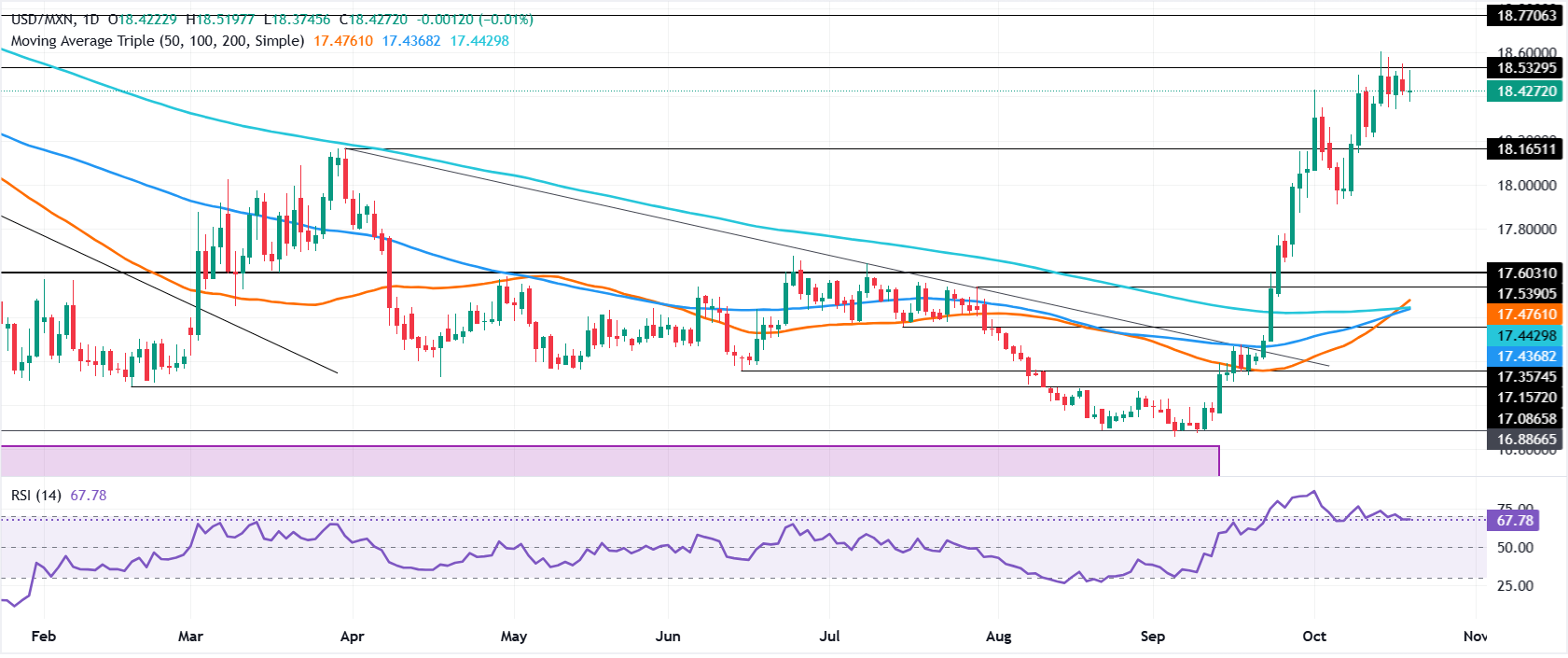
Technically, USD/MXN trades near 18.4272, above clustered simple moving averages around 17.4761. This configuration supports a bullish near-term trend, following the recovery from the 16.8866 horizontal support level.
The 14-day Relative Strength Index (RSI) stands at 67.78, approaching the overbought threshold of 70. Momentum remains positive, although the elevated reading increases the possibility of consolidation near resistance.
Initial downside support lies around 17.48, where the moving-average cluster could attract buying interest. A sustained break below this zone would weaken the bullish structure and expose 16.89 support.
On the upside, the principal barrier is the descending resistance trend line originating near 21.0808. A decisive breakout could support an extended USD/MXN recovery, while rejection could trigger range-bound trading or a corrective decline.
Conclusion
The Mexican Peso remains supported near 18.40 by improving prospects for a US-Mexico trade agreement, while the narrowing 250-to-200-basis-point interest rate differential threatens carry-trade demand.
The next move in USD/MXN will depend on inflation data, relative bond yields, trade implementation, and technical resistance. With the RSI at 67.78 and price above moving-average support, the technical bias remains bullish for USD/MXN, although a confirmed trade breakthrough could strengthen the Peso.
Trade policy, monetary policy divergence, and technical confirmation remain central to the exchange rate outlook.