
West Texas Intermediate (WTI) advances to approximately $99.15 per barrel during Tuesday’s early European session, extending its recovery to a more than one-month high. The move reflects an increase in the geopolitical risk premium as traders assess potential disruptions to crude oil transportation across the Middle East.
The article delves into the topic, offering detailed insights from Risance’s brokers.
Price direction remains closely linked to developments around the Strait of Hormuz, the security of regional energy infrastructure, and the pace of Gulf export recovery.
The Strait of Hormuz is a critical global oil transit chokepoint, connecting major Persian Gulf producers with international markets. An extended disruption could reduce seaborne crude availability, increase freight and insurance costs, and widen regional supply-demand imbalances.
These risks are supporting WTI despite evidence that physical crude flows have partially recovered, as persistent geopolitical uncertainty and elevated transportation costs continue to underpin prices.
Iran Threatens Wider Maritime Disruptions
The Islamic Revolutionary Guard Corps (IRGC) has indicated that Iran has not fully closed the Strait of Hormuz and could extend its blockade to the Bab al-Mandeb Strait and the Suez Canal. Restrictions across these routes would increase the risk of simultaneous disruptions to energy transportation between the Middle East, Europe, and Asia.
Iranian officials have also warned against renewed military attacks, adding to uncertainty surrounding the duration and geographical scope of the conflict. The potential expansion of maritime restrictions represents a significant upside risk for crude benchmarks because alternative shipping routes can increase transit times, freight expenses, and delivery uncertainty.
The Houthi movement has also claimed attacks against King Khalid International Airport in Riyadh, Saudi Aramco facilities in Yanbu, the Shaybah oilfield, and Saudi naval forces. These reported incidents raise concerns about the security of energy production, export terminals, and regional shipping infrastructure.
Further damage to oil facilities or commercial vessels could tighten physical crude supply and strengthen upward pressure on benchmark oil prices.
Gulf Exports and Global Supply-Demand Fundamentals
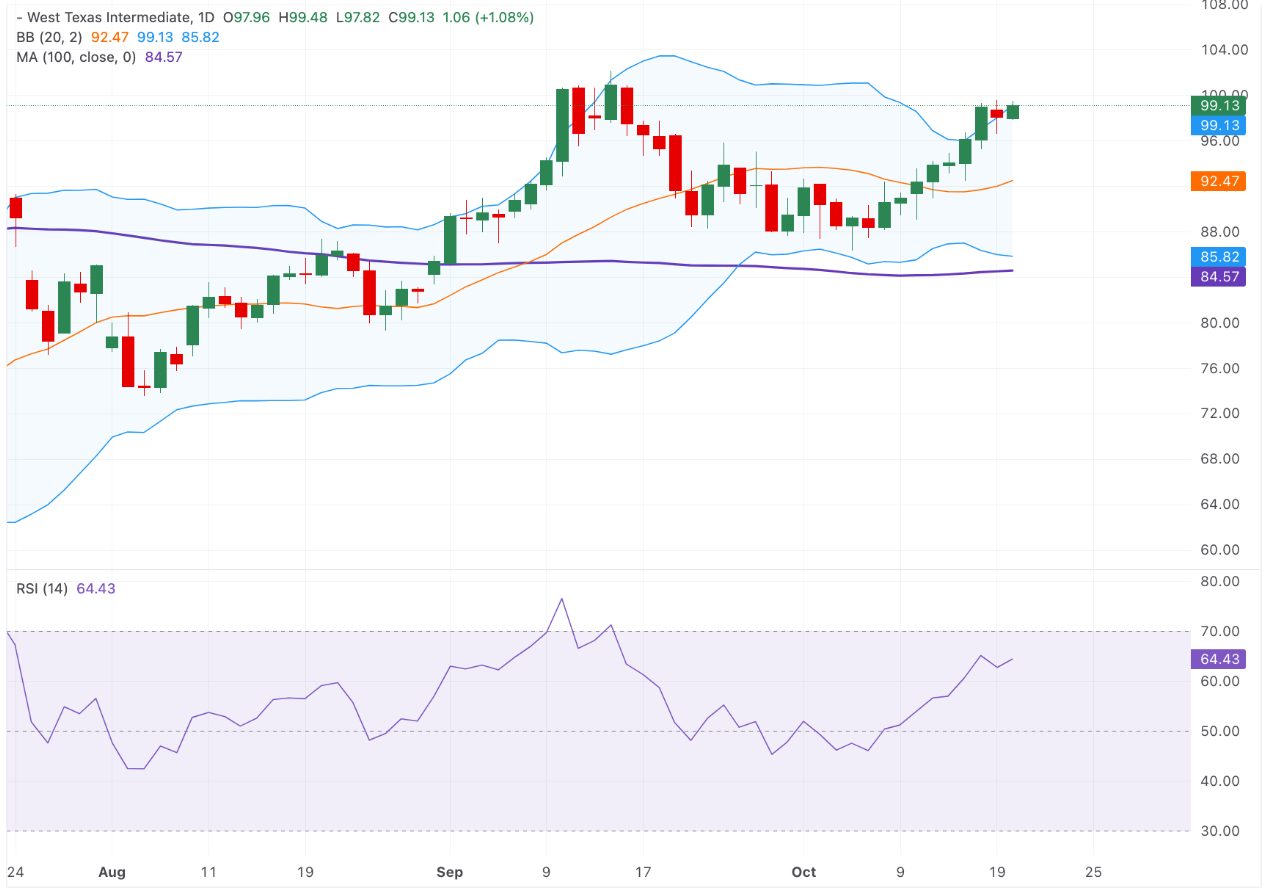
US Energy Secretary Chris Wright has stated that Gulf oil flows have recovered to approximately 80% of their pre-war level, indicating a partial normalization of export activity. The remaining shortfall of approximately 20% highlights the continuing vulnerability of regional supply chains.
Refined petroleum product shipments also remain constrained, potentially creating additional pressure on product markets even as crude exports improve.
The market is therefore balancing two opposing forces: supply disruption risk and recovering export volumes. Higher physical flows can reduce immediate scarcity, moderate regional crude differentials, and ease pressure on inventories.
Renewed attacks could reverse these improvements and prompt traders to price in a larger probability of supply losses.
The distribution of risks remains skewed to the upside. From a market-pricing perspective, this implies that the potential cost of supply disruptions may outweigh the immediate benefit of recovering exports, particularly if tanker movements become less reliable.
Technical Analysis: Resistance Near $99.13
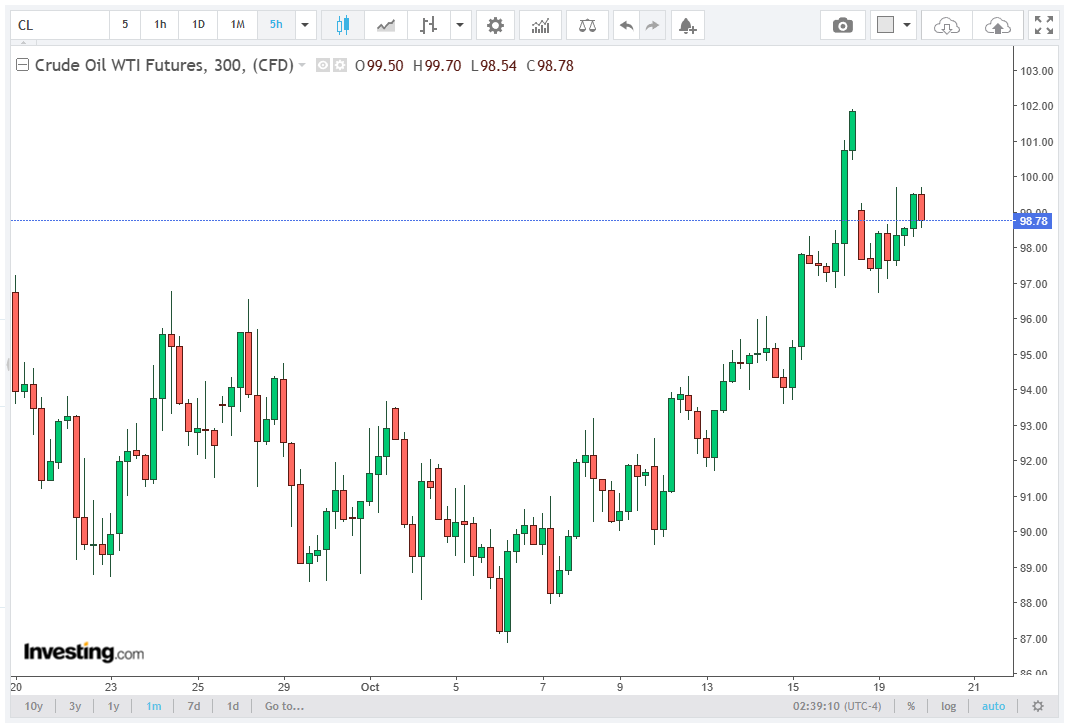
WTI’s daily chart indicates a bullish near-term structure, with prices trading around $99.13, above the 100-day simple moving average at $84.57 and the Bollinger Bands’ middle line at $92.47. The separation between the current price and these reference levels indicates that the recent recovery has strengthened the underlying trend.
The upper Bollinger Band near $99.13 represents immediate technical resistance. A sustained daily close above this threshold could signal a continuation of bullish momentum, while repeated rejection could trigger consolidation or a short-term pullback.
The 14-day Relative Strength Index (RSI) at 64.43 confirms positive momentum while remaining below the conventional 70 overbought threshold. Buying pressure is therefore elevated but not yet at an extreme level according to this indicator. A further RSI increase alongside a confirmed resistance breakout would strengthen the bullish signal.
On the downside, $92.47 is the first major technical reference, corresponding to the middle Bollinger Band. A break below this level would weaken immediate momentum and expose the lower Bollinger Band at $85.82. The 100-day SMA at $84.57 provides a deeper structural reference for assessing whether the broader recovery remains intact.
Conclusion
WTI’s move above $99.00 reflects a combination of escalating geopolitical risk, uncertain maritime access, and evolving supply-demand fundamentals.
The possibility of restrictions extending to the Bab al-Mandeb Strait and Suez Canal increases the potential scale of disruption, while Gulf exports recovering to 80% of pre-war levels provide a partial counterweight.
Technically, $99.13 is the immediate resistance level, with $92.47 serving as a key downside reference. A confirmed breakout could extend the rally, while easing tensions, stronger physical flows, or bearish inventory data could trigger a correction. The near-term bias remains bullish but sensitive to supply developments and resistance-driven volatility.