
The EUR/USD currency pair rises approximately 0.15% to 1.1230 during the Asian trading session, supported by renewed weakness in the US Dollar (USD).
The US Dollar Index (DXY) falls about 0.16% to 101.80, extending recent downward pressure as investors reassess the sustainability of artificial intelligence (AI) investment among major US technology companies.
Risance’s experts break down this topic in detail throughout the article.
Despite the intraday recovery, the broader EUR/USD outlook remains bearish, with Eurozone-specific risks limiting bullish momentum. French fiscal uncertainty, widening sovereign bond spreads, and persistent Russia-Ukraine tensions continue to undermine demand for the single currency.
Market attention is shifting toward Meta’s third-quarter earnings report, which could influence expectations for US corporate capital expenditure and broader risk sentiment.
Although near-term USD weakness supports EUR/USD, the pair’s ability to sustain gains will depend on whether buyers can overcome key technical resistance amid deteriorating Eurozone fundamentals.
Meta Earnings and AI Capital Expenditure Shape USD Dynamics
Investors are closely monitoring Meta’s earnings and forward guidance for indications of whether major technology companies will maintain their aggressive AI investment strategies.
According to Goldman Sachs estimates reported by Reuters, five major AI hyperscalers could increase combined capital expenditure to approximately $1.2 trillion next year.
The earnings outlook matters because elevated AI spending has become a key driver of expectations for US corporate earnings, productivity growth, and technology-sector valuations.
Evidence of sustained investment could reinforce confidence in US economic resilience, while weaker guidance could trigger a reassessment of expected returns on AI infrastructure.
For the foreign exchange market, the impact on the US Dollar will depend on changes in growth expectations, Treasury yields, and risk appetite. A deterioration in technology-sector sentiment could extend USD weakness and provide temporary upside momentum for EUR/USD.
Stronger-than-expected earnings could stabilize the Greenback and expose the currency pair’s underlying bearish structure.
French Fiscal Concerns and Geopolitical Risks Pressure the Euro
The Euro continues to face substantial fundamental headwinds from French fiscal instability and deteriorating investor sentiment toward French assets. Political tensions, public-service concerns, and affordability pressures have increased uncertainty surrounding fiscal policy implementation and the country’s broader economic outlook.
French equities and government bonds have underperformed, while the French-German 10-year sovereign bond yield spread has widened to approximately 145 basis points. This elevated differential indicates that investors are demanding a larger risk premium to hold French government debt relative to German Bunds.
Further spread widening could signal deteriorating confidence in French public finances, increase sovereign financing costs, and weigh on Eurozone financial conditions. From a currency perspective, higher perceived sovereign risk reduces the Euro’s relative attractiveness, particularly if uncertainty spreads to other regional bond markets.
EUR/USD Technical Forecast: 1.1274 Resistance Caps Recovery
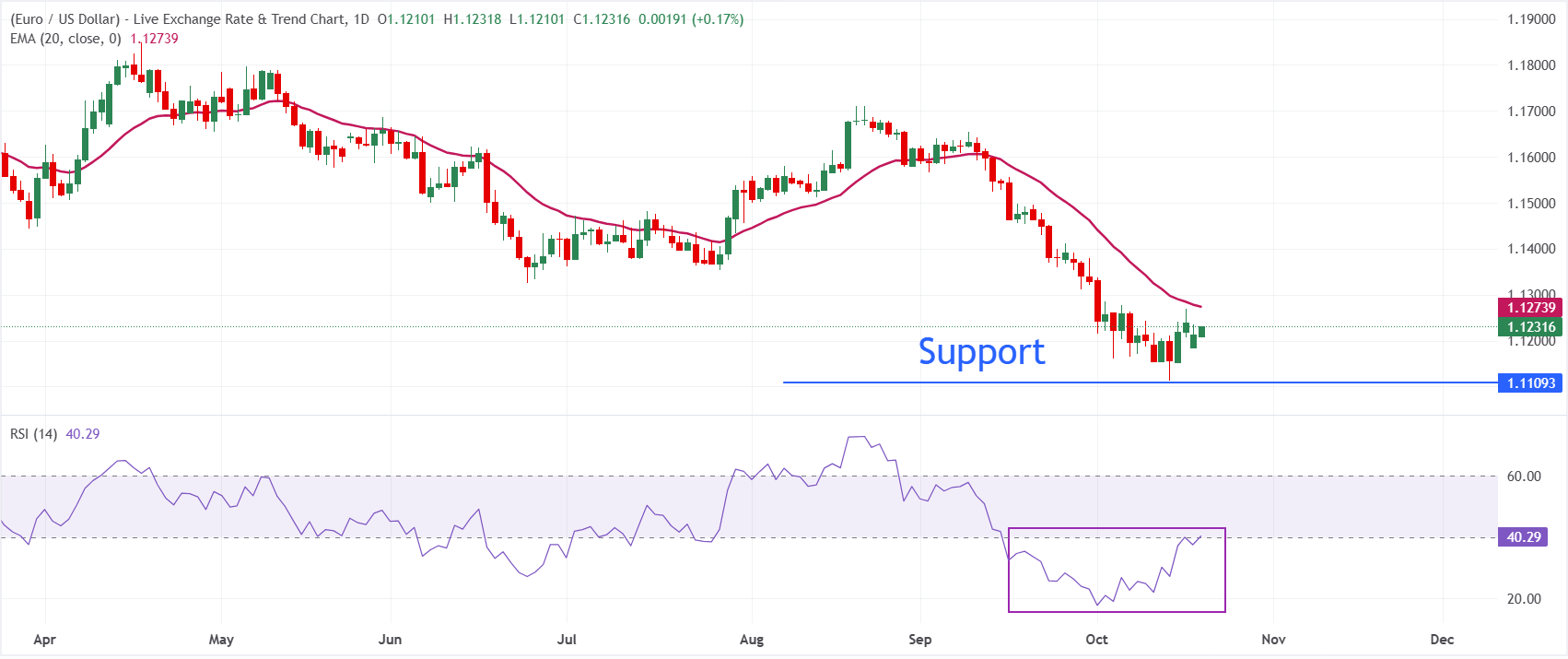
On the daily chart, EUR/USD trades near 1.1232, remaining below its 20-period exponential moving average (EMA) at 1.1274. The pair’s position beneath this dynamic resistance indicates that the short-term trend remains bearish and that recent gains have yet to confirm a structural reversal.
The 1.1274 level represents the immediate resistance threshold. A sustained daily close above this moving average would weaken the prevailing bearish configuration and potentially open the way for an extended corrective recovery. Failure to break above this level would preserve the downside bias and leave rallies vulnerable to renewed selling pressure.
The 14-period Relative Strength Index (RSI) stands at 40.28, recovering from oversold territory while remaining below the neutral 50 threshold. This configuration suggests that bearish momentum has moderated without establishing a bullish momentum regime.
A move above 50 would provide stronger evidence of improving buying pressure, while a renewed decline toward 30 would indicate increasing downside momentum.
On the downside, 1.1113, corresponding to the October 14 swing low, represents the primary support level. A decisive daily close below this threshold could confirm a bearish continuation pattern and expose EUR/USD to further losses. A break of support accompanied by a declining RSI would strengthen the technical case for additional downside.
Conclusion: Bearish Structure Persists Below Key Resistance
The EUR/USD forecast remains tilted to the downside as French fiscal risks, a 145-basis-point French-German bond spread, and geopolitical uncertainty offset the support provided by a weaker US Dollar near 1.1230.
Meta’s earnings may generate short-term volatility through changing expectations for AI capital expenditure, but the pair’s technical structure remains vulnerable. Resistance at 1.1274 is the immediate level bulls must reclaim, while support at 1.1113 marks the critical downside threshold.
A failure to overcome resistance would preserve the bearish bias, with a confirmed support break increasing the probability of further depreciation. Sustained improvement in momentum and Eurozone risk sentiment would be necessary to establish a more durable recovery.