
The USD/CAD pair remains under selling pressure for the third consecutive session, extending its correction from the recent swing high near 1.4295 and approaching the 1.4100 psychological support level. Vaulltier’s brokers deliver a detailed explanation of this topic throughout the article.
The pair has fallen to an over three-week low, following its rejection from the 1.4300 region, its highest level since April 2025. Despite the bearish price action, the absence of decisive downside follow-through suggests that sellers have yet to establish an unambiguous technical breakdown.
Market attention is shifting toward the upcoming Canadian Consumer Price Index (CPI) release, which could influence expectations for the Bank of Canada (BoC) and determine the next directional move.
An upside inflation surprise could reinforce expectations for tighter monetary policy, supporting the Canadian Dollar (CAD) and increasing downside pressure on USD/CAD. Softer-than-expected inflation could weaken the Loonie by strengthening expectations for a more accommodative policy outlook.
Crude Oil Weakness and Safe-Haven Demand Support USD/CAD
The Canadian Dollar’s sensitivity to crude oil prices remains a significant factor in the pair’s short-term outlook. As a major energy exporter, Canada benefits from stronger oil prices through improved export revenues and potentially stronger terms of trade.
Crude oil has retreated from a one-month high, limiting the Loonie’s ability to appreciate against the US Dollar.
At the same time, geopolitical uncertainty has supported safe-haven demand for the US Dollar (USD). Expectations surrounding a potential Federal Reserve interest-rate increase have also contributed to the broader monetary-policy narrative, although the outlook remains dependent on incoming inflation, employment, and activity data.
These competing forces complicate the near-term outlook. Bearish USD/CAD momentum contrasts with the potential support provided by a softer oil market and renewed demand for USD liquidity. The Canadian CPI release could determine whether the pair breaks below 1.4100 or enters a corrective rebound.
Technical Analysis: RSI Signals Oversold Conditions
On the four-hour chart, USD/CAD exhibits a deteriorating short-term structure following its rejection near 1.4295. Spot prices remain above the 200-period Simple Moving Average (SMA) at 1.4065, preserving an important underlying support reference.
The Relative Strength Index (RSI) has dropped below 30, indicating oversold momentum. Although this reading confirms the intensity of recent selling, it does not independently establish a bullish reversal.
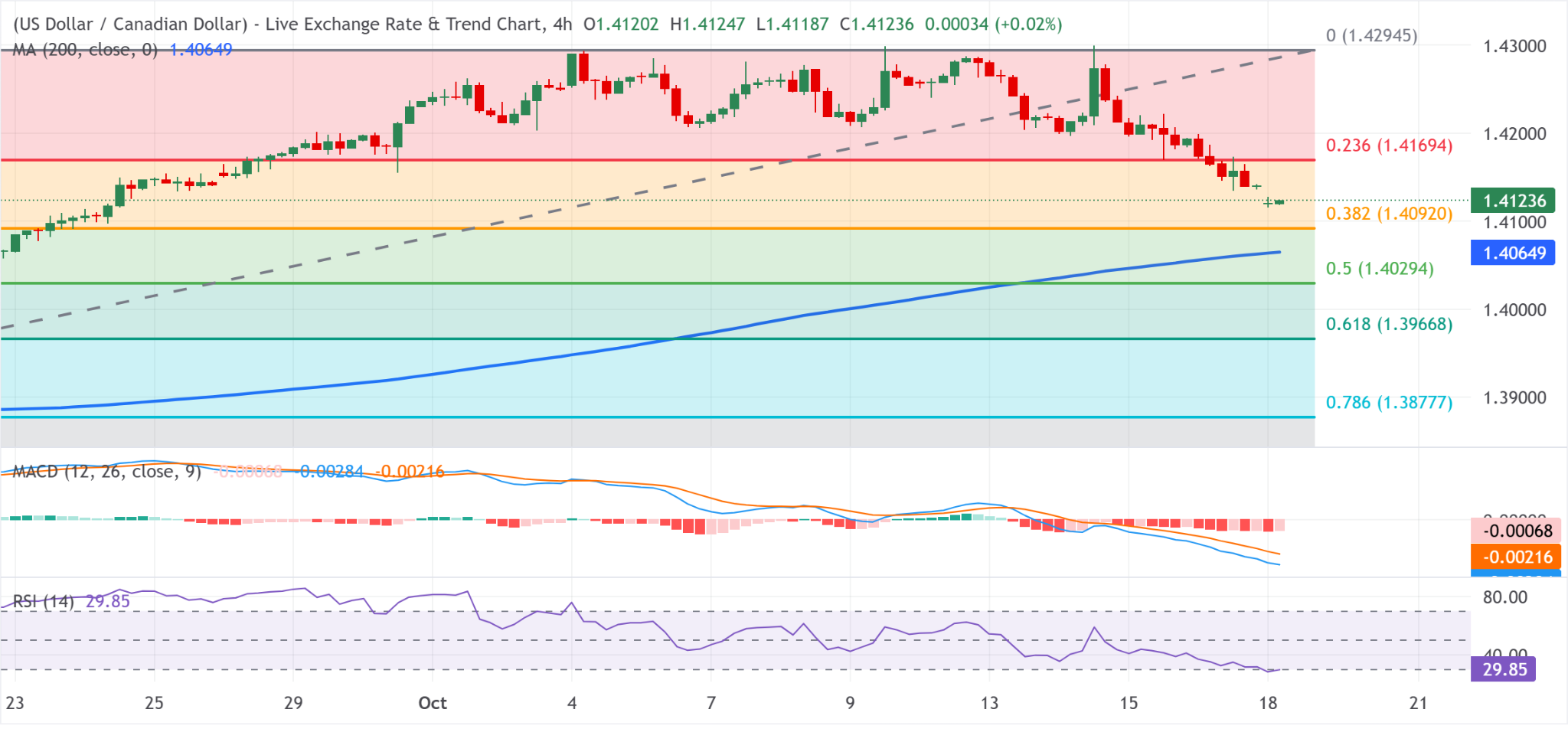
A sustained RSI recovery above 30 would provide preliminary evidence that downside momentum is moderating, particularly if accompanied by a higher price low.
The Moving Average Convergence Divergence (MACD) remains slightly negative, maintaining a bearish momentum signal. Its relatively subdued downside configuration suggests that selling pressure may be losing acceleration. Confirmation would require improving MACD momentum alongside stabilization above nearby support.
The technical structure therefore presents a distinction between short-term bearish momentum and the risk of a corrective rebound. A sustained close below 1.4100, followed by continued trading beneath this threshold, would strengthen the breakdown scenario.
Key Fibonacci Levels and Price Targets
The 1.4100 region represents the immediate technical pivot, situated near the 38.2% Fibonacci retracement zone. Market acceptance below this area would increase the probability of an extension toward the 50.0% retracement at 1.4029.
Further downside levels are located at 1.3967 and 1.3878, representing subsequent Fibonacci support zones. A sustained break beneath these levels would expose the 1.3764 cycle-low region, indicating a deeper deterioration in the broader price structure.
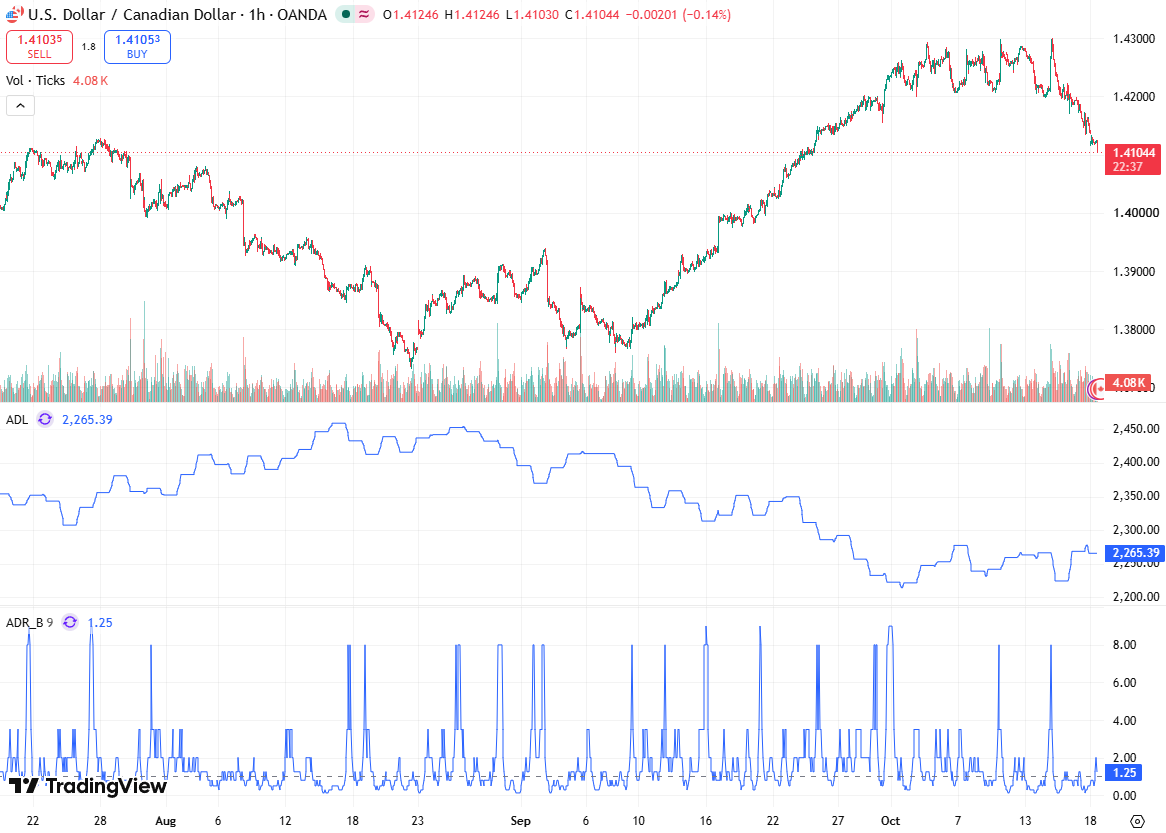
The 200-period SMA at 1.4065 remains an important intermediate support reference that could interrupt bearish continuation.
On the topside, initial resistance stands at the 23.6% Fibonacci retracement near 1.4169. A four-hour close above this level would indicate improving short-term price action and potentially open the way for a retest of the 1.4200 area, followed by the 1.4295 swing high. The latter remains the key resistance reference for any broader recovery.
The relationship between these levels is critical. A break below 1.4100 would favor bearish continuation, whereas a recovery above 1.4169 would weaken the immediate downside structure. A move through 1.4295 would be necessary to challenge the recent bearish reversal more convincingly.
Conclusion: CPI and 1.4100 Define the Near-Term Outlook
The USD/CAD forecast remains bearish in the short term, with price action approaching 1.4100 amid negative MACD momentum and an RSI below 30. Oversold conditions and support near the 200-period SMA at 1.4065 increase the possibility of temporary stabilization.
The upcoming Canadian CPI release represents the principal fundamental catalyst, with inflation surprises likely to influence BoC expectations and CAD demand. A confirmed breakdown would expose 1.4029, 1.3967, and 1.3878, while a recovery above 1.4169 could encourage a corrective advance toward 1.4295.
Until either scenario receives confirmation, the pair remains vulnerable to elevated volatility, making price acceptance, momentum confirmation, and macroeconomic repricing essential to the next directional assessment.