
The Indian Rupee (INR) extends its upward momentum, building on its strong performance as persistent selling pressure in US Artificial Intelligence (AI)-related equities weighs on the US Dollar (USD). This article explores the topic in detail with insights from Vaulltier’s brokers.
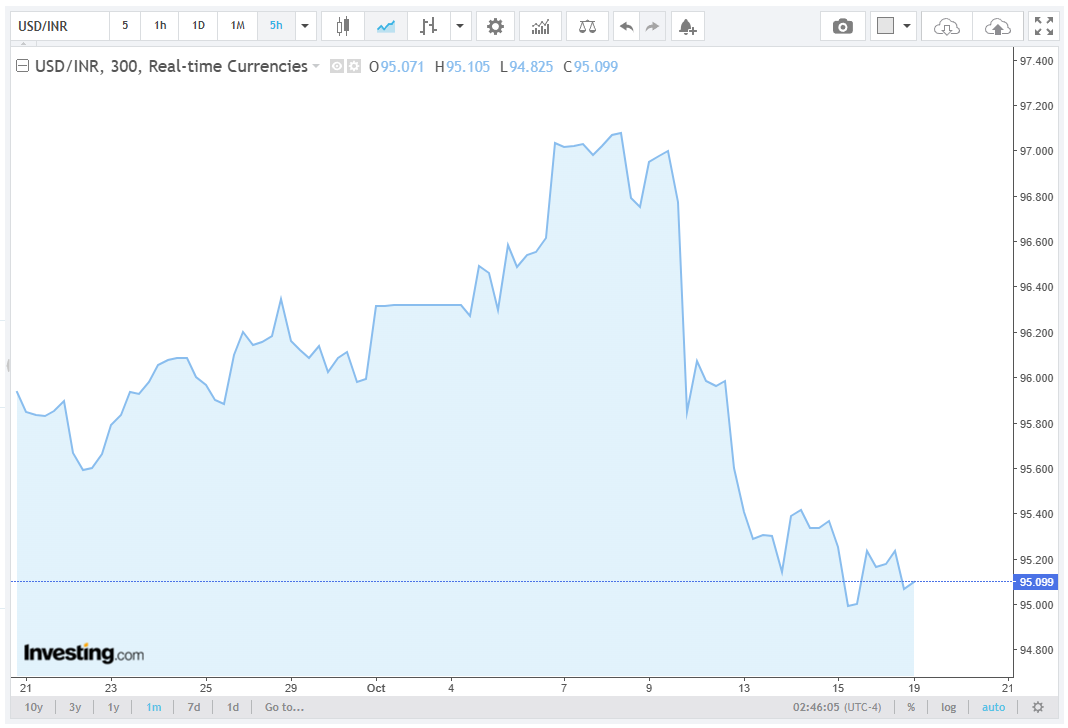
The USD/INR exchange rate declines toward the 94.80 level, reflecting a combination of external Dollar weakness, domestic foreign exchange measures, and improved liquidity conditions.
The move indicates continued downside pressure on the currency pair, although the sustainability of the Rupee’s appreciation will depend on global risk sentiment and domestic capital flows.
The US Dollar Index (DXY) trades near 101.80, remaining close to its recent low of 101.57 and below the psychologically significant 102.00 threshold. The index’s inability to recover above this level reinforces its deteriorating short-term technical structure.
Continued weakness in the Greenback provides an external tailwind for emerging-market currencies, including the Rupee, although fluctuations in global investment flows remain a potential source of volatility.
AI Sector Correction Reshapes Currency Market Dynamics
The ongoing correction in US AI-related stocks is generating broader financial-market repercussions as investors reassess elevated valuations, capital expenditure requirements, and corporate borrowing exposure.
Concerns surrounding the sustainability of AI investment and the debt issued by major technology companies have increased sensitivity to developments in equity and credit markets.
The resulting currency movements suggest that conventional safe-haven dynamics are becoming less predictable. Currencies closely linked to AI hardware and semiconductor supply chains, including the Taiwanese Dollar and South Korean Won, have experienced substantial pressure.
The US Dollar has struggled to attract consistent defensive demand despite deteriorating equity-market sentiment.
This divergence indicates that investors are increasingly distinguishing between traditional liquidity preferences and the financial risks associated with specific sectors. Further weakness in AI equities or deterioration in corporate credit conditions could maintain downward pressure on the DXY, particularly if investors reduce exposure to Dollar-denominated assets.
A sustained recovery in US equities, however, could alter positioning and trigger short-covering in the Greenback.
RBI Injects Up to ₹1 Trillion Into the Banking System
Domestic monetary and regulatory measures are providing additional support to the Indian Rupee. The Reserve Bank of India (RBI) has announced a seven-day variable rate repo (VRR) operation to inject up to ₹1 trillion, equivalent to approximately $10.53 billion, into the banking system.
The operation is intended to alleviate temporary liquidity pressures associated with tax-related outflows and tighter daily cash reserve requirements. Through the VRR mechanism, eligible banks obtain short-term funds from the central bank through competitive bidding, helping manage funding requirements and stabilise money-market conditions.
The proposed injection represents a significant liquidity-management measure, although its direct impact on USD/INR will depend on the distribution of funds, interbank funding conditions, and prevailing foreign exchange demand.
Adequate domestic liquidity can reduce funding stress and improve market functioning, but it does not independently guarantee sustained currency appreciation.
USD/INR Technical Analysis: Bearish Momentum Remains Intact
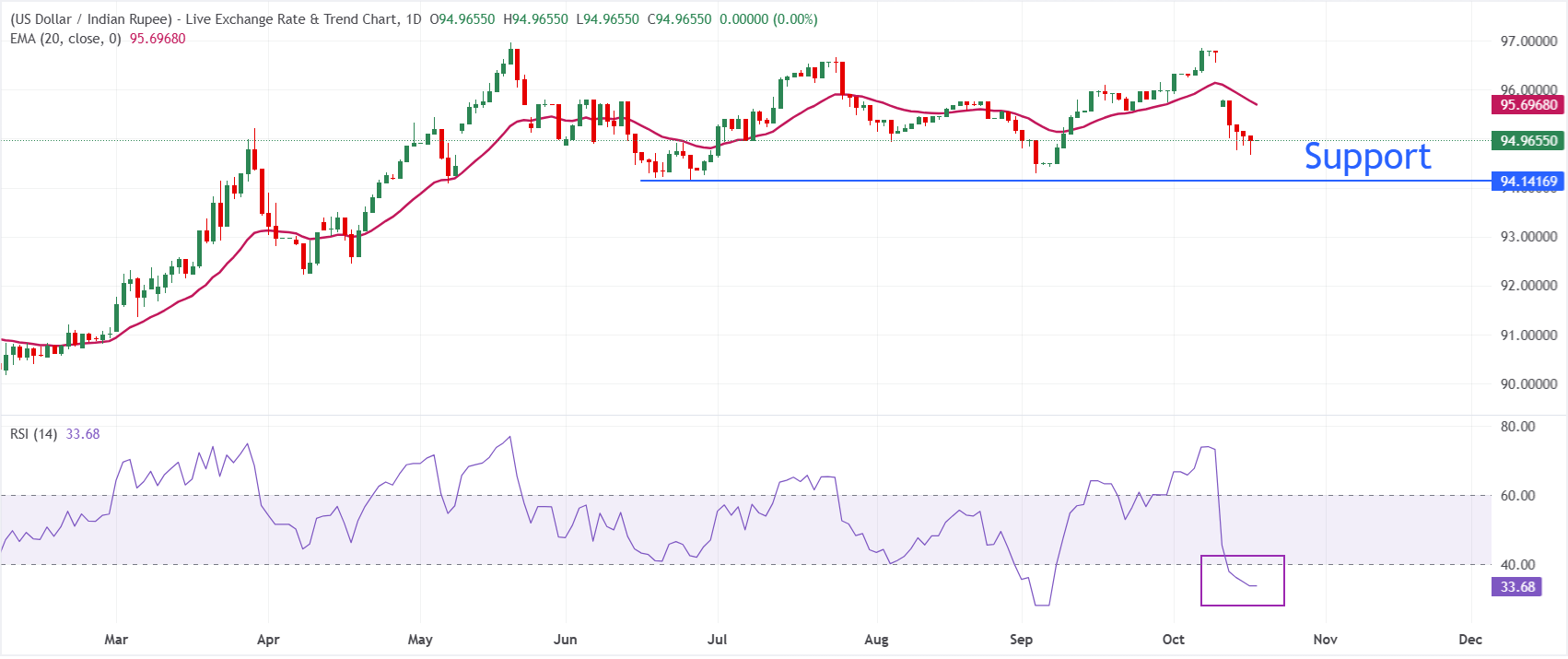
The daily chart maintains a bearish configuration, with USD/INR trading below its 20-day exponential moving average (EMA) at 95.6968. The spot exchange rate is indicated at 94.9655, approximately 0.77% below the moving average, confirming that the pair remains under short-term selling pressure.
The Relative Strength Index (RSI) stands near 34, indicating negative momentum and proximity to the conventional oversold threshold of 30. Although the RSI does not yet confirm an oversold reading, further downside could bring the indicator into that territory.
Such a development could increase the probability of a technical rebound without necessarily invalidating the prevailing bearish trend.
On the upside, 95.70 represents the primary resistance zone, aligned with the 20-day EMA. A sustained recovery above this threshold would weaken the immediate bearish structure and potentially open the way for a broader corrective advance. Continued trading below the moving average would preserve downside risks.
The available technical data do not establish a reliable immediate support level beneath the current exchange rate. A decisive break below the 94.80 region could expose USD/INR to additional declines, although confirmation would require sustained price action rather than a brief intraday breach.
Conclusion
The Indian Rupee’s continued appreciation reflects converging external and domestic factors, including US Dollar weakness, the correction in AI-related equities, and the RBI’s measures to improve liquidity and restrict selected foreign exchange activities.
The planned ₹1 trillion VRR injection supports short-term banking-system liquidity, while the broader regulatory framework seeks to moderate excessive Dollar demand. Technically, USD/INR remains bearish below 95.70, with the RSI near 34 signalling persistent downside momentum and a growing possibility of a temporary rebound.
The next directional move will depend on whether selling pressure pushes the pair sustainably below 94.80 or buyers regain control above the 20-day EMA. Global risk sentiment, crude oil prices, capital flows, and RBI policy implementation remain the principal variables shaping the Rupee’s near-term outlook.