
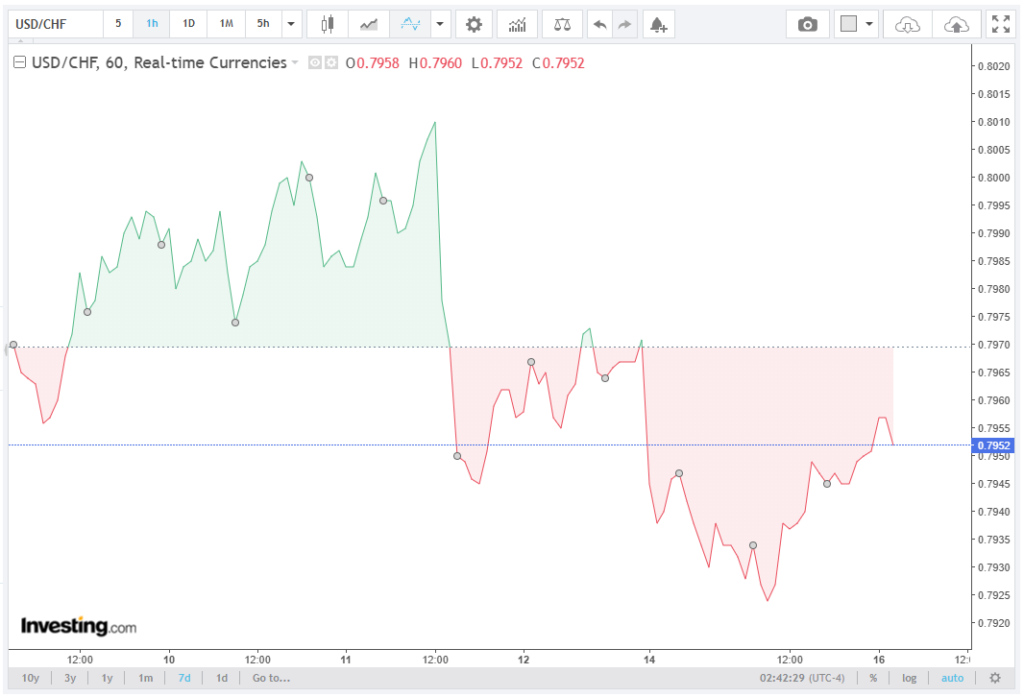
The Swiss Franc (CHF) continues to trade under pressure as USD/CHF advances toward the 0.7950 handle during Asian hours, recovering from a previous session decline of approximately 0.2% intraday volatility range. The move reflects a combination of US Dollar strength, shifting interest rate expectations, and a persistent geopolitical risk premium embedded in FX markets.
The brokers at Rubizio present a thorough and easy-to-follow overview of the subject in this article.
From a microstructure perspective, intraday order flow shows sustained USD bid support above 0.7920, suggesting short-term accumulation in the Dollar leg of the pair. Meanwhile, CHF demand remains relatively muted, consistent with reduced defensive positioning in European FX flows outside of acute risk-off spikes.
Monetary Policy Divergence: Fed Hold vs SNB Neutral Bias
Interest rate expectations remain a critical driver of relative currency valuation. Markets are currently pricing the US policy rate at 3.50%–3.75%, with a near 90% probability of no change at the upcoming policy meeting. This reinforces a policy plateau regime, where real yields remain elevated relative to historical averages.
The real policy rate differential versus Switzerland continues to widen. The Swiss policy environment remains anchored by expectations that the Swiss National Bank (SNB) will maintain its benchmark rate unchanged through year-end, reflecting subdued domestic inflation and weak pricing power.
This divergence supports a structurally higher interest rate spread between USD and CHF, estimated at approximately +325 to +375 basis points, which is a key medium-term driver of USD/CHF carry attractiveness.
Inflation Dynamics and Macro Surprise Index in Switzerland
Swiss inflation data continues to reflect persistent disinflationary pressure. The latest release shows Producer and Import Prices declining 1.8% year-on-year, compared with a prior reading of -2.0%, indicating a marginal slowdown in the deflationary trend but still deeply negative price momentum.
Every month, prices fell 0.4%, significantly below consensus expectations for a +0.4% rebound, representing an 80 basis point downside surprise swing. This negative surprise contributes to a weaker macro surprise index, which typically correlates with CHF underperformance in risk-adjusted FX models.
Import price weakness remains a structural driver, reflecting both subdued external demand and reduced global input cost pressures. However, the absence of a sustained inflation rebound reduces the probability of any near-term policy tightening by the Swiss National Bank (SNB).
Cross-Asset Correlation: Oil, FX, and Risk Sentiment
Recent declines in crude oil prices have temporarily reduced inflationary pressure across major economies. Brent crude has retreated from recent highs by approximately 3–5% over the last trading window, easing immediate concerns about imported inflation.
However, the sensitivity of energy markets to geopolitical disruption remains elevated. Any supply shock through strategic maritime routes could rapidly reintroduce energy-driven inflation spikes, which would reprice both interest rate expectations and FX volatility surfaces.
The correlation between oil volatility and USD strength remains positive in the current regime, as higher uncertainty tends to increase USD liquidity preference across global portfolios.
USD/CHF Technical Structure and Flow Analysis
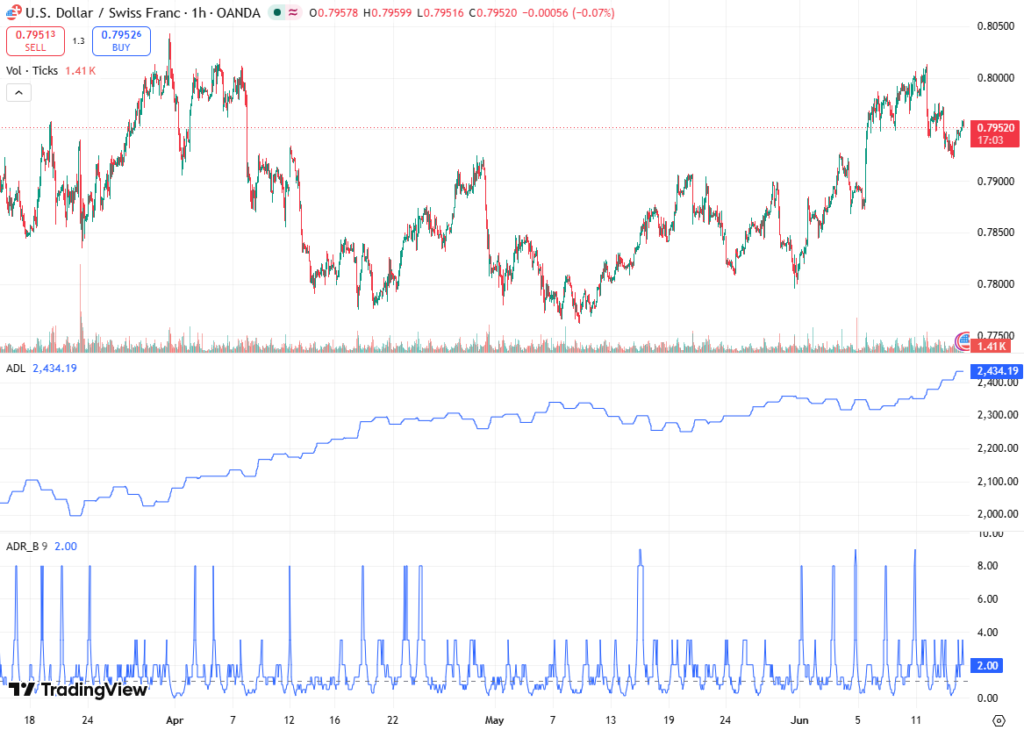
From a technical standpoint, USD/CHF is consolidating above the 0.7920–0.7930 support band, with intraday momentum indicators showing a gradual recovery in short-term RSI positioning toward the 55–60 neutral-bullish zone.
Resistance is observed near 0.7975–0.8000, where prior distribution zones and option-related gamma exposure are concentrated. A sustained break above this zone could trigger systematic flow adjustments, particularly from short volatility strategies that have accumulated CHF exposure during prior declines.
Order book depth analysis indicates stronger liquidity on the bid side in USD, suggesting that downside movements are being absorbed more efficiently than upside moves are being sold.
Relative Policy Stability and Forward Curve Implications
Forward rate agreements continue to reflect a flattened policy expectation curve for Switzerland, with negligible probability assigned to rate hikes through year-end. This reinforces the CHF low-yield profile and reduces its attractiveness in carry-adjusted portfolios.
In contrast, USD forward curves remain elevated, with short-end rates anchored above 3.50%, sustaining a structurally positive carry differential.
This asymmetry in forward guidance pricing continues to be a primary driver of medium-term USD/CHF structural bias, particularly in macro discretionary and systematic FX strategies.
Conclusion: Structural USD Bid Maintains Pressure on CHF
The current decline in the Swiss Franc reflects a convergence of macroeconomic divergence, geopolitical uncertainty, and yield differentials. The combination of a stable US interest rate regime at 3.50%–3.75%, weak Swiss inflation dynamics, and elevated geopolitical risk premium continues to favor USD strength.
Unless there is a material improvement in global risk sentiment or a shift in relative central bank guidance, USD/CHF is likely to remain structurally supported, with short-term price action biased toward range extension above the 0.7950 equilibrium zone and potential retests of higher resistance bands driven by sustained USD demand.