
The EUR/USD pair continues to exhibit a short-term bearish structure, trading near 1.1580 during the European session while failing repeatedly to sustain gains above the 20-day Exponential Moving Average (EMA). In this article, Rubizio brokers break down the subject in a detailed and accessible way.
The broader price action reflects a market in compression ahead of a high-impact monetary event, with volatility contracting as participants position around policy divergence between the Eurozone and the United States.
Spot remains capped below 1.1600, aligning closely with the 20-day EMA at 1.1599, reinforcing this zone as a dynamic resistance band rather than a neutral midpoint. At the same time, the pair trades above its medium-term structural base near 1.1409, maintaining a neutral-to-bearish consolidation regime rather than a full trend breakdown.
The US Dollar continues to dictate directional bias, supported by firmer macro expectations and a marginal uptick in the US Dollar Index (DXY), which trades near 99.75, reflecting a 0.1% intraday gain.
Federal Reserve Policy and Rate Expectations
The primary macro driver remains the upcoming policy decision from the Federal Reserve, where markets price an unchanged interest rate decision in the 3.50%–3.75% range for the fourth consecutive meeting.
The probability distribution derived from the CME FedWatch Tool shows an overwhelming skew toward a policy hold scenario exceeding 90% probability, reinforcing the view that the decision itself is largely discounted. The market sensitivity is therefore concentrated in the forward guidance trajectory, particularly any adjustment in inflation language or balance sheet expectations.
Inflation dynamics remain central, with recent energy-driven input costs contributing to a perceived re-acceleration risk in headline CPI components. This has reduced expectations for near-term easing and preserved a higher-for-longer rate environment, which structurally supports the US Dollar through interest rate differential widening.
The introduction of a new policy communication cycle under the current Fed leadership has added another layer of uncertainty, but market pricing still reflects a neutral policy bias with restrictive undertones, limiting aggressive repositioning ahead of the announcement.
Technical Analysis: EMA Compression and Momentum Weakness
From a technical perspective, EUR/USD remains confined within a descending corrective structure, originating from the 1.1849 swing high, which defines the upper boundary of the medium-term downtrend.
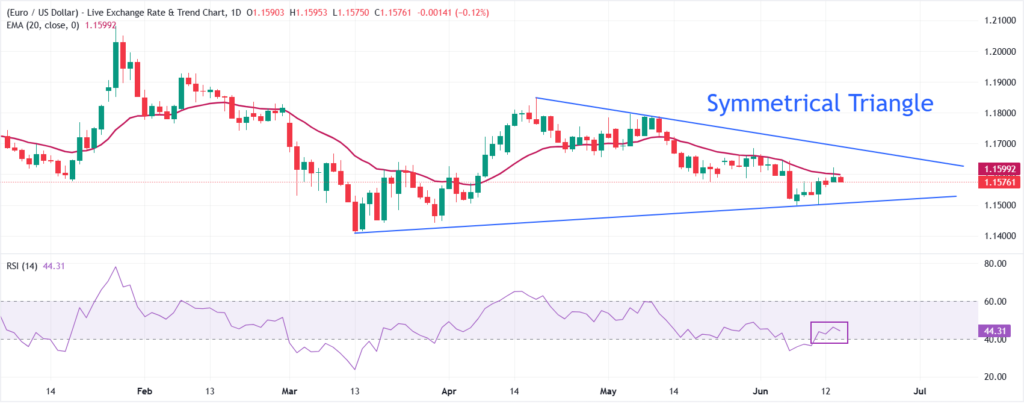
The most critical technical constraint is the 20-day EMA at 1.1599, which has acted as a repeated rejection point. Price behavior beneath this level confirms a bearish momentum regime, where rallies are systematically sold into rather than extended.
The Relative Strength Index (RSI) is currently positioned near 44, remaining below the neutral 50 threshold. This reading indicates sub-neutral momentum with downside skew, where recovery attempts lack sufficient follow-through strength to transition into a bullish phase.
Volatility compression is also evident, with price oscillating within a narrowing range between 1.1506 support and 1.1600 resistance, suggesting an impending directional expansion following the macro catalyst.
Key Technical Levels and Market Thresholds
On the upside, the immediate barrier remains the 20-day EMA near 1.1600, which now functions as a pivot resistance zone. A sustained break above this level would require a structural shift in momentum and would initially expose 1.1687, the previous breakdown level within the descending structure.
Beyond that, the critical resistance remains at 1.1849, which defines the upper boundary of the medium-term bearish channel. A recovery toward this level would require a significant repricing of Fed policy expectations toward a more dovish trajectory.
On the downside, initial support is established at 1.1506, representing a key liquidity zone where prior demand absorption occurred. A decisive break below this level would accelerate downside pressure toward 1.1409, the structural base of the broader trend formation.
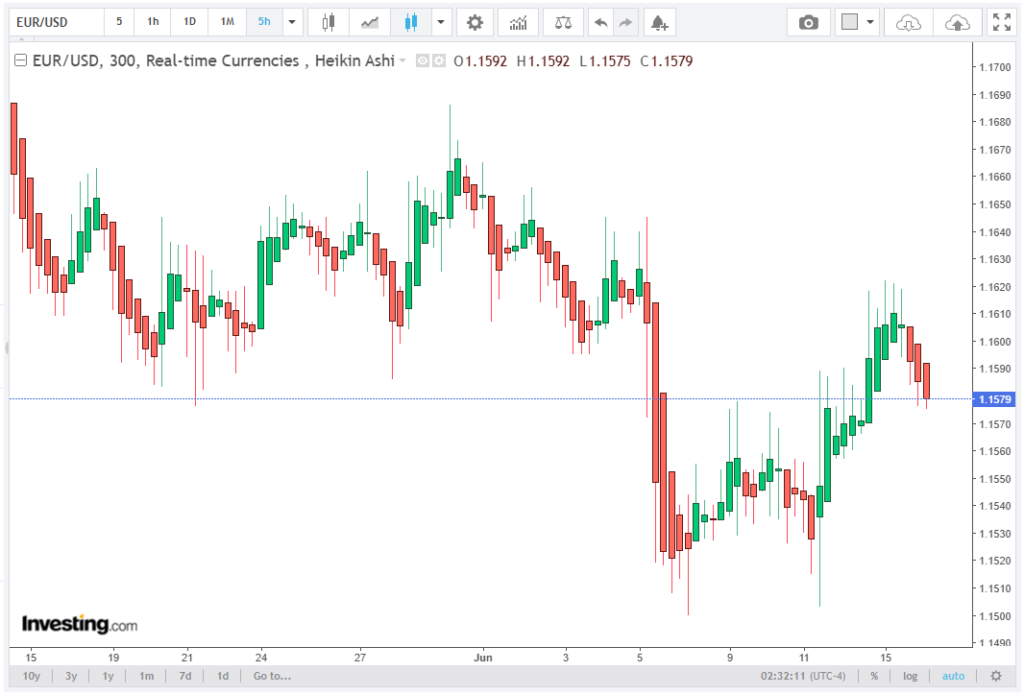
A breach of 1.1409 would represent a meaningful shift into a broader bearish continuation phase, potentially signaling extension of the corrective cycle rather than consolidation.
Conclusion: Macro Compression Ahead of Volatility Expansion
The EUR/USD pair remains technically constrained and fundamentally sensitive to upcoming policy signals from the Federal Reserve. With price repeatedly failing to reclaim the 20-day EMA at 1.1599, short-term structure continues to favor bearish momentum continuation unless a macro catalyst triggers a repricing of rate expectations.
The Euro remains partially supported by cautious rhetoric from the European Central Bank, but lacks sufficient momentum divergence to counterbalance USD strength. Meanwhile, steady positioning reflected in the US Dollar Index (DXY) underscores persistent demand for the US Dollar.
With volatility compressed and momentum indicators subdued, EUR/USD is positioned for a directional breakout phase, with the catalyst likely originating from changes in expectations tracked by the CME FedWatch Tool following the upcoming policy announcement.