
Gold (XAU/USD) continues to trade with a mild bearish bias as price action remains locked inside a tight consolidation structure ahead of the FOMC rate decision. The market is exhibiting classic pre-event volatility compression, with realized intraday ranges contracting to roughly $25–$40, significantly below the recent $70–$100 daily expansion phases observed earlier in the month.
In this article, Nummixo brokers offer a comprehensive yet easy-to-follow overview of the subject.
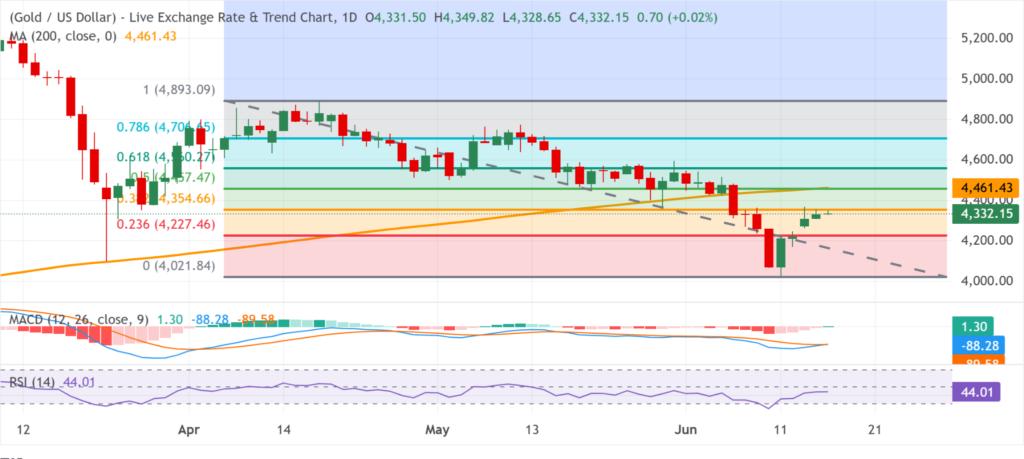
Spot gold is holding marginally above the $4,300 psychological pivot, while still failing to reclaim the $4,400 micro-resistance cluster, indicating that buyers are reducing exposure rather than adding directional risk. The broader structure remains capped beneath the 200-day Simple Moving Average (SMA), currently aligned near the $4,445–$4,450 zone, reinforcing a medium-term distribution phase rather than accumulation.
Price remains below the weekly swing high printed at $4,520, confirming that upside continuation has stalled at the 38.2% Fibonacci retracement of the April–June corrective leg, which acts as a key technical ceiling.
Monetary Policy Expectations: Fed Pricing Still Hawk-Weighted
The dominant driver remains the upcoming FOMC policy decision, with markets overwhelmingly pricing a policy hold scenario above 90% probability, but assigning increasing importance to the forward guidance path shift.
The key repricing mechanism is centered around expectations that the Fed may formally transition away from an implicit easing bias, reflecting the persistence of sticky core inflation dynamics, which remain above the medium-term target band.
Current market-implied pricing reflects approximately a 60% probability of a 25 basis point tightening cycle extension by December, indicating that terminal rate expectations have not fully peaked. This reduces the attractiveness of non-yielding assets like gold, particularly in real-yield-adjusted models.
The updated dot plot distribution is expected to be the primary volatility trigger. Any upward revision in the median policy path by even +25 basis points over the 12–18 month horizon could reinforce USD strength and compress gold multiples through higher discount rate assumptions.
Dollar Dynamics: Soft Bias but No Structural Breakdown
The US Dollar Index (DXY) remains in a mild corrective phase, with downside momentum constrained by persistent rate expectations. While geopolitical easing has reduced immediate safe-haven demand, the dollar has not entered a structural breakdown regime.
This creates a two-sided equilibrium condition where gold receives intermittent support from USD softness but lacks the macro tailwind required for a breakout above major resistance clusters.
Technical Structure: Resistance, Dominance, and Momentum Decay
From a technical standpoint, gold remains inside a compressed ascending corrective channel, but price action continues to respect a broader downtrend initiated from the $4,893 Fibonacci extension region.
The most significant technical barrier remains the $4,445–$4,450 confluence zone, which aligns the 200-day SMA with the 50% Fibonacci retracement of the April–June decline. This zone has acted as a repeated rejection band, confirming it as a high-volume supply area.
Momentum indicators reinforce this structure. The Relative Strength Index (RSI) is currently fluctuating near 44–46, indicating sub-neutral momentum with weak bullish divergence formation but no confirmed reversal signal. Meanwhile, the MACD histogram remains marginally positive but flat, reflecting deceleration of bearish momentum rather than true bullish expansion.
Critical Price Levels and Structural Inflection Zones
On the upside, immediate resistance is concentrated at $4,400, followed by a stronger technical ceiling at the $4,445–$4,450 zone, where both Fibonacci and long-term moving average resistance converge.
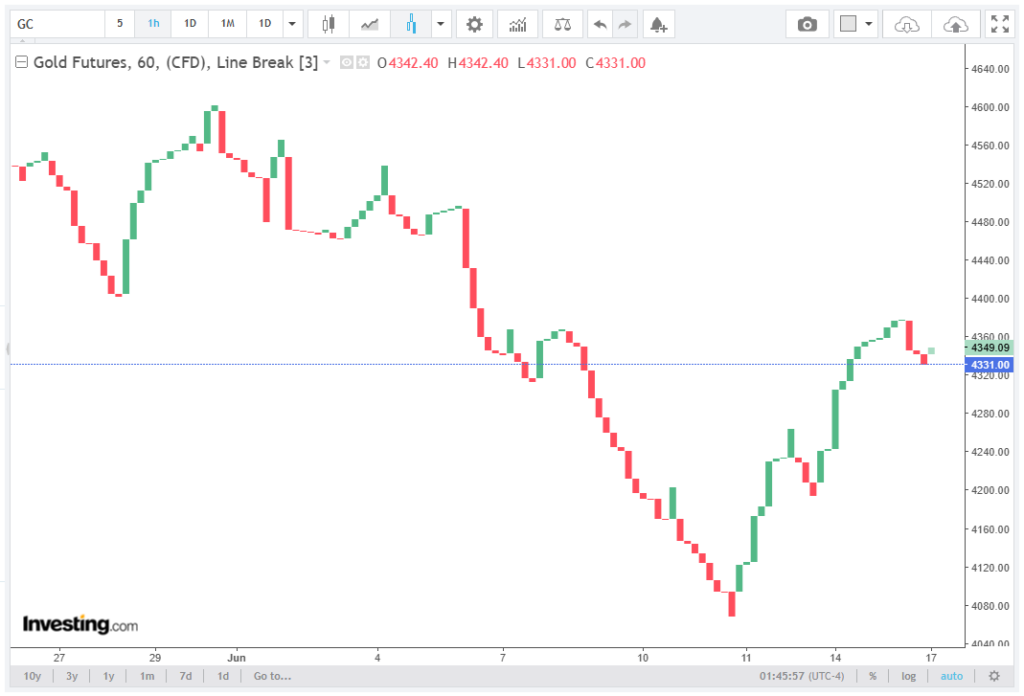
A decisive daily close above $4,450 would represent a structural shift, potentially converting the zone into support and triggering a move toward $4,560, corresponding to the 61.8% Fibonacci retracement level.
Above this level, liquidity gaps open toward $4,707, followed by a higher extension target near $4,893, which represents the upper boundary of the prior distribution leg.
On the downside, immediate support is located at $4,227, representing the 23.6% Fibonacci retracement threshold, which acts as the first structural defense against bearish continuation. A breakdown below this level exposes the $4,022 swing low, a critical structural floor that defines the boundary between corrective consolidation and renewed bearish trend expansion.
A sustained break below $4,022 would likely accelerate downside momentum through a liquidity vacuum zone, increasing downside volatility toward prior accumulation regions.
Conclusion: Pre-Event Equilibrium With Directional Breakout Pending
Gold remains in a state of technical equilibrium compression, driven by a combination of Fed policy uncertainty, geopolitical stabilization signals, and declining volatility regimes. The current price structure reflects indecision within a defined $4,227–$4,450 range, with both bulls and bears awaiting macro confirmation.
Until the FOMC delivers clarity through the dot plot trajectory and inflation-adjusted forward guidance, gold is likely to remain in a range-bound consolidation phase with a mild negative bias, where directional conviction remains suppressed, and volatility expansion is deferred to the post-announcement regime shift.