
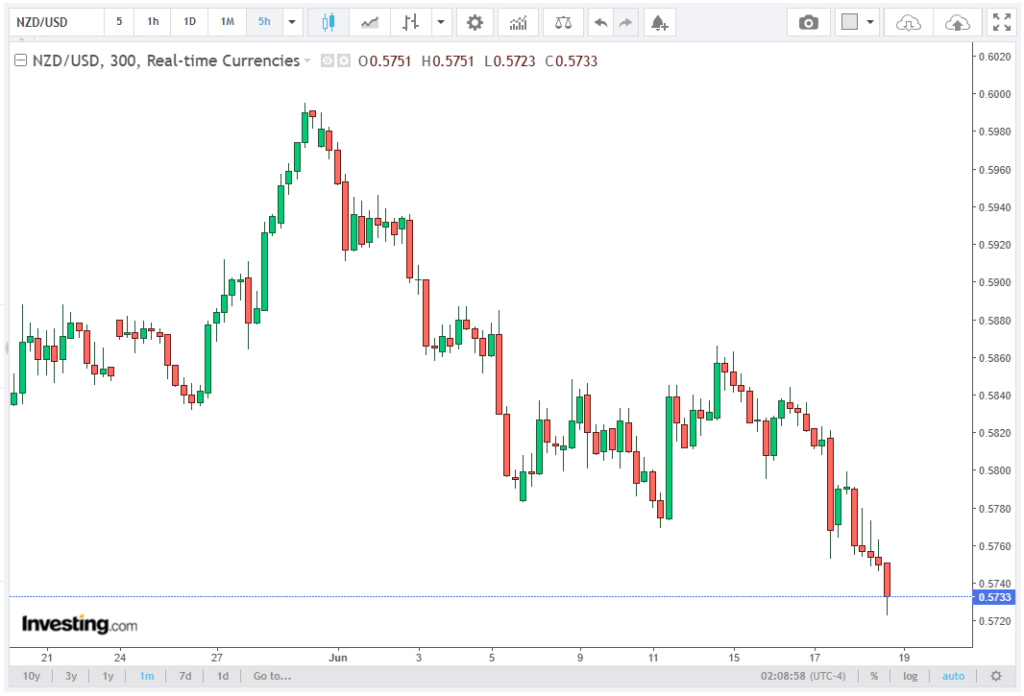
The New Zealand Dollar (NZD) continues to face sustained selling pressure against the US Dollar (USD), with the NZD/USD pair extending losses for a third consecutive session. The pair has slipped to a fresh low since April 8, reversing an earlier Asian session rebound toward the 0.5775 region.
At present, spot prices hover just below the mid-0.5700s, reflecting a market increasingly dominated by USD strength, interest rate divergence, and cautious risk sentiment. In the article, Rubinax’s brokerage professionals break down this topic with detailed insights and analysis.
The broader tone remains decisively bearish for the NZD as traders continue to price in a more hawkish Federal Reserve (Fed) outlook, which is reinforcing demand for the Greenback across FX markets.
US Dollar Strength Driven by Hawkish Fed Expectations
The primary driver behind the recent decline in NZD/USD is the sustained appreciation of the US Dollar Index (DXY), which has climbed to its highest level since May 2025. This rally reflects growing conviction that the Federal Reserve is unlikely to shift toward policy easing in the near term.
Fed policymakers have revised their projections for the federal funds rate, now expecting it to reach approximately 3.8% by the end of the year, up from 3.4% in March. This adjustment signals the potential for at least one additional 25-basis-point rate hike, reinforcing a clear hawkish monetary policy bias.
Higher US interest rate expectations continue to support the USD through multiple channels. First, they enhance yield differentials in favor of US assets, attracting capital inflows. Second, they reinforce the perception of US economic resilience relative to other major economies. Together, these forces maintain strong upward pressure on the Greenback, leaving risk-sensitive currencies such as the NZD on the defensive.
As a result, the NZD/USD pair remains structurally capped, with rallies being sold into as traders prioritize the USD carry advantage and safe-haven demand.
RBNZ Hawkish Shift Offers Partial Cushion for NZD
Despite persistent downside pressure, the New Zealand Dollar is not without support. The Reserve Bank of New Zealand (RBNZ) has adopted a more hawkish policy stance, signaling that interest rates may need to remain elevated for longer than previously anticipated.
Market expectations suggest that the Official Cash Rate (OCR) could rise toward approximately 2.85% by year-end, implying the possibility of up to three additional rate hikes. This repricing has introduced a degree of resilience in the NZD, preventing more aggressive bearish positioning.
A more hawkish RBNZ improves the relative yield attractiveness of NZD-denominated assets and partially offsets the impact of USD strength. However, the magnitude of Fed tightening expectations continues to dominate the interest rate differential narrative, keeping the NZD/USD bias tilted to the downside.
In essence, while the RBNZ provides a fundamental floor for the NZD, it is currently insufficient to counterbalance the stronger macro forces driving USD appreciation.
Price Action Signals Continued Bearish Momentum
From a technical perspective, the NZD/USD pair remains firmly entrenched in a downtrend structure. The recent failure to sustain gains above the 0.5775 area highlights persistent selling pressure during intraday rebounds.
The break toward a fresh multi-month low reinforces bearish momentum and suggests that sellers remain in control of the market. The pair is now threatening a broader retracement from the 0.6000 psychological level, which previously marked the May swing high.
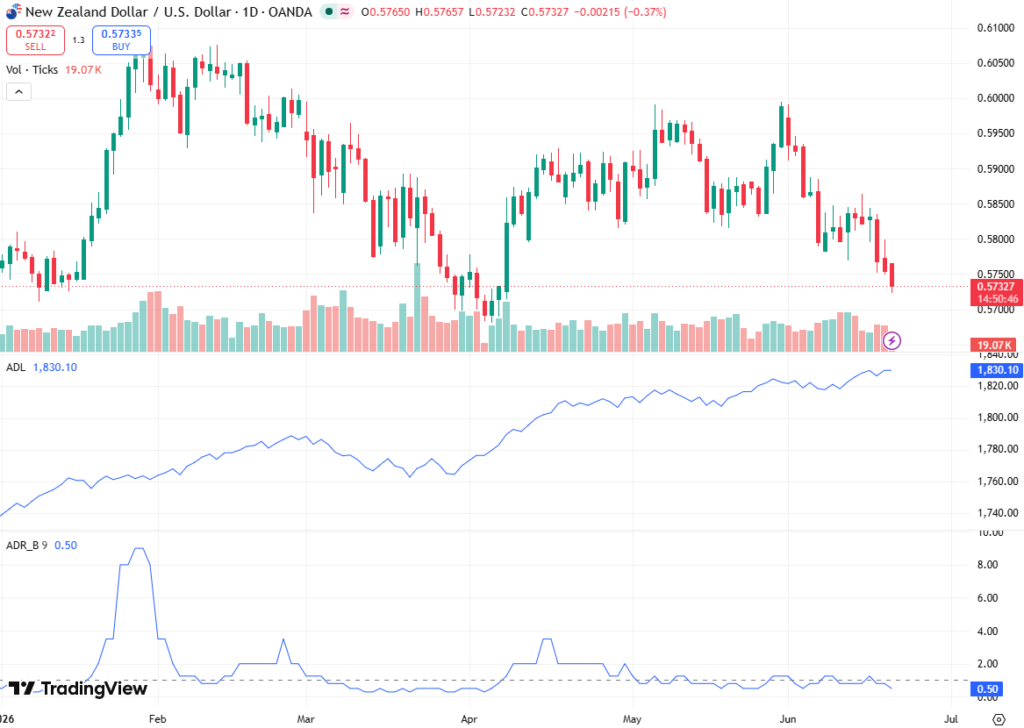
Momentum indicators continue to reflect a negative price bias, with rallies increasingly viewed as opportunities for profit-taking rather than trend reversal. Until the pair can reclaim and stabilize above key resistance zones, particularly in the 0.5800–0.5850 range, downside risks are likely to remain dominant.
Liquidity Conditions and Holiday Thin Trading Risk
Looking ahead, trading conditions may be affected by reduced liquidity due to the US Juneteenth National Independence Day holiday. Lower participation from US market operators often leads to exaggerated intraday volatility and less reliable price discovery.
In such environments, trend continuation can occur in low-volume conditions, but so can sharp corrective rebounds driven by thin order books. This makes it difficult for traders to confidently position for a sustained breakout without confirmation.
As a result, market participants are likely to remain cautious, preferring to wait for strong follow-through selling before anticipating an extension of the current downtrend.
Outlook: USD Dominance Remains Key Driver
Overall, the outlook for NZD/USD remains heavily influenced by the interplay between Fed hawkishness and RBNZ tightening expectations. However, the balance of risks continues to favor the USD.
Unless there is a meaningful shift in US rate expectations or a deterioration in US economic data, the US Dollar is likely to remain supported, limiting recovery attempts in the NZD.
For now, the pair appears poised to remain under pressure, with any rebounds likely to be viewed as corrective within a broader bearish continuation trend rather than a structural reversal.