
Dow Jones futures traded in an extremely narrow range around 52,040, signaling a clear volatility compression phase ahead of the Federal Reserve policy announcement. Price action remained subdued during European trading hours, with intraday movement contained within a tight band of less than 0.15%, indicating low conviction positioning among institutional participants.
In contrast, broader index futures showed mild upside bias. S&P 500 futures advanced approximately 0.26% to 7,540, while Nasdaq 100 futures outperformed with a 0.8% increase to 30,240. This divergence reflects a continued preference for high-duration growth exposure, even as overall leverage remains constrained ahead of a macro catalyst.
Cross-asset behavior suggests markets are in a pre-event hedging equilibrium, where directional exposure is reduced, and liquidity provision dominates intraday flows. In this article, you’ll find Sollventis’ brokers simplifying the topic with a mix of detailed explanation and guidance.
Interest Rate Expectations Anchored at 3.50%–3.75%
The dominant macro driver remains the upcoming Federal Reserve interest rate decision, with futures markets pricing an overwhelming probability of a policy hold under the Federal Reserve. The benchmark rate is expected to remain unchanged in the 3.50% to 3.75% corridor, reflecting a neutral-to-restrictive monetary stance.
Implied probability curves indicate more than 90% probability of no change, while only a marginal probability is assigned to any deviation. This has led to a collapse in short-term rate volatility expectations, with front-end rate instruments showing subdued repricing activity.
However, the focus has shifted away from the decision itself toward the policy trajectory signal embedded in the statement and projections. Even minor revisions in these variables could trigger repricing across equity risk premia, particularly in high-duration segments of the market.
Volatility Regime and Derivatives Positioning
Options market data suggests a continued volatility suppression regime ahead of the announcement from the Federal Reserve. Short-dated implied volatility remains elevated relative to realized volatility, indicating traders are pricing in a post-event expansion in price dispersion.
The spread between 1-week and 1-month implied volatility remains positive, reinforcing expectations of a binary macro event response structure. Historically, such configurations precede directional breakouts of 1.0%–2.5% in major indices within 24–48 hours following policy releases.
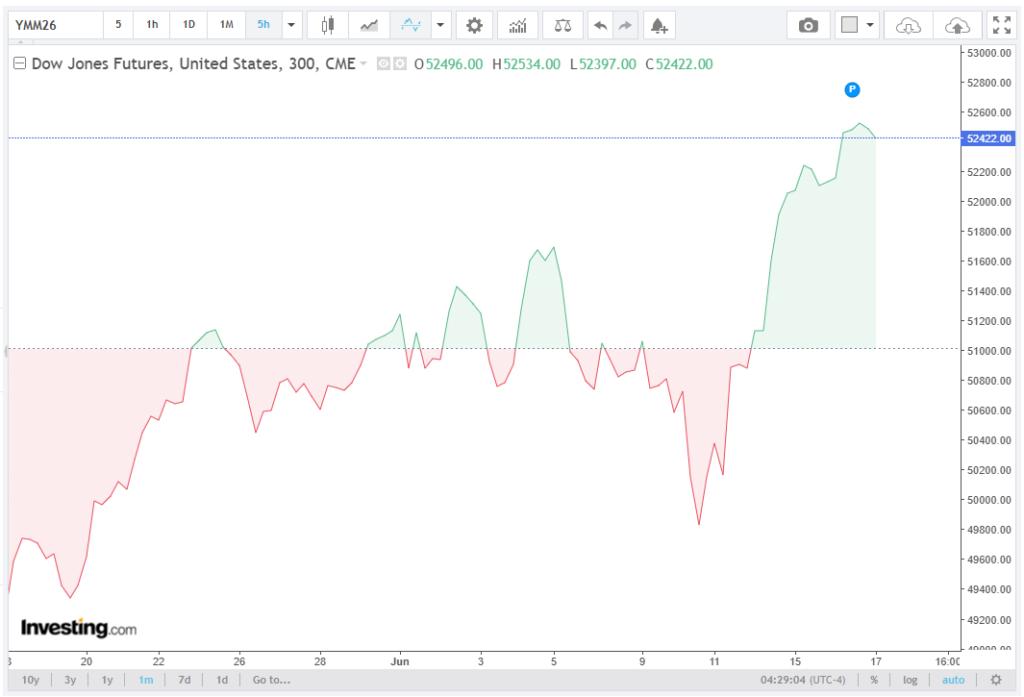
Equity futures positioning also reflects reduced directional conviction, with leveraged funds maintaining net-neutral exposure across large-cap indices while selectively increasing exposure to high-beta technology futures.
Previous Session: Divergence Across Major Indices
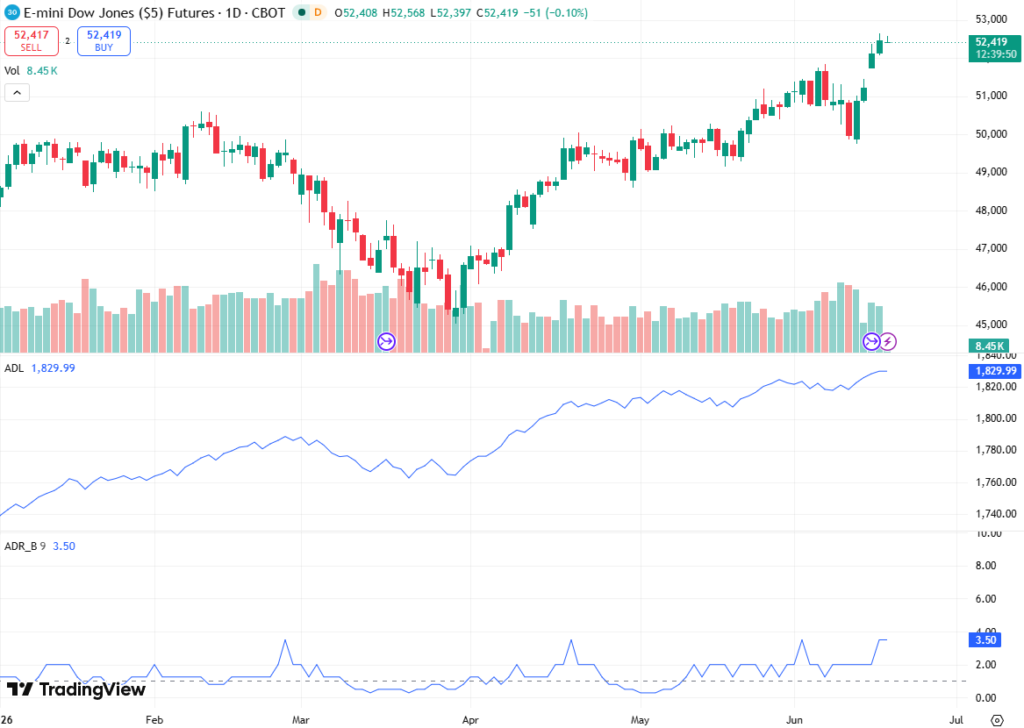
The prior US trading session displayed a clear index-level divergence pattern. The Dow Jones Industrial Average gained 0.64%, benefiting from defensive rotation flows and relative strength in non-technology components.
Conversely, broader equity benchmarks weakened. The S&P 500 declined 0.57%, while the Nasdaq 100 fell 1.15%, driven primarily by valuation compression in high-growth equities and sector-specific profit-taking.
Technology Sector Correction and Factor Rebalancing
The most pronounced weakness was concentrated in the semiconductor and AI infrastructure complex, where profit-taking accelerated after an extended multi-week rally.
Key downside moves included Micron Technology Inc. declining 6.2%, Broadcom Inc. falling 4.4%, and Nvidia Corporation retreating 2.4%. These moves were not driven by deteriorating fundamentals but rather by short-term valuation normalization and position de-risking.
The sector experienced a reduction in forward price-to-earnings expansion momentum, as investors recalibrated exposure following strong inflows into artificial intelligence-linked equities. This resulted in a temporary beta unwind across high-multiple technology names.
Despite the pullback, long-term structural demand indicators for AI compute infrastructure remain intact, suggesting the move is primarily technical rather than fundamental deterioration.
Cross-Asset Growth Narrative and Corporate Developments
Amid the broader tech consolidation, select high-growth narratives continued to attract capital. SpaceX recorded a 4.8% increase, extending gains following its recent market debut trading phase.
Market enthusiasm has been reinforced by speculation surrounding a potential $60 billion acquisition involving the AI assistant platform Cursor, highlighting accelerating consolidation dynamics within the AI software stack.
This development underscores an emerging macro theme: capital concentration in vertically integrated AI ecosystems, spanning hardware, cloud infrastructure, and applied machine intelligence layers.
Such transactions are increasingly viewed as strategic multipliers for long-duration growth assets, reinforcing the structural bid for companies positioned at the intersection of aerospace, data infrastructure, and AI compute systems.
Conclusion: Market Compression Ahead of Catalyst Event
The current market structure is defined by low realized volatility, compressed trading ranges, and elevated macro sensitivity ahead of the Federal Reserve decision. With Dow Jones futures stable near 52,040, markets are effectively in a pre-repricing equilibrium state.
This configuration typically precedes post-event volatility expansion, where market direction becomes increasingly sensitive to forward guidance signals rather than the rate decision itself. A break from the current range-bound structure is likely once policy communication resets short-term expectations across rate and equity derivatives markets.