
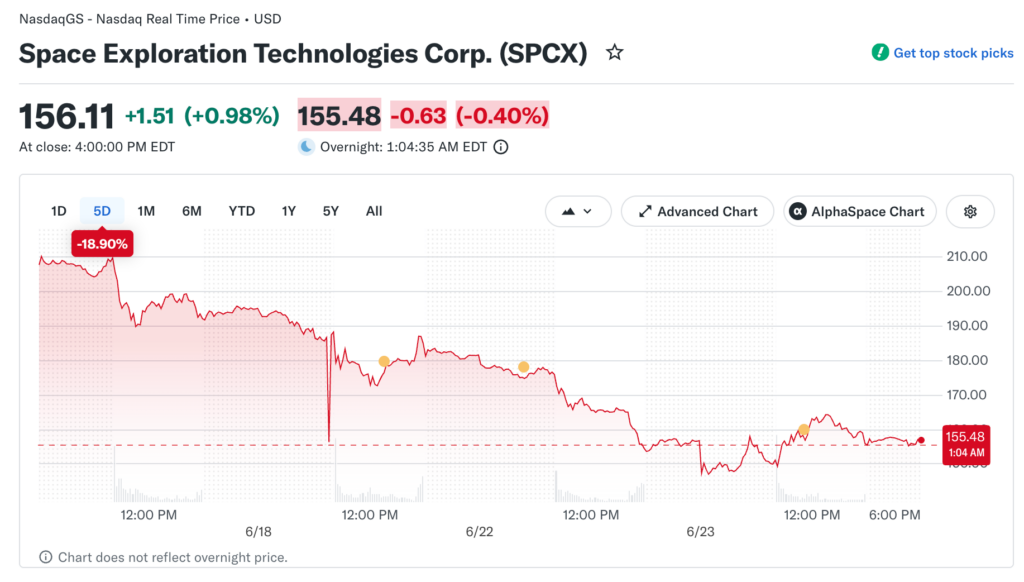
SpaceX (SPCX) shares fell sharply for a second consecutive session on June 23, 2026, declining around 8% after reports emerged that the company was proposing a $20 billion bond sale just days after its IPO closed on June 12.
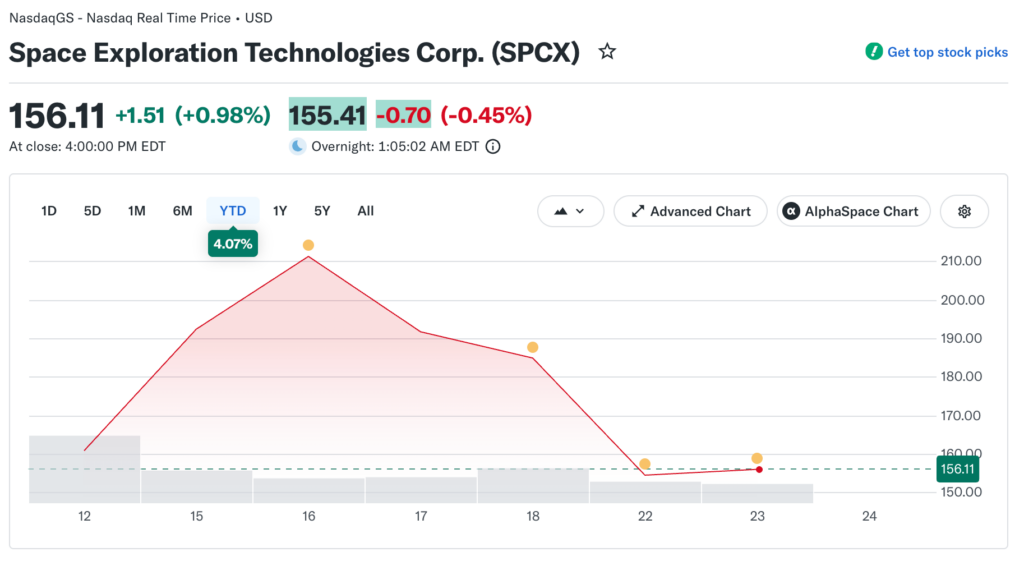
The stock, which peaked at $225.64 on June 17, has now entered bear market territory from its highs despite maintaining a market capitalization above $2.3 trillion. The brand’s junior broker highlights why the timing of the bond offering matters as much as its size, and what Kepler-Group sees as the key signals for investors holding SPCX at current levels.
The IPO-to-Bond Sequence and Why Markets Noticed
SpaceX raised $85.7 billion through its IPO, the largest public offering in American history. Within days of that close, the company disclosed it held approximately $100.8 billion in cash and cash equivalents as of June 19, and then simultaneously proposed a $20 billion bond sale. That sequence raised immediate questions about capital structure at a moment when the stock’s post-IPO enthusiasm was already under pressure from the broader technology selloff.
Issuing investment-grade bonds shortly after an equity raise is not inherently alarming. Large companies routinely optimize their capital structure by mixing equity and debt to reduce the overall cost of capital. What attracted scrutiny in SpaceX’s case was the sheer scale of the bond offering relative to the recent IPO and the speed with which it followed the equity raise.
What the $20 Billion Might Actually Fund
SpaceX’s capital requirements are genuinely enormous relative to most publicly traded companies. The Starship program requires continued heavy investment in manufacturing, launch infrastructure, and testing capacity.
The Starlink constellation needs ongoing replenishment launches and ground station expansion to maintain its subscriber base. The $60 billion Anysphere acquisition, parent company of the AI coding tool Cursor, adds another layer of integration investment that does not appear in most analyst models.
At $330 per share before the recent decline, SpaceX was priced to deliver on all three programs simultaneously and generate meaningful free cash flow on top of them. A $20 billion bond offering signals that management sees capital demands exceeding what the IPO proceeds alone will cover in the near to medium term.
The Bear Market Trigger and What Comes Next
A stock entering bear market territory within the first two weeks of trading as a public company is unusual. It does not necessarily signal business trouble. It does signal that the IPO price and the immediate post-IPO trading peak incorporated assumptions about future performance that subsequent news flow has not fully supported.
The bond proposal, a valuation that Morningstar has flagged as overextended, and the mechanical unwind of options-driven momentum buying have all contributed to the pullback from $225.64.
SpaceX’s $2.3 trillion remaining market cap still places it above Amazon and among the five largest public companies in the world, which tells you how much valuation remains embedded in the stock after a significant correction from its highs.
How the Bond Deal Fits the Broader AI Infrastructure Theme
One underappreciated angle in the SpaceX bond story is what the proceeds might fund in the context of AI infrastructure. If a meaningful portion of the $20 billion funds the Cursor integration or new AI-oriented product development within SpaceX, the market’s initial negative reaction may prove short-sighted over a longer time horizon.
The Nasdaq-100 inclusion, expected around early July 2026, will bring approximately $14 billion in forced passive buying regardless of how the bond deal is perceived, creating a floor beneath SPCX that is disconnected from any fundamental assessment.
The Metric That Will Determine the Recovery
Starlink subscriber growth, Cursor integration revenue, and the first formal quarterly earnings report as a public company are the three data points that will determine whether SPCX recovers toward its IPO-week highs or consolidates further at current levels.
The bond deal raises questions that the business itself has not yet had the opportunity to answer with actual reported financial results under public company disclosure standards. That information gap is the primary source of the uncertainty investors are currently pricing into the stock