
Micron Technology heads into its fiscal Q3 2026 earnings release on June 24 carrying a bruise it did not have at the start of the week. A broad semiconductor rout on June 23 sent shares down sharply to close at $1,074.60, erasing more than eleven percent in a single session before the company’s biggest earnings event of the year.
Street estimates call for revenue around $34.66 billion and earnings per share near $19.95. The brand’s lead financial analyst stresses that Kepler-Group treats this report as something rarer than a quarterly scorecard. It is a live referendum on whether the AI memory boom represents a lasting structural shift or a cycle that got well ahead of itself.
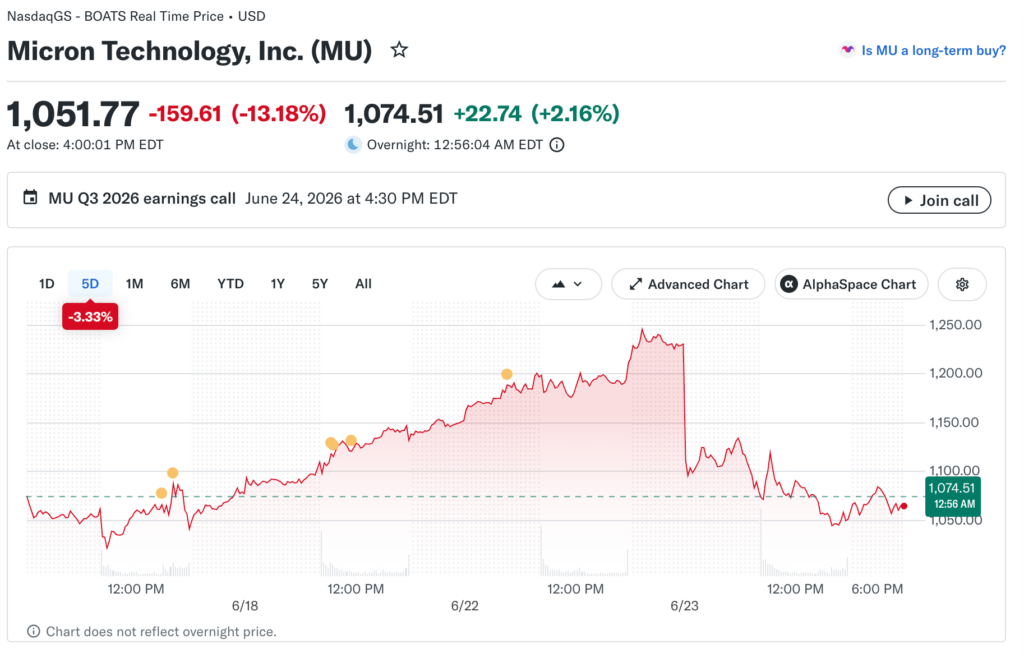
What Changes When a Stock Falls Hard Before It Reports
A double-digit pre-earnings drop reshapes the math in ways that work in both directions. Investors who were most exposed at the top have already trimmed or exited, leaving a cleaner holder base behind. Short positions accumulated during the selloff create potential covering demand if the numbers land well.
Meanwhile, the consensus estimate bar does not move just because the share price does, which means beating the same target now requires less stock price appreciation to look meaningful than it would have from a higher starting point.
Micron’s Q2 fiscal 2026 result landed more than 40 percent above consensus, with earnings per share of $12.20 against an $8.60 estimate. A repeat of that gap on June 24 would combine short covering and fundamental buying into a recovery move that could significantly exceed the pre-earnings decline in speed.
The Allocation Gap That Keeps the Bull Case Alive
At the heart of the Micron investment thesis sits a persistent mismatch between what customers need and what the industry can deliver. Buyers of high-bandwidth memory are currently able to source somewhere between half and two-thirds of their target bit requirements, with no clear timeline for the gap to close. That imbalance shifts pricing dynamics entirely in the supplier’s favor.
Deutsche Bank and TD Cowen both revised their price targets upward to $1,500 in the days leading into the June 24 print, with both citing an AI-driven demand environment that continues to outpace available supply well into 2028. Micron’s commitment of more than $25 billion in capital spending for fiscal 2026 reflects management’s view that this demand environment is structural rather than cyclical.
Why the Next Memory Generation Deserves Attention on This Call
The June 24 call represents the first real opportunity for Micron management to say something substantive about HBM4, the next iteration of high-bandwidth memory that follows the HBM3E product line. HBM4 is designed to deliver better performance and commands a higher price per unit than its predecessor.
Any production ramp commentary or early customer commitment signals would imply that Micron’s revenue per unit is set to rise even as overall volumes continue growing, a combination that produces margin expansion beyond what existing consensus models reflect.
Micron is progressing manufacturing facilities in Idaho, New York, Singapore, and Hiroshima, with the Tongluo site deal closing ahead of schedule. That execution track record is the kind markets price with a premium when paired with strong reported earnings.
Reading the DRAM ETF as a Separate Signal
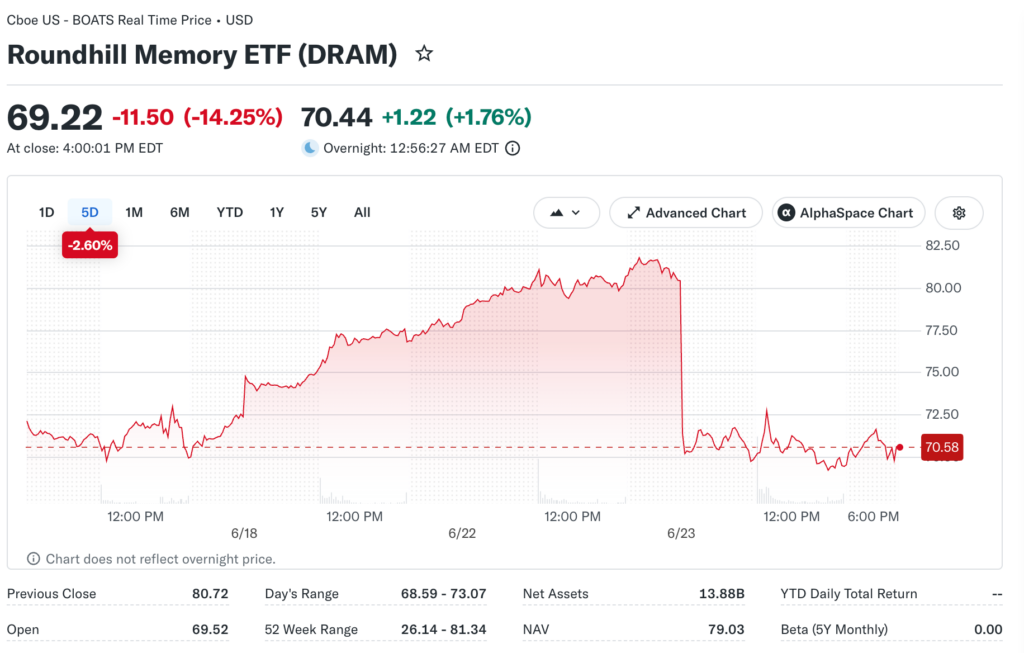
One detail from June 23 that cut against the prevailing narrative of the day was the DRAM ETF reaching a fresh record high while Micron’s individual shares were selling off by more than eleven percent in the same session.
Those two facts cannot both be right in the long run, but they can coexist briefly because they reflect different investor calculations. The ETF move represents a view on the memory industry broadly, while Micron’s single-stock decline reflects uncertainty about what a specific company will report in a specific quarter.
If June 24 confirms supply tightness and pricing discipline remain intact, that divergence collapses quickly. A disappointing print, however, would leave the ETF itself vulnerable to a catch-down move that extends sector losses into the following week.
A Background Signal That Got Buried
FedEx posted revenue of $25.0 billion and adjusted operating income of $2.09 billion on June 23, logging the lowest capital-to-revenue spending ratio in its history. Logistics volume growing at that pace is a real-economy confirmation that the demand environment supporting AI infrastructure has not cracked under higher borrowing costs.
Three Numbers to Watch After the Bell
When Micron reports after the close on June 24, three figures will carry more interpretive weight than anything else. Forward guidance on HBM3E and HBM4 customer allocations tells investors whether near-term pricing power is holding. Commentary on inventory held at the hyperscaler level reveals whether buyers are building buffer or running lean.
Any revision to the fiscal 2026 capital plan signals how management reads its own order book heading into the back half of the year. The elevated volatility environment surrounding the print means the market’s reaction, in either direction, will arrive fast and move far.