
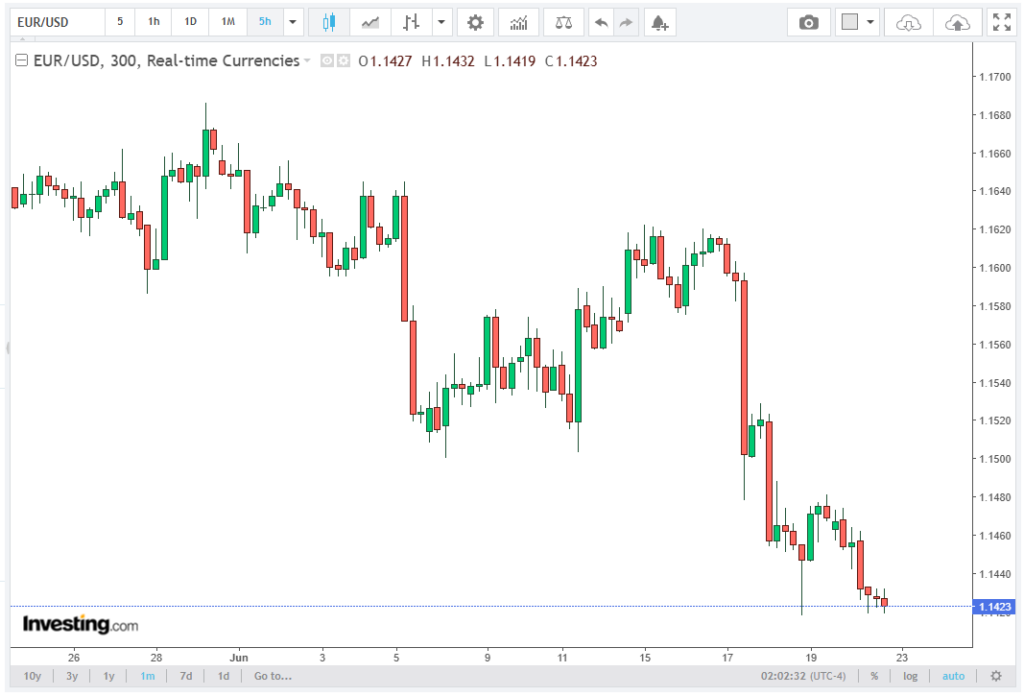
The EUR/USD pair extended its decline in Tuesday’s early European session, slipping toward 1.1425, marking modest losses as the Euro came under renewed selling pressure. The move reflects a combination of risk-off sentiment, a strengthening US Dollar (USD), and growing uncertainty around geopolitical developments involving the United States and Iran. This article features an in-depth analysis of the topic by Findtech Group’s expert brokerage team.
The pair’s drift lower below the 1.1450 threshold highlights a cautious market environment where traders are increasingly favoring the USD as a defensive asset, while reducing exposure to the more risk-sensitive Euro (EUR). Overall positioning remains fragile as markets reassess both monetary policy divergence and geopolitical stability.
US Dollar Strength and Risk-Off Flows
The US Dollar Index (DXY) edged higher in early trading, supported by broad-based demand for safe-haven assets. This appreciation in the USD has placed additional downward pressure on EUR/USD, reinforcing the pair’s intraday weakness.
A key driver behind this move is the persistence of risk-off sentiment. Investors remain hesitant to hold higher-beta currencies such as the Euro, especially amid unresolved geopolitical tensions and uncertainty regarding global growth momentum.
The latest price action suggests that traders are increasingly prioritizing capital preservation, rotating into the USD as both a liquidity anchor and a perceived safe-haven currency during periods of instability.
Federal Reserve Policy Expectations and Yield Support
Monetary policy expectations remain a central pillar supporting the US Dollar. Markets are increasingly positioning for a more hawkish Federal Reserve (Fed) trajectory under the leadership of new Chair Kevin Warsh.
Last week, the Fed opted to maintain its benchmark interest rate within the 3.50%–3.75% range, signaling a temporary pause rather than a pivot toward easing. However, Warsh emphasized that price stability will remain the Fed’s primary objective, reinforcing expectations that policy tightening may resume if inflation proves persistent.
According to the CME FedWatch Tool, markets are currently pricing in nearly an 89% probability of a Fed rate hike in December, a significant increase from approximately 61% before the last FOMC meeting. This sharp repricing underscores growing conviction that US monetary policy will remain restrictive for longer, providing strong structural support for the USD.
Higher expected interest rates increase the attractiveness of USD-denominated assets, boosting yield differentials against the Eurozone and contributing to continued EUR/USD downside pressure.
Macroeconomic Data Focus: PMI Releases Ahead
Markets are focused on upcoming PMI releases from Germany, the Eurozone, and the United States, with emphasis on manufacturing and services, and the key 50.0 threshold separating expansion from contraction.
In the Eurozone, PMIs are already close to or below 50, especially in manufacturing, which has remained in contraction for multiple months across core economies. A negative surprise of around -0.5 to -1.5 points vs expectations would reinforce weak growth, soft industrial output, and subdued demand, limiting EUR upside momentum.
In the United States, PMIs have been relatively stronger, often in the 50–55 range. An upside surprise of roughly +1 to +2 points would support economic resilience, sustain expectations for restrictive policy rates, and reinforce the USD yield advantage.
Overall, PMI data acts as a key short-term driver of rate expectations and growth differentials, meaning even small deviations can trigger sharp EUR/USD repricing. Reaction ranges of roughly 30–70 pips remain likely around releases, depending on surprise magnitude and direction.
Technical Outlook for EUR/USD
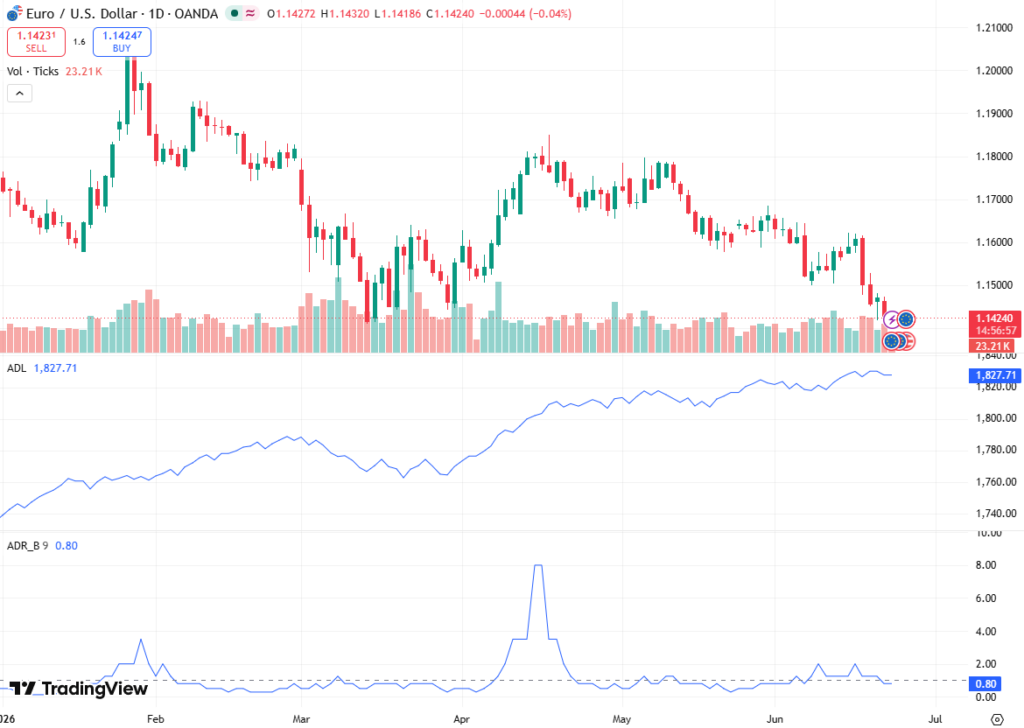
From a technical perspective, the EUR/USD pair remains under mild bearish pressure after failing to sustain levels above 1.1450. The break lower toward 1.1425 signals weakening bullish momentum and reinforces the presence of a near-term resistance zone between 1.1460 and 1.1480.
Immediate support is now seen near 1.1400, a psychologically significant level that may act as a short-term floor. A decisive break below this zone could expose the pair to further downside toward 1.1360, where previous consolidation levels may attract renewed buying interest.
On the upside, recovery attempts will likely face resistance from both technical barriers and macro-driven USD strength. Any sustained rebound would require a clear shift in either Fed policy expectations or a reduction in geopolitical tensions, neither of which appears imminent.
Conclusion
The EUR/USD pair’s decline below 1.1450, with trading near 1.1425, reflects a convergence of hawkish Federal Reserve expectations, US Dollar strength, and escalating geopolitical uncertainty surrounding US–Iran relations.
As markets continue to price in a high probability of further US rate hikes and navigate unresolved diplomatic tensions in the Middle East, the Euro remains structurally vulnerable in the near term.
Upcoming PMI data releases will serve as a critical catalyst for short-term direction, but unless there is a meaningful shift in either monetary policy expectations or geopolitical risk sentiment, the USD is likely to retain its defensive advantage over the Euro.