
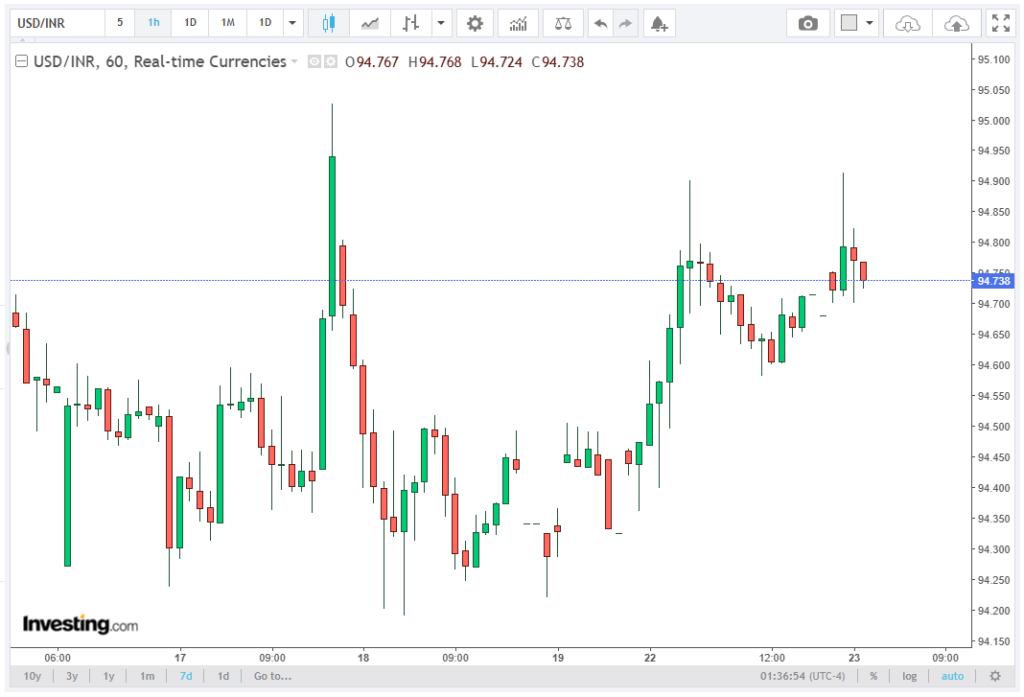
The Indian Rupee (INR) remains confined within a narrow intraday and multi-session range against the US Dollar (USD), with USD/INR trading around 94.60–94.75. Price action continues to reflect a low-volatility consolidation regime, where directional conviction is limited due to offsetting macroeconomic drivers. In this article, Findtech Group’s team of specialist brokers explores the topic in detail.
The pair is structurally influenced by a combination of USD strength driven by rate expectations and partial INR support from lower crude oil prices, resulting in a compressed trading band of roughly 0.8%–1.1% over recent sessions.
The US Dollar Index (DXY) remains firm near 101.0, indicating sustained broad-based USD appreciation against major currencies and reinforcing a tight correlation between USD/INR and global dollar liquidity conditions.
Monetary Policy Divergence and USD Yield Advantage
The dominant macro driver remains expectations of tighter policy from the Federal Reserve. Market pricing continues to reflect a hawkish repricing cycle, with implied terminal rate expectations shifting higher following recent macroeconomic data.
Forward-looking projections from Bank of America indicate three additional 25-basis-point rate hikes, distributed across the second half of the year. This implies a cumulative tightening of +75 bps, pushing policy rates toward the 3.75%–4.00% implied corridor, depending on realized inflation persistence.
The current policy rate remains in the 3.50%–3.75% range, but forward guidance embedded in the latest dot-plot trajectory suggests a projected endpoint near 3.8%, reinforcing a higher-for-longer interest rate regime.
From a FX perspective, this widens the interest rate differential (IRD) between USD and INR assets, increasing demand for USD-denominated carry and limiting INR appreciation potential. The result is persistent USD bid support in the 94.20–95.60 USD/INR zone.
Crude Oil Dynamics and External Balance Support
Crude oil prices continue to function as a counterbalancing macro variable for the INR. Brent-linked benchmarks and MCX crude futures remain near multi-month lows, with the domestic contract hovering around 7,000–7,050, compared with a recent swing low near 6,900.
This represents a retracement of approximately 8%–10% from prior local peaks, easing India’s import bill pressure and improving near-term current account stability.
The downward pressure in oil is driven by improving expectations of expanded supply availability and easing geopolitical risk premiums, particularly as negotiations around energy-linked geopolitical constraints progress. This reduces implied risk-adjusted crude pricing, compressing volatility in the energy complex.
For India, where crude imports account for a significant portion of trade expenditure, every $10 per barrel decline in oil prices typically improves the trade balance by an estimated 0.3%–0.4% of GDP equivalent annualized impact, indirectly supporting INR stability.
However, this support remains insufficient to offset USD strength, given the scale of global interest rate differentials.
Technical Structure: Descending Triangle with Bearish Bias
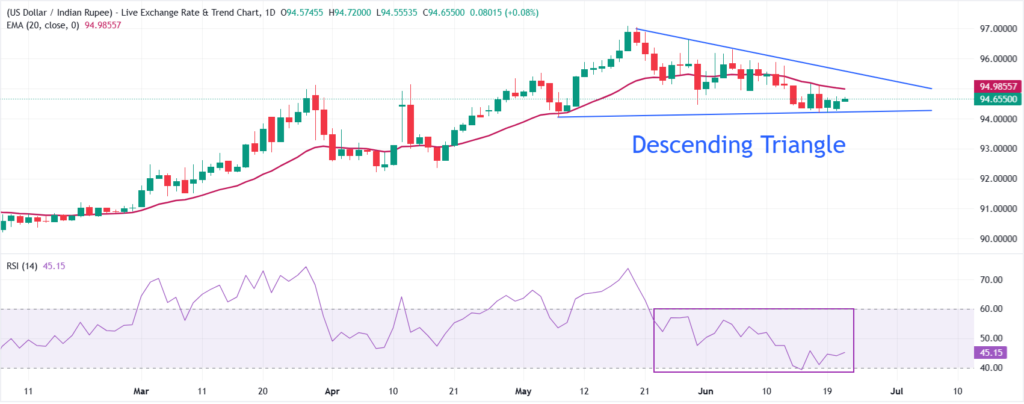
USD/INR price structure continues to evolve within a descending triangle consolidation pattern, characterized by lower highs and a stable support base.
Spot levels remain anchored near 94.65, with intraday volatility compressed within a ~35–45 paise range, reflecting declining realized volatility.
Key technical parameters include the 20-period Exponential Moving Average (EMA), which is positioned near 94.98, acting as dynamic resistance. Price rejection below this level reinforces short-term bearish pressure.
A broader structural resistance trend line is located near 95.55–95.60, marking the upper boundary of the descending channel. Sustained trading above this level would be required to invalidate the current bearish micro-structure.
Momentum indicators show that the Relative Strength Index (RSI 14) is positioned just below the 50 neutral threshold, indicating neutral-to-negative momentum skew without entering oversold territory. This suggests continued range compression rather than trend reversal exhaustion.
Support levels remain concentrated near 94.20–94.25, representing the lower boundary of the current ascending micro-support trend line. A breakdown below this zone would expose a potential extension toward lower liquidity pockets, with increased downside velocity likely.
Forward Outlook: Macro Compression Phase
The USD/INR pair remains in a macro compression phase, where directional breakout requires a catalyst from either.
A shift in Fed policy trajectory from the Federal Reserve, particularly a deviation from the projected tightening path, or a stronger-than-expected acceleration in Indian macro growth differentials.
At present, neither condition is present. The interest rate differential remains USD-favorable, while India’s PMI trajectory indicates steady but decelerating expansion.
Lower crude oil prices provide a structural cushion, improving external stability metrics, but are not sufficient to offset the USD yield advantage gap of several hundred basis points.
As a result, USD/INR is expected to remain in a tight equilibrium band, with structural resistance near 95.60 and support near 94.20, continuing a regime of range-bound consolidation with slight upside bias for USD flows driven by global monetary conditions.