
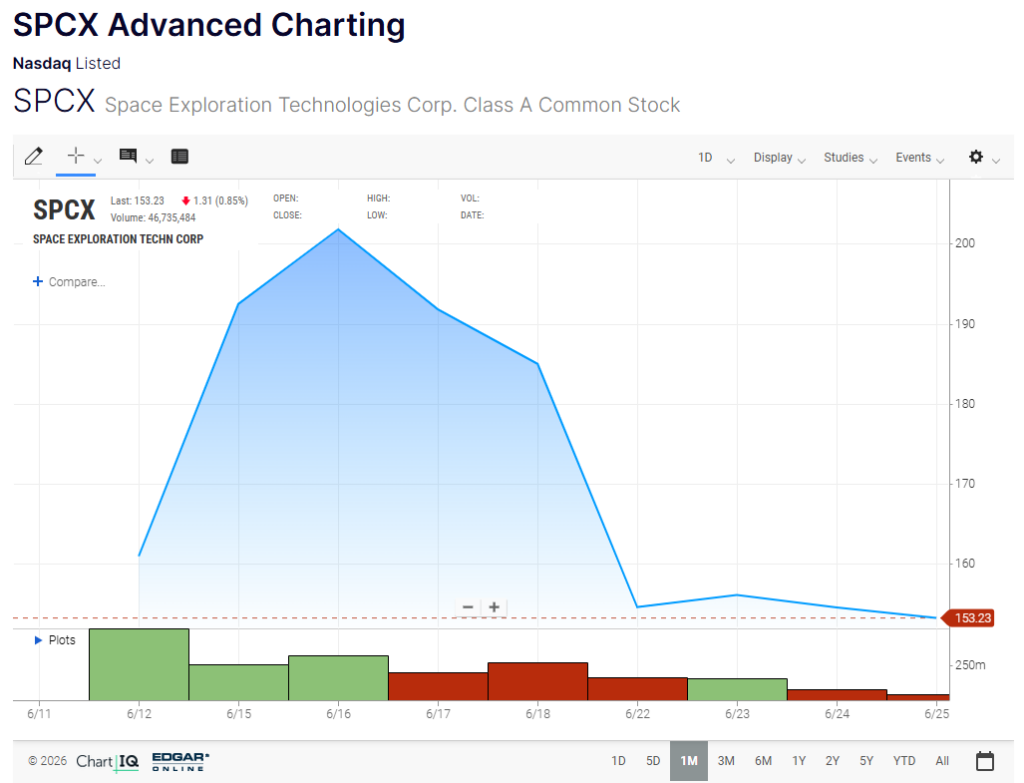
SpaceX has experienced more volatility in its first two weeks of trading than many companies see over several years. Since its June 12 IPO debut, the stock has surged to record highs, plunged during a sharp multi-day selloff that wiped out an estimated $400 billion in market value, and then rebounded once again this week.
The dramatic swings highlight how sensitive the stock remains to AI-sector sentiment, Federal Reserve policy expectations, and broader risk appetite, rather than company-specific developments. Below, Risance‘s equity research team examines the key events behind the rally, selloff, and subsequent recovery.
Record-Breaking Debut
SpaceX entered the public markets with unprecedented scale. The company priced its IPO at $135 per share, selling 555.5 million shares and raising approximately $75 billion, making it the largest IPO ever completed.
The offering immediately became one of the most closely watched events in recent market history, drawing interest from institutional investors, retail traders, and technology-focused funds eager to gain exposure to the company’s expanding presence in AI infrastructure, cloud computing, and next-generation technology markets.
When SpaceX began trading on the Nasdaq on June 12, investor demand was exceptionally strong, driven by optimism surrounding AI spending and the company’s position as a major technology player. The stock gained ground during its first three trading sessions, reflecting intense market enthusiasm.
At its peak, shares traded nearly 50% above the IPO price, briefly boosting SpaceX’s valuation and reinforcing its status as one of the most valuable publicly traded technology companies. The rally was fueled by both confidence in the company’s growth prospects and the broader AI investment boom.
Three Sessions Up, Three Sessions Down
The strong post-IPO rally proved difficult to maintain. After reaching an intraday high near $225, SpaceX shares reversed sharply as investors began taking profits and market sentiment toward growth stocks weakened. Over the following three sessions, the stock fell more than 16%, dropping to $185 by June 18 before sliding further to $165.08 on June 22.
From its peak, the stock lost roughly 25% of its value, including a single-day decline of more than 10% and three consecutive losing sessions. The pullback was driven by a combination of profit-taking, concerns about AI spending sustainability, and changing Federal Reserve policy expectations, which pressured technology stocks broadly.
Despite the correction, SpaceX remained well above its $135 IPO price, indicating that early investors were still sitting on substantial gains. The episode underscored both the excitement and volatility that often accompany high-profile technology IPOs during the price-discovery phase.
What Triggered the Reversal
Multiple factors weighed on investor sentiment simultaneously. Concerns over AI talent departures across the technology sector intensified after reports that senior researchers were leaving Alphabet for competing firms, contributing to a 5% decline in Alphabet shares and spilling over into other AI-related companies, including SpaceX, given its expanding AI infrastructure ambitions.
The weakness was broad-based, with Amazon falling about 4.8%, Meta Platforms declining roughly 2.3%, and Microsoft slipping around 3% during the same period.
Although SpaceX briefly reduced its losses after announcing a computing partnership with AI startup Reflection, the positive impact was short-lived as broader market uncertainty and risk-off sentiment continued to pressure technology stocks.
A Hawkish Fed Adds to the Pressure
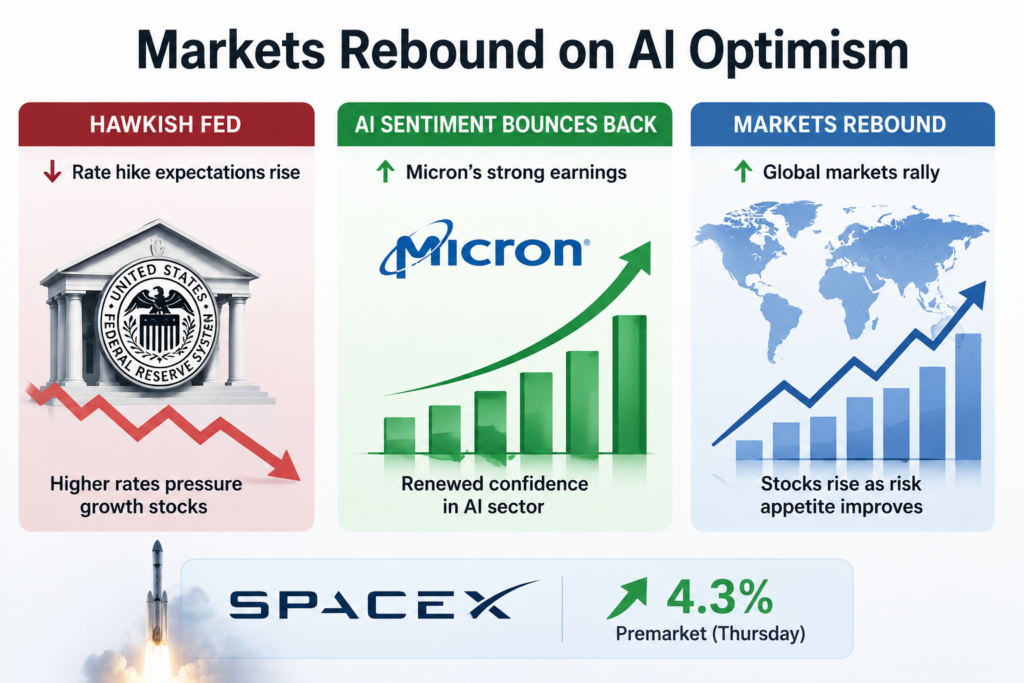
The larger source of pressure came from changing expectations for Federal Reserve policy. New Fed Chair Kevin Warsh adopted a more hawkish stance than markets anticipated, surprising investors who had largely expected interest rates to remain near 3.5%.
This shift is particularly significant for capital-intensive, debt-dependent companies such as SpaceX and other AI infrastructure firms, where higher financing costs can directly impact growth plans. According to Barclays, hyperscalers are expected to issue around $200 billion in new debt this year to support AI-related capital expenditures, making rising borrowing costs a meaningful headwind for the sector’s long-term growth outlook.
Wednesday’s Bounce: AI Sentiment Snaps Back
Sentiment improved sharply by Wednesday after Micron’s strong fiscal third-quarter earnings report renewed investor confidence in the broader AI sector. SpaceX participated in the rebound, rising 4.3% to approximately $160.98 in premarket trading on Thursday.
The positive momentum extended globally, with South Korea’s Kospi index jumping as much as 6%, while declining oil prices provided an additional boost to risk appetite, supporting gains across international equity markets.
What It Means for the Stock Going Forward
SpaceX’s first two weeks as a public company highlight the volatility that often accompanies price discovery in a major IPO. The stock’s movements have been driven more by broader AI market sentiment, Federal Reserve policy expectations, and overall tech-sector risk appetite than by company-specific developments.
Until investors establish a clearer view of fair value, SpaceX is likely to continue trading as a high-beta proxy for the AI theme, with share price movements remaining closely tied to shifts in market sentiment rather than the more stable trading patterns typically seen in mature large-cap companies.