
The USD/JPY pair remains in a bullish consolidation phase during Tuesday’s Asian session, trading above 161.50 after retreating from the 161.95-162.00 resistance zone. Despite the modest pullback, the pair continues to hold near its highest levels in roughly four decades, underscoring the strength of the prevailing uptrend. The expert brokers at Findtech Group take a deep dive into this topic in the article.
Price action remains supported by a combination of USD strength, a wide US-Japan yield differential, and persistent weakness in the Japanese Yen (JPY). However, increasing speculation regarding potential foreign-exchange intervention by Japanese authorities is limiting aggressive upside positioning and contributing to near-term consolidation.
Intervention Concerns Cap Momentum Near 162.00
Market participants remain cautious as USD/JPY approaches the psychologically significant 162.00 handle, an area historically associated with heightened intervention risks. Recent comments from Japanese officials and reports of discussions between Japanese and US authorities regarding currency volatility have reinforced expectations that excessive yen depreciation could trigger policy action.
These concerns have prevented fresh speculative selling of the JPY and created a temporary ceiling for spot prices. Nevertheless, intervention threats alone have yet to generate a sustained reversal, particularly as underlying macroeconomic fundamentals continue to favor further USD appreciation against the Japanese currency.
Yield Differential Continues to Support USD/JPY
The primary driver behind the longer-term bullish trend remains the substantial interest-rate differential between the United States and Japan. US Treasury yields continue to trade well above comparable Japanese government bond yields, preserving favorable carry-trade dynamics.
As long as this yield spread remains elevated, demand for USD-denominated assets is likely to continue supporting USD/JPY. Moreover, the US Dollar Index (DXY) remains near its strongest levels since May 2025, providing an additional tailwind for the pair.
Meanwhile, concerns surrounding the Middle East conflict and potential disruptions to energy shipments through the Strait of Hormuz could negatively impact Japan’s energy-import-dependent economy. Such risks tend to weaken the JPY by worsening trade-related pressures and increasing economic uncertainty.
Technical Outlook Remains Constructive
From a technical perspective, the broader trend remains decisively bullish. Last week’s confirmed breakout above the former intervention zone at 160.50-160.60 represented a significant structural development and reinforced the continuation of the medium-term uptrend.
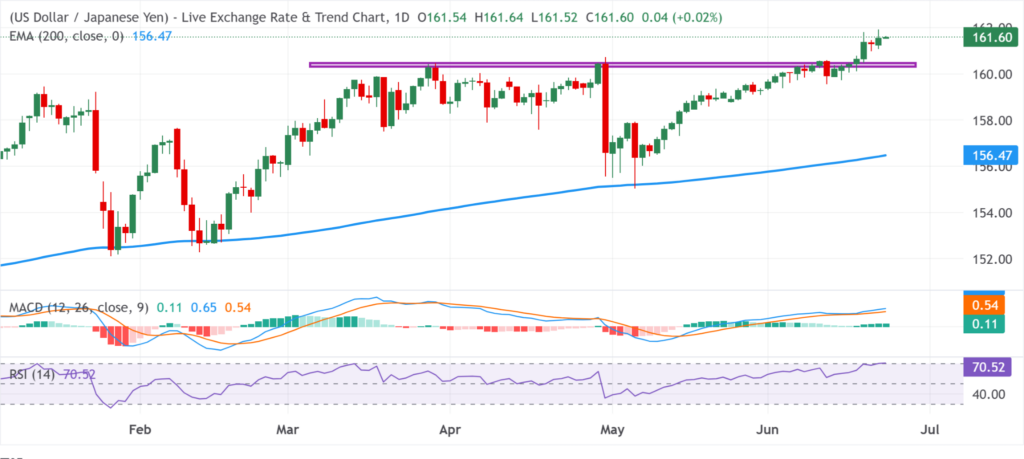
The breakout followed a strong rebound from the 200-day Exponential Moving Average (EMA), currently located at 156.47, highlighting the strength of underlying buying interest. The ability of bulls to maintain price action above 160.50 keeps the breakout structure valid and preserves the positive outlook.
The next major resistance remains positioned at 162.00, followed by potential extension targets near 162.50 and 163.00 if bullish momentum accelerates. A sustained break above the July 2024 high would place USD/JPY in a fresh multi-decade trading range with limited historical resistance overhead.
Momentum Indicators Signal Strength but Also Caution
Momentum studies continue to favor the upside, although signs of short-term exhaustion are becoming increasingly visible.
The Relative Strength Index (RSI 14) is fluctuating near the 70 level, indicating overbought conditions. While elevated RSI readings often precede consolidation phases, they do not necessarily signal an imminent trend reversal, especially within strong directional markets.
At the same time, the Moving Average Convergence Divergence (MACD) remains firmly above both its signal line and the zero axis, confirming that bullish momentum continues to dominate the broader market structure.
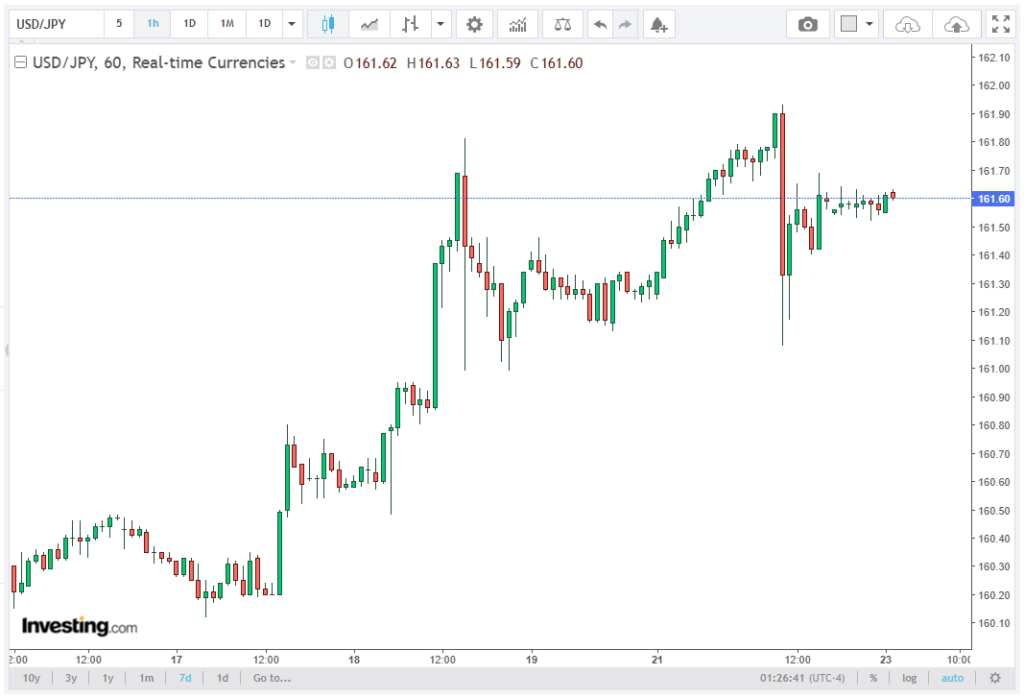
Accordingly, the most probable near-term outcome, based on the current indicator structure, is either a period of consolidation or a modest corrective pullback. Any such retracement would be consistent with a healthy continuation of the broader uptrend, allowing momentum indicators to reset before potential continuation of the prevailing bullish trajectory.
Key Levels to Watch
The immediate support zone is located at 160.60–160.50, which now serves as the primary structural pivot following last week’s breakout and recent consolidation. A decisive break below this region could expose additional downside momentum toward 159.00 and 158.00, where buyers may attempt to re-establish control.
On the upside, the 162.00 resistance area remains the key near-term barrier and breakout trigger. A sustained move above this level could ignite a renewed bullish leg toward 162.50 and 163.00, with scope for further extension if momentum accelerates, as traders continue to target fresh multi-decade highs.
Overall, the technical bias remains bullish while USD/JPY holds above 160.50. Although intervention concerns may continue to generate volatility and limit immediate gains, the combination of strong trend structure, positive MACD readings, persistent yield-spread support, and a firm US Dollar suggests that dips are likely to attract buyers, keeping the focus on a potential test and break of the 162.00 threshold.