
The GBP/USD cross is trading around 1.3195, remaining under pressure during Thursday’s European session after UK Prime Minister Keir Starmer’s resignation announcement on Monday triggered a wave of political and fiscal uncertainty.
The intraday structure reflects a controlled corrective pullback rather than a disorderly sell-off, with price still operating inside a medium-term bearish consolidation channel. This article offers a detailed exploration of the topic, led by Risance team of expert brokers.
Selling pressure has been concentrated near 1.3140 to 1.3160, the pair’s multi-month trough, where dip buyers have repeatedly stepped in. Despite this support, upside momentum remains limited, indicating that the market is still balancing UK political transition risk against a more hawkish Federal Reserve outlook that continues to support broad dollar strength.
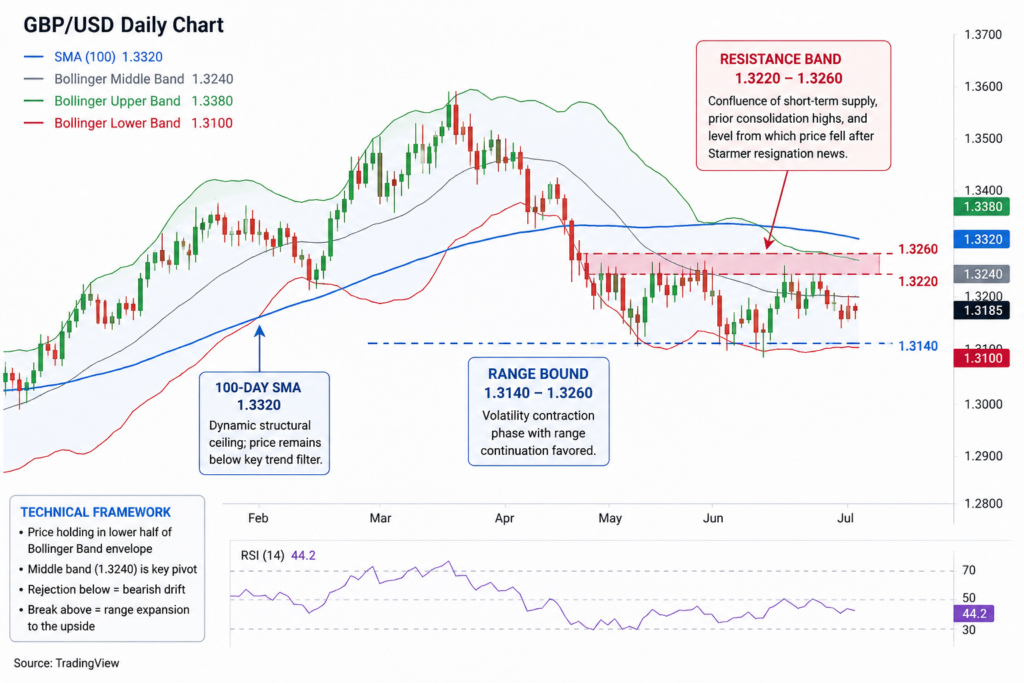
Price Structure: Pressure Below the 1.3220 Resistance Band
GBP/USD remains compressed below the key 1.3220–1.3260 resistance zone, an area reinforced by short-term selling pressure, previous consolidation highs, and the selloff triggered by Starmer’s resignation news.
Multiple rejections from this range suggest the pair is in a volatility contraction phase, with upside attempts being capped by political uncertainty, broad US dollar strength, and weak UK economic data. Recent PMI readings were disappointing, with the Composite PMI at 49.4 and Services PMI at 48.7, both indicating economic contraction.
With intraday volatility narrowing to 0.004–0.006, the market is increasingly likely to remain range-bound between 1.3140 and 1.3260 until a stronger catalyst drives a breakout.
Technical Structure: Bollinger and SMA Framework
GBP/USD remains technically vulnerable on the daily chart, with price continuing to trade below the 100-day SMA near 1.3320, which is acting as a key resistance level and reinforcing the broader bearish trend.
The pair is also trading in the lower half of its Bollinger Band range (1.3100–1.3380), indicating that downside pressure remains dominant. The 1.3240 Bollinger middle band is the critical pivot level: continued rejection below it supports a bearish outlook, while a decisive break above 1.3240 could signal improving momentum and a move toward higher resistance levels.
Momentum Analysis: RSI Signals Neutral-Bearish Drift
The Relative Strength Index (RSI) is currently positioned at 38.2, reflecting a mild bearish tilt within a neutral regime. This reading sits below the 50 equilibrium level but remains above the 30 oversold threshold, indicating the market is correcting rather than capitulating.
Historically, RSI readings in the 35 to 40 band during GBP/USD downtrends tend to correspond with consolidation phases rather than sharp reversals, particularly while price remains below the 100-day SMA. Momentum compression here is consistent with current price behavior, suggesting volatility is being stored for a more decisive move once clarity emerges on Labour’s leadership contest and the Fed’s next policy signal.
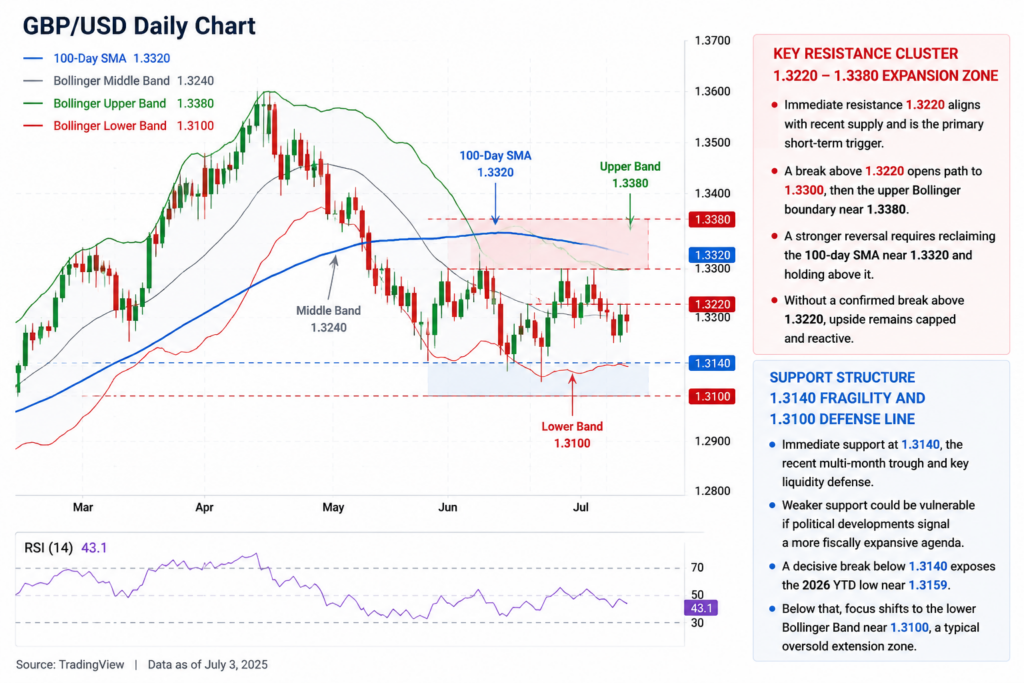
Key Resistance Cluster: 1.3220 to 1.3380 Expansion Zone
Immediate resistance sits at 1.3220, aligning with recent supply and acting as the primary short-term trigger level. A sustained break above 1.3220 would shift structure from consolidation to corrective recovery, opening a path toward 1.3300, followed by the upper Bollinger boundary near 1.3380.
Beyond that range, a stronger reversal signal would require GBP/USD to reclaim the 100-day SMA near 1.3320 and hold above it, which would meaningfully alter the pair’s medium-term trend classification. Without a confirmed break above 1.3220, upside remains technically capped and reactive.
Support Structure: 1.3140 Fragility and 1.3100 Defense Line
Immediate downside focus remains on 1.3140, the pair’s recent multi-month trough, which has become a key liquidity defense level. Repeated tests of this zone indicate active absorption, but weakening support integrity, particularly if the Labour leadership contest produces signals of a more fiscally expansive agenda once nominations open on July 9.
A decisive break below 1.3140 would expose the 2026 year-to-date low near 1.3159 and, beyond that, the lower Bollinger Band near 1.3100, a zone that typically represents statistical oversold extension where mean-reversion probability increases.
Conclusion: Consolidation With Mild Bearish Structural Bias
GBP/USD maintains a mildly bearish medium-term outlook, with price remaining below the 100-day SMA near 1.3320 and trading within the lower Bollinger Band range. The pair continues to face pressure from UK political uncertainty and a stronger US Dollar driven by rising Fed rate-hike expectations, keeping it capped below 1.3220.
For now, the market is largely range-bound between support at 1.3140–1.3100 and resistance at 1.3220. A break above 1.3220 could pave the way toward 1.3300 and 1.3380, while a drop below 1.3100 would increase the risk of a deeper correction. Until a breakout occurs, GBP/USD is likely to remain in consolidation with a mildly bearish bias.