
Investor caution before the latest Federal Reserve decision weighed on the New Zealand Dollar, pushing the NZD/USD pair toward the 0.5820 level. Brokers from Achievements AI look at the main factors affecting the currency pair and what they could mean for the market.
Many investors have become more careful due to uncertainty about future interest rate decisions in the United States. Because of this, higher-risk currencies like the New Zealand Dollar have found it difficult to attract buyers, while the US Dollar has remained stronger as investors seek stability during uncertain market conditions..
Federal Reserve Remains the Primary Market Focus
The upcoming Federal Reserve meeting is expected to be the most significant catalyst for currency markets in the near term.
Current expectations suggest that policymakers will keep the benchmark interest rate unchanged within the 3.50% to 3.75% range. While the decision itself is widely anticipated, investors remain highly focused on the Fed’s guidance and policy outlook.
Any indication that US policymakers intend to maintain restrictive monetary conditions for an extended period could further strengthen the US Dollar. Higher interest rates typically increase the appeal of US-denominated assets, encouraging capital inflows and creating challenges for currencies with lower relative yields.
For NZD/USD, this means market sensitivity remains elevated, and even small changes to policy language, economic forecasts, or future rate expectations could trigger significant moves across the foreign exchange market.
Improving Geopolitical Conditions Offer Limited Support
Although monetary policy remains the dominant market driver, recent geopolitical developments have introduced a degree of optimism into global markets.
Reports of renewed diplomatic engagement between the United States and Iran have improved investor confidence and reduced some concerns surrounding geopolitical risk. Discussions aimed at easing tensions have contributed to a modest improvement in overall market sentiment.
Typically, improving risk conditions can benefit growth-sensitive currencies such as the New Zealand Dollar (NZD). However, the impact has remained limited as traders continue prioritizing central bank policy expectations over geopolitical headlines.
Until greater clarity emerges from monetary authorities, geopolitical developments are likely to remain a secondary influence on currency valuations
Domestic Economic Data Adds Pressure
Recent economic indicators from New Zealand have also contributed to the NZD’s weaker performance.
The country’s current account deficit widened to NZD 1.01 billion during the first quarter of 2026, compared with NZD 0.71 billion previously. Although the result was slightly better than market expectations, the broader trend points to ongoing external balance challenges.
Consumer sentiment has also weakened considerably.
Latest data showed Consumer Confidence falling to 80.4, its lowest reading since 2023. Higher living costs, elevated fuel prices, and continued global uncertainty have weighed on household sentiment and spending expectations.
These developments suggest that domestic demand conditions remain fragile, limiting expectations for stronger economic growth in the near term.
For currency markets, weaker economic data often reduces the attractiveness of a country’s currency, particularly when compared to economies demonstrating greater resilience.
Technical Outlook Remains Cautious
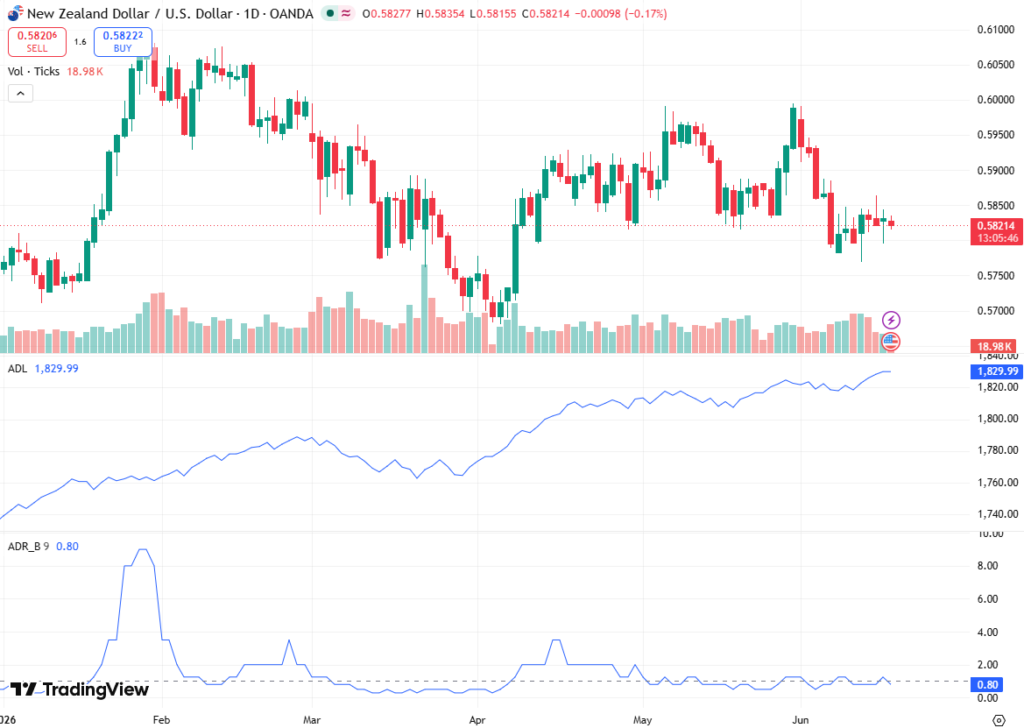
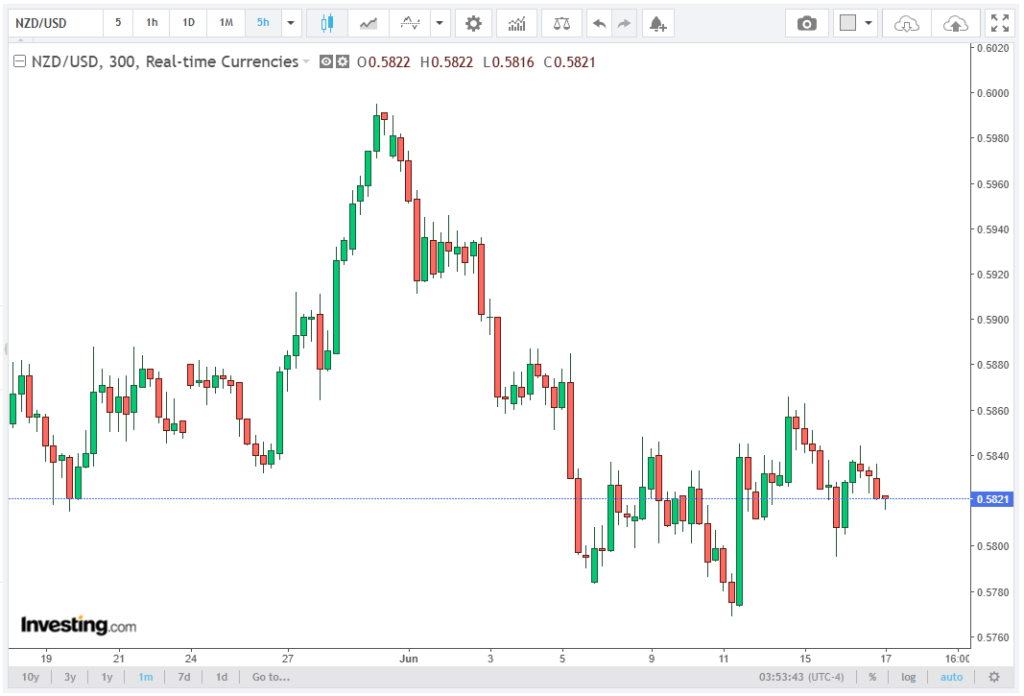
From a technical perspective, NZD/USD continues to trade within a relatively weak structure.
Recent attempts to move higher have encountered resistance near the 0.5850 to 0.5880 zone, where selling pressure has repeatedly emerged. This pattern suggests that buyers remain hesitant to establish stronger positions without a clearer catalyst.
On the downside, immediate support is located around 0.5780. A sustained move below this level could expose the pair to additional downside risk and potentially open the door toward the important 0.5700 psychological level.
Momentum indicators currently point toward a neutral-to-bearish outlook, reflecting the market’s cautious stance ahead of the Federal Reserve announcement.
Until a significant catalyst emerges, traders may continue to view rallies as opportunities to reduce exposure rather than initiate aggressive bullish positions.
Why Interest Rate Differentials Matter
One of the most important drivers of currency valuations remains the difference between interest rates offered by competing economies.
When US interest rates remain elevated relative to those of other countries, international investors often favor US assets due to their higher potential returns. This dynamic supports demand for the US Dollar and can place downward pressure on currencies such as the New Zealand Dollar (NZD).
As long as markets expect US monetary policy to remain relatively restrictive, the NZD may struggle to generate sustained upward momentum against the Dollar..
Outlook
The New Zealand Dollar remains under pressure as investors await greater clarity from the Federal Reserve. While improving geopolitical conditions have provided some support for broader risk sentiment, the influence of monetary policy expectations continues to outweigh other market drivers.
With the Federal Reserve expected to maintain rates within the 3.50% to 3.75% range, attention will quickly shift toward future policy guidance and economic projections.
Until stronger domestic economic data emerges or market expectations for US interest rates begin to soften, NZD/USD is likely to remain vulnerable to further downside pressure, particularly if the US Dollar continues benefiting from favorable interest rate differentials and defensive investor positioning.