
A prominent global technology services enterprise is experiencing significant equity volatility following a strategic revision of its forward-looking revenue guidance. Market participants are aggressively recalibrating their valuation models as the firm balances robust quarterly earnings against a more conservative outlook for the upcoming fiscal period.
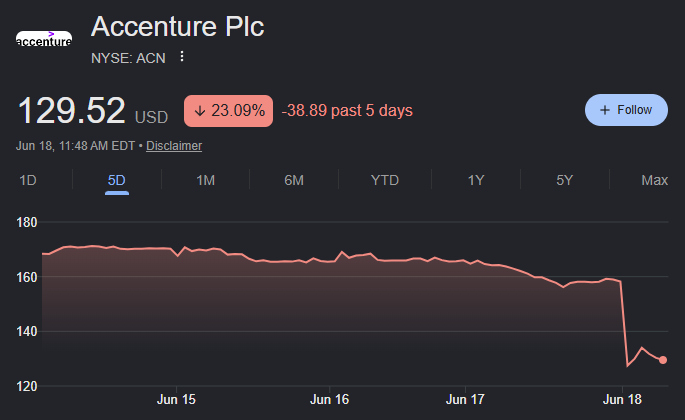
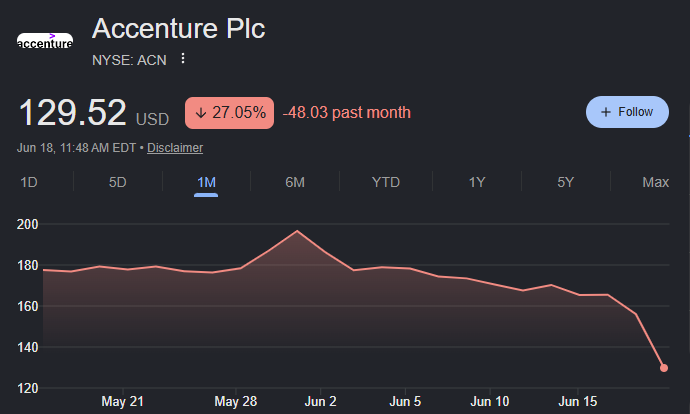
The equity has endured an extended stretch of price compression, with recent sessions accelerating the downward trend.
Equity analysts are currently debating whether the present share price represents a deep value opportunity or a long-term structural warning signal. The current pricing environment reflects growing investor skepticism regarding the pace at which large-scale digital transformation initiatives translate into top-line revenue expansion.
This tension between historical operational success and revised growth expectations has pushed valuations to levels not witnessed in previous fiscal cycles.
Market participants are observing a significant divergence between prevailing narrative-driven fair value estimates and current market prices. The economic research team at Bankolla has compiled alternative data that indicates the most widely followed valuation models suggest a theoretical fair value near $210. This implies a potential 25.7% undervaluation gap relative to the recent closing price of $156.01. However, realized market momentum remains trapped in a bearish feedback loop as investors discount future growth projections.
Quarterly Financial Performance And Strategic Guidance Revisions
During the latest financial period concluding May 31, the corporation delivered adjusted earnings per share of $3.80, which successfully exceeded the consensus Wall Street estimate of $3.72. Despite this bottom-line success, top-line performance remained mixed, with quarterly revenue rising 6% year over year to $18.7 billion.
This result fell slightly short of the $18.78 billion consensus expectation, acting as a catalyst for the recent aggressive sell-off.
The core cause for investor apprehension lies in the revised fiscal 2026 revenue guidance. The firm has reduced its growth target to a range of 3% to 4% in local currency, representing a marked decline from the prior 3% to 5% growth projection.
Even when isolating variables and excluding a 1% impact from federal government business segments, the firm anticipates a moderated 4% to 5% revenue expansion path.
Transformation Program Metrics And Booking Velocity Challenges
The firm maintains that demand for large-scale enterprise reinvention remains robust, highlighting 104 separate client bookings valued at $100 million or more year-to-date. This represents a 13% increase in high-value contract frequency, signaling that the largest global organizations remain committed to multi-year technological overhauls.
Furthermore, management reports that 1,300 of its core 9,000 clients are now actively integrating advanced artificial intelligence transformation programs into their operational workflows.
Despite this project velocity, management acknowledged that the conversion of these transformation programs into sustained revenue growth is facing implementation headwinds. Many global enterprises currently suffer from fractured data architectures and complex process limitations that actively slow the deployment of AI-based solutions.
While these challenges are viewed as temporary, they are currently limiting the immediate pace at which transformation work scales into meaningful corporate earnings growth.
Operational Efficiency And Shareholder Capital Return Metrics
Notwithstanding the revenue outlook contraction, the firm continues to prioritize operational efficiency and shareholder liquidity. The operating margin expanded by 20 basis points to reach 17.0% during the quarter, reflecting disciplined cost management across all service verticals.
Furthermore, the enterprise generated $3.6 billion in free cash flow, enabling the return of $2.2 billion to shareholders through a combination of share repurchases and dividends.
The leadership team emphasized that total capital returned to shareholders has already reached $8.2 billion for the current fiscal year. This sustained focus on capital allocation provides a layer of defensive support for the equity, even as top-line growth expectations remain under intense scrutiny.
Institutional allocators are now weighing this capital return profile against the broader risks associated with slower revenue expansion in the technology services sector.
Future Outlook And Potential Valuation Divergence Drivers
The path toward closing the current 25.7% valuation gap will likely depend on the company’s ability to accelerate its adoption rates in newer growth markets. Specifically, the firm must prove that its emerging capabilities in cybersecurity and Industry X platforms can gain broader enterprise traction.
It is possible that the company could deviate from its current cautious growth trajectory and justify a higher market multiple if these sectors scale faster than that which is predicted by the models that are currently in use.
Portfolio managers are currently pressure-testing their investment theses by comparing these results against other high-quality value plays. While the current narrative remains mixed, identifying whether the firm is an undervalued service leader or a value trap remains the primary focus of equity research desks.
Future success will require the firm to reconcile its robust project pipeline with the realities of slower enterprise decision-making cycles and tightened digital transformation budgets.