
IBM (IBM) has unveiled new AI-powered features for Wimbledon 2026, built on its watsonx platform, to enhance the fan experience through more interactive and personalized content.
According to analysts at Byronixel, the more important takeaway is not the tennis partnership itself, but what it reveals about IBM’s expanding position in enterprise AI. The Wimbledon collaboration demonstrates how IBM is transforming AI into practical, real-world applications rather than simply developing experimental technology.
For investors, this supports IBM’s strategy of growing its presence in AI, hybrid cloud, and automation markets, further strengthening its long-term AI growth story. .
Key Moments and Match Chat: IBM’s AI Upgrade for Tennis Fans
The centerpiece of the rollout is Key Moments, a feature that uses live and historical match data to identify the rallies, shots, and turning points that meaningfully affect a player’s probability of winning. This effectively transforms raw match footage into a real-time analytical breakdown for fans.
In addition, IBM has enhanced Match Chat, an AI-powered assistant that can answer fan questions instantly using live match data, historical statistics, and AI-generated insights. Some responses are also enriched with supporting photos and videos content, creating a more interactive viewing experience.
15,000 Pieces of Content, Four Weeks: A Quiet Infrastructure Win
Less visible, but potentially more important, is what happened behind the scenes. IBM used its internal AI tool, IBM Bob, to migrate more than 15,000 articles, videos, and images to Wimbledon’s new digital platform, completing the process in roughly four weeks instead of several months of manual work.
This type of AI-driven productivity improvement may not generate headlines, but it demonstrates how AI can deliver meaningful efficiency gains, lower operational costs, and improved scalability. It also highlights the strength of IBM’s long-standing partnership with the All England Lawn Tennis Club and its ability to deploy practical AI solutions in large-scale, real-world environments.
The Competition Isn’t Standing Still
IBM is not competing in the AI market alone. Microsoft (MSFT) continues to integrate AI across Windows, Office, Azure, and its Copilot platform, enhancing productivity tools used by millions of customers.
At the same time, Amazon (AMZN) is deploying AI throughout its operations, from optimizing delivery routes and warehouse efficiency to upgrading Alexa with generative AI capabilities and developing custom AI chips to reduce computing costs.
Against that backdrop, IBM’s Wimbledon partnership is relatively small in scale compared with the massive AI investments being made by Microsoft and Amazon. However, the value of the initiative lies less in its direct financial impact and more in its ability to demonstrate IBM’s AI capabilities in a highly visible, real-world environment.
While a tennis partnership alone is unlikely to materially affect IBM’s revenue or share price, it serves as another example of how the company is commercializing AI solutions and strengthening its enterprise AI credentials. For investors, the broader AI strategy matters far more than the Wimbledon showcase itself.

IBM’s Stock Tells a Very Different Story Than Its Tech
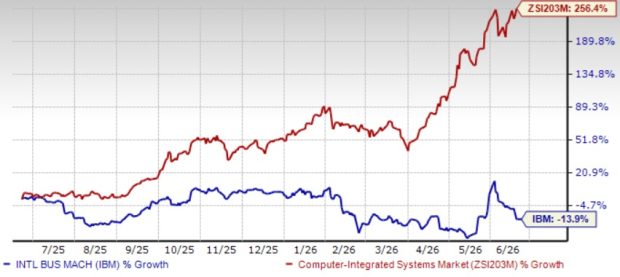
The market’s skepticism toward IBM’s AI story becomes clear when looking at the stock’s performance. IBM shares have declined 13.9% over the past year, while the broader computer-integrated-systems industry has surged 256.4%, suggesting that investors have yet to assign significant value to the company’s AI initiatives.
That caution is also reflected in IBM’s valuation. The stock trades at a forward price-to-sales ratio of 3.21, well below the industry average of 7.05, indicating relatively modest expectations. Analyst forecasts have improved only slightly, with 2026 earnings estimates rising 0.2% to $12.38 per share and 2027 estimates increasing 0.8% to $13.42 per share over the past 60 days.
Outlook: Good Tech, Unconvinced Market
The Wimbledon AI rollout provides a credible demonstration of IBM’s watsonx platform in a high-profile, real-world environment, while the IBM Bob migration project highlights the practical efficiency gains AI can deliver in large-scale operational tasks.
However, neither development is likely to be the single catalyst that dramatically narrows IBM’s performance gap with faster-growing AI competitors. For investors, the more important takeaway is that IBM’s AI capabilities may be more advanced than the market currently reflects in its valuation.
That creates two possible interpretations: the stock may represent an undervalued opportunity, or the market may be waiting for stronger evidence that IBM can translate its AI capabilities into sustained financial growth. The combination of a Hold consensus rating and a below-average valuation multiple suggests that many analysts remain cautious and are looking for clearer proof before becoming more bullish on the stock..