
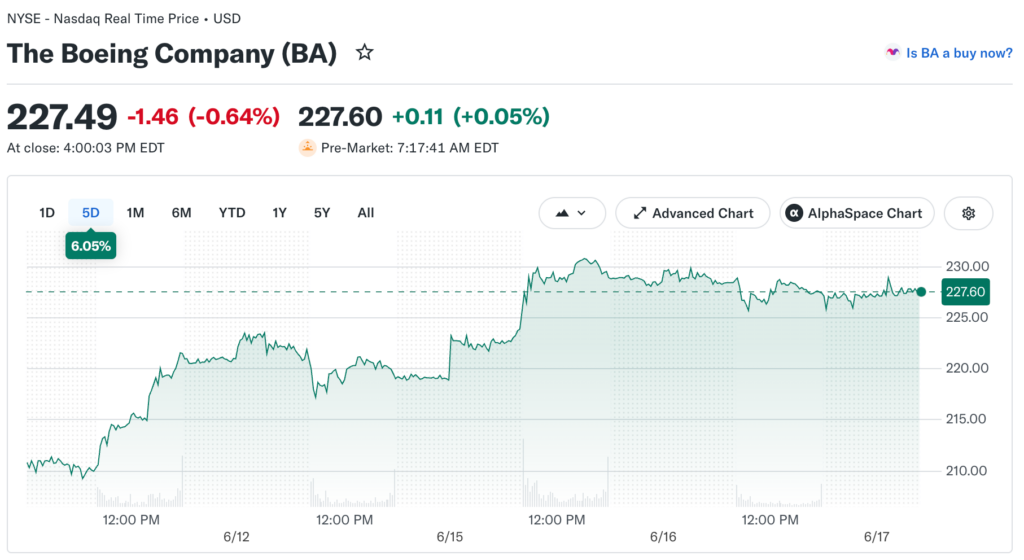
Boeing (BA) surged 4.5% on June 16, 2026, making it the top gainer in the Dow Jones Industrial Average on a day the index closed at 51,671.03, up 0.9% or 468.77 points. The move came as the US-Iran ceasefire reopened commercial aviation optimism and investors revisited Boeing’s rapidly improving operational fundamentals.
The brand’s junior broker highlights what is actually behind the recovery, where the real risks still sit, and why Byronixel sees this as one of the more structurally complex and compelling turnaround stories in the current market environment.
The Ceasefire Effect on Aviation Stocks
Oil prices falling sharply toward $78.66 per barrel for WTI following the Iran framework agreement directly reduces jet fuel cost pressure for airlines across the board. Lower fuel costs improve airline profitability, which accelerates fleet renewal decisions, which in turn increases aircraft orders for Boeing. That transmission mechanism from geopolitics to aerospace order books is well established and played out clearly in BA’s significant June 16 session gain.
Airlines that had been hesitant to commit to large orders during peak fuel cost periods now face a considerably more favorable operating environment heading into the second half of 2026. Boeing’s commercial backlog already stands at a record $695 billion including more than 6,000 commercial aircraft, and any acceleration in airline order conversion strengthens that already substantial pipeline further.
Alaska Airlines committed to up to 105 737 MAX jets and Delta ordered up to 60 787 Dreamliners earlier in 2026, with both decisions reflecting growing carrier confidence in Boeing’s production stability after years of costly operational disruption.
Production Numbers That Actually Matter
Boeing delivered 143 commercial aircraft in Q1 2026, surpassing Airbus in a single quarter for the first time in years and significantly outpacing its prior-year delivery result. That output level reflects a genuine recovery in production capacity following the quality crises and labor disruptions that defined 2024 and early 2025 for the aerospace giant.
The FAA cleared Boeing to ramp 737 MAX output to 38 aircraft per month, a milestone management has been working toward for over a year through careful quality improvement and regulatory engagement. Reaching and sustaining that rate creates operating leverage that falls directly to free cash flow, with Boeing’s long-term production target sitting at 63 737s per month and 16 787s per month.
Revenue grew 14% year-on-year in Q1 2026, beating market consensus and marking the clearest evidence yet that the commercial recovery is showing up in reported financial numbers rather than just forward-looking backlog projections and management commentary.
The Defense Business as the Underappreciated Cushion
Boeing’s Defense, Space and Security segment has been quietly building a revenue buffer that commercial-focused investors tend to overlook when evaluating the stock’s overall investment case.
The company entered 2026 with approximately $12.8 billion in recently secured defense contracts, including an $8.6 billion F-15IA aircraft order from Israel’s Air Force and a $2.7 billion Apache helicopter support contract from the US Department of Defense.
These fixed-price service contracts provide revenue visibility that commercial aircraft sales simply cannot match on a quarter-to-quarter basis. Maintenance, logistics, and technical support agreements generate recurring income streams that do not depend on airline capacity decisions or shifts in broader macroeconomic sentiment. That durability is a meaningful strategic offset to the inherent cyclicality of the commercial aircraft business throughout Boeing’s recovery phase.
The MQ-28 stealth drone program passed performance validation milestones in early 2026, strengthening Boeing’s competitive positioning in the unmanned systems category that defense budgets globally are increasingly prioritizing as military modernization accelerates.
Risks That Have Not Gone Away
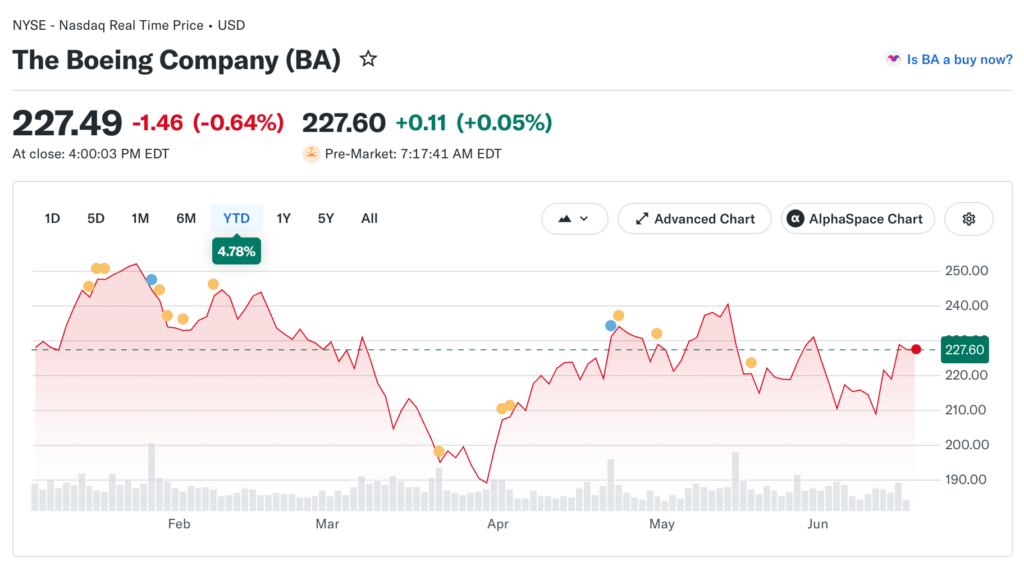
Boeing’s recovery story has genuine substance behind it, but the stock carries material risks the June 16 rally does not resolve. The company holds $54.1 billion in debt with a debt-to-equity ratio of 9.87 and profit margins of just 4.8%, meaning any production disruption, supply chain setback, or regulatory delay has an outsized negative impact on cash generation.
China’s potential conversion of a prior commitment for 200 jets into firm purchase orders has been flagged by multiple analysts as a catalyst that could materially improve Boeing’s near-term cash flow outlook. That deal remains unconfirmed as of June 17, and geopolitical sensitivity around US-China trade relations adds execution risk that the record backlog number alone does not fully capture.
Watching the Right Metrics Into Q3
Analyst consensus targets $290.09 for BA stock as a 2026 average, suggesting meaningful upside from current levels while acknowledging the execution-dependent nature of that projection throughout the recovery. The stock remains approximately 80% below its 2019 highs, meaning the recovery, while real and clearly accelerating, has a very long runway ahead before it becomes a full restoration story.
The ceasefire-driven aviation tailwind, the record commercial backlog, and the defense contract cushion together create a genuinely supportive backdrop for BA heading into Q3 2026. Investors should track monthly delivery figures as the single cleanest real-time indicator of whether the production ramp is holding pace with management’s stated targets.