
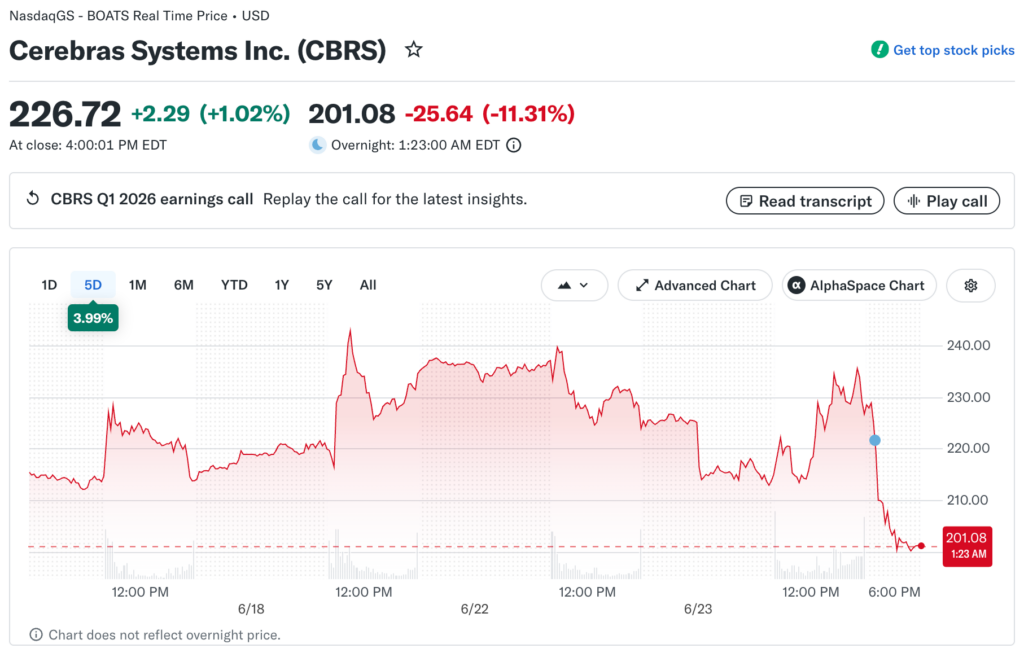
Cerebras Systems chose an unfortunate week to introduce itself to public market investors. The company’s first earnings report as a listed company landed on June 23, 2026, the same session that saw semiconductor stocks broadly collapse, NVIDIA losing 3.2%, Micron shedding 11.4%, and the VanEck Semiconductor ETF dropping 6.5% in a single afternoon.
Evaluating what Cerebras actually reported required separating its specific business reality from a sector-wide pressure event that had nothing to do with the company’s own numbers. A junior financial expert at Nummvix breaks down what the debut earnings tell investors about Cerebras’s competitive position and where the AI chip landscape is heading beyond the incumbent GPU architecture that currently dominates.
A Chip Architecture That Breaks From Convention
Most AI chips in commercial use today are graphics processing units, devices originally designed for rendering images that were adapted for the parallel computation that neural network training requires.
Cerebras took a different path entirely. Its processors are built at wafer scale, meaning each chip occupies the full surface of a silicon wafer rather than representing one of many smaller chips cut from that wafer and then reconnected through external interfaces.
The practical difference matters for specific workloads. Connecting multiple chips requires moving data across physical boundaries, introducing latency and consuming power that reduces throughput.
A wafer-scale design eliminates those boundaries by keeping everything on one continuous surface, removing a communication bottleneck that limits GPU performance in inference workloads. Enterprise customers running high-frequency AI applications have begun evaluating this tradeoff seriously.
Why the First Report Covers Incomplete Ground
Cerebras raised capital through a May 2026 IPO, which created an odd situation for the June 23 earnings release. The numbers on the page covered only a partial quarter under public company disclosure obligations, not a full three-month operating period.
That limitation means the headline revenue figure carries less analytical weight than it normally would for an established company reporting against prior-period comparables.
What matters more in this debut report is the qualitative texture of the business management chose to describe.
Commentary on pipeline evolution, which customer types are committing to production deployments, and whether contract sizes are growing gives investors more forward signal than a partial-quarter revenue line. The question most worth answering is whether Cerebras is landing chips in commercial production environments or still operating primarily in research and government contexts.
NVIDIA Sells Off for Macro Reasons, Not Competitive Ones
NVIDIA’s 3.2% decline on June 23 traced back to a Bank of America research note warning of potential rate hikes and broad AI cost concerns rather than any news about the competitive chip landscape.
That distinction matters when evaluating what the session’s semiconductor selloff actually meant. NVIDIA did not decline because Cerebras reported well. It declined because institutional investors were reducing exposure to high-multiple technology assets across the board.
A company reporting its first public earnings on a day when even the category leader sells off for unrelated reasons will see its results overshadowed by forces outside its control.
Intel’s foundry discussions with Apple, AMD’s expanding data center footprint, and Cerebras’s wafer-scale approach together represent the most significant diversification of AI hardware competition since large language model demand began in earnest. The GPU ecosystem remains the first choice for training workloads, and that position is not under meaningful near-term threat.

What the AMC Bond Offering Said About the Day
AMC Networks, once one of the defining meme stocks of the 2021 retail trading era, was closing a bond offering on the same day Cerebras was reporting its first earnings. The pairing was coincidental but generated market commentary about the contrast between speculative retail momentum from five years ago and the institutional AI infrastructure buildout playing out now.
Both dynamics eventually reach points where valuation outpaces verified fundamentals, and the June 23 session applied that pressure to a former meme-era name and the newest entrant in AI hardware simultaneously. June 23 carried an unusually layered set of market narratives simultaneously, making clear-eyed analysis of any individual name harder than it would be on a more orderly trading day.
How Micron’s June 24 Results Flow Into the Cerebras Story
Micron reporting fiscal Q3 results on June 24 carries indirect significance for Cerebras investors. If Micron confirms that hyperscaler demand for high-bandwidth memory remains tight and fully allocated, it signals that AI workloads are generating genuine hardware consumption at the data center level.
That demand environment benefits all AI chip companies, including those competing in inference rather than training.
A soft Micron result would complicate that picture by suggesting AI infrastructure deployment is running below the pace embedded in current sector valuations.
For Cerebras, strong memory demand data from Micron provides the macro context that makes its commercial inference expansion story more credible to institutional investors who are still forming their initial view of the company. The Micron result on June 24 will do more to shape Cerebras’s near-term investor perception than anything the company itself reports at this early stage.