
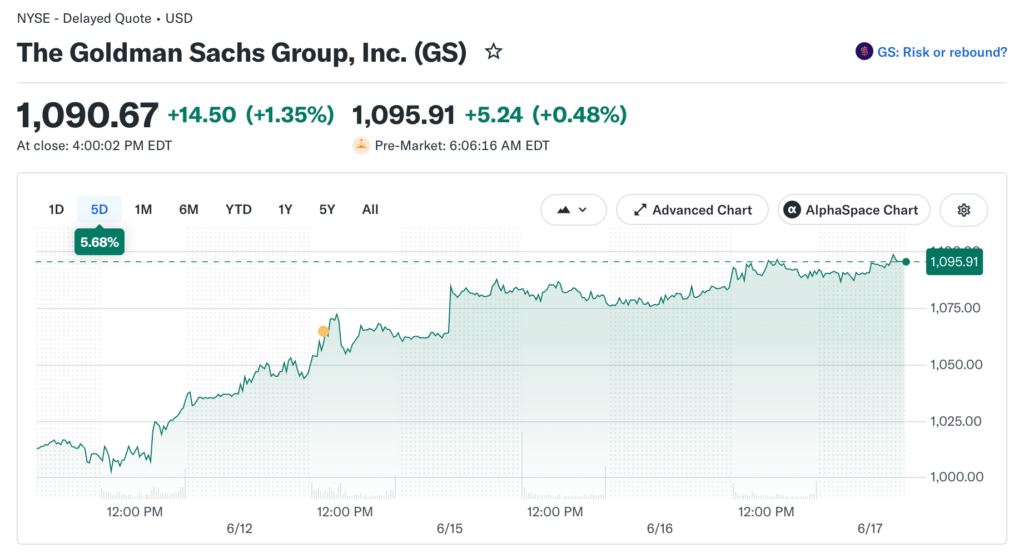
Goldman Sachs crossed $1 trillion in merger and acquisition advisory volume by June 16, 2026, the fastest any investment bank has ever reached that milestone in a single calendar year. The firm’s investment banking fees already jumped 48% year-over-year to $2.84 billion in Q1 alone.
A senior financial analyst at Nummvix examines what this dealmaking surge signals for financial stocks, market valuations, and the sectors most likely to see consolidation activity through the rest of 2026.
A Record That Reframes the Market Cycle
Goldman’s announcement, confirmed through Dealogic data and posted on June 16, comes at a time when many investors expected M&A activity to remain subdued. Instead, global M&A volumes have already exceeded $2.6 trillion in 2026, with Goldman holding its position as the top-ranked global M&A advisor for the second consecutive year, ahead of JPMorgan Chase in second place.
The trigger for this acceleration was not simply a return of confidence. It was a structural regulatory shift. Under the current administration, the tone from antitrust authorities moved from an outright “no” to a far more permissive posture on large strategic deals. For corporate executives who had been sitting on merger ambitions since 2022, the change was an immediate green light.
Goldman’s role as lead underwriter on SpaceX’s $85.7 billion IPO added historic weight to an already record-breaking year. That single deal alone reshaped the firm’s deal league table position for 2026 in ways that will be difficult for any competitor to close.
What Goldman’s Stock Is Actually Pricing
Goldman Sachs stock trades at a trailing P/E of 19.93x, which is notably elevated against its 5-year median P/E of 14.28x. That premium reflects market expectations of sustained high advisory fee revenue, elevated trading volumes, and continued deal flow through the second half of the year.
Insider activity, however, has been telling a slightly different story. Over the past three months, insiders sold a combined $35.6 million in shares, which is a level of selling that warrants attention even if it does not signal a reversal.
When insiders sell at elevated multiples during record revenue periods, it often reflects personal portfolio diversification rather than fundamental concern, but investors should weigh it accordingly.
The stock’s GF Score from GuruFocus shows a strong momentum rank of 10 out of 10 alongside a relatively weak financial strength score of 2 out of 10. For an investment bank, financial strength scores reflect leverage ratios and capital structure rather than operational weakness, so that discrepancy is partly structural to the business model itself.
The AI and Consolidation Thesis Behind the Deals
Goldman CEO David Solomon described the current environment as a “top decile” opportunity for dealmaking as early as February 2026. The reasoning goes beyond regulatory permissiveness.
Artificial intelligence is compressing competitive advantages faster than most companies can organically respond to, pushing boards toward acquisition as the preferred path to staying relevant.
Industries facing the most acute AI disruption, including media, fintech, enterprise software, and healthcare IT, are the ones generating the most M&A interest. The Paramount-WBD merger received Department of Justice clearance in mid-June, validating that even large-scale horizontal mergers are moving through regulatory review faster than at any point since 2018.
Trading volumes have also reached all-time highs in 2026, contributing to Goldman’s fee income from both advisory and markets divisions simultaneously.
JPMorgan and the Competitive Landscape
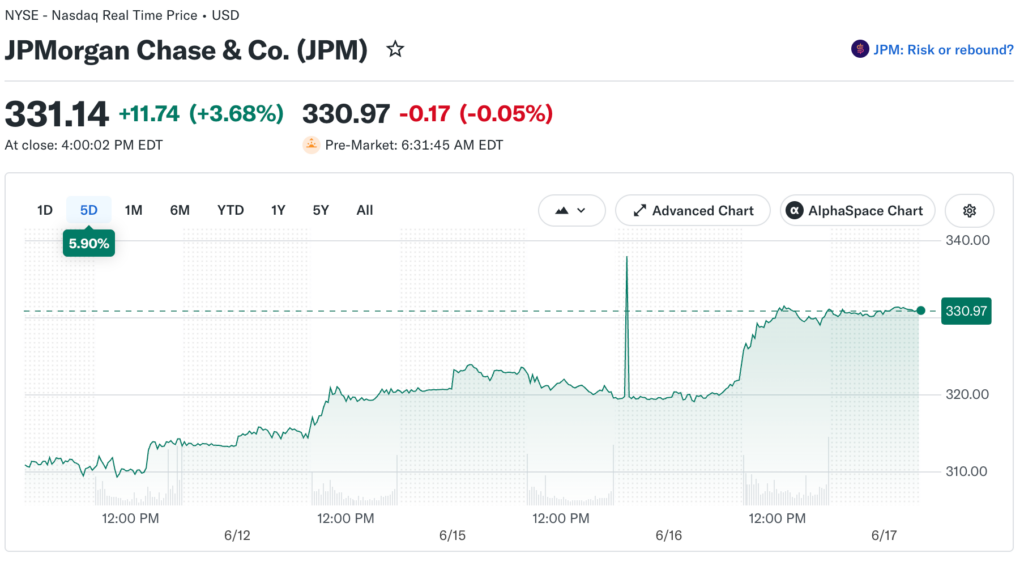
While Goldman holds the top advisory spot, JPMorgan Chase occupies second place with its own strong deal pipeline. The competition between the two firms at the top of league tables creates its own market dynamic. Both stocks benefit from elevated M&A activity, and both have seen their investment banking revenue lines recover sharply from the 2023 to 2024 slowdown.
For investors tracking financial sector exposure, the key distinction is that Goldman derives a larger share of its revenue from advisory fees relative to consumer lending than JPMorgan does. That makes Goldman more directly leveraged to deal volumes and more sensitive to any slowdown in corporate M&A appetite.
What Investors Should Watch Before Year-End
The durability of this M&A wave depends on three variables that are all in flux simultaneously. Interest rates staying manageable, the regulatory posture holding permissive, and AI investment momentum continuing to push boards toward strategic acquisitions rather than organic build strategies.
If the Fed’s June 17 decision signals a return to rate hike territory, financing costs for leveraged buyouts rise and deal volumes could moderate. Any reversal in the regulatory posture would have a similar dampening effect. But if both conditions hold, Goldman’s second half of 2026 could produce advisory revenue that makes the first half look like a warm-up.
The GS stock and the M&A cycle are more linked right now than at any point in recent memory. Watching deal announcement volumes weekly gives investors a real-time read on whether the record pace is holding or beginning to plateau into year-end.